Casefile
// CASEFILEA companion guide to the four-book arc of the Parata Occult Mysteries: The Artifact, The Betrayed, Commune, and The Disturbed. This is the cross-cutting view — the connections, escalations, and payoffs that only show themselves when you read the books together. The four per-book casefiles cover inventory, deep dives, and easter eggs in detail; this one tries not to repeat them.
Introduction
The Parata Occult Mysteries is a four-book occult-noir detective series set across the Florida Panhandle and southern Louisiana in 1984–1985, anchored by Revel “Rev” Parata: a six-foot-seven private investigator working out of a converted Creole townhouse on Palafox Street in Pensacola; half Apache (mother’s people, White Mountain reservation), with a father from New Zealand. The voice is straight Chandler — first-person, wry, a man who knows the city’s bars and back streets better than its churches — and the world Rev moves through, beneath the noir surface, is the Lovecraft Mythos rendered as something the police, the Catholic Church, and a half-criminal Irish ex-boss are all secretly trying to cope with.
Each book is, in the most literal sense, a case. The Artifact is the Egyptian-relic theft that turns into a cult ritual. The Betrayed is a missing-persons case for a New Orleans parish that turns into a hunt for a centuries-old cannibal. Commune is a missing-priest case in a forgotten bayou village built atop something that should not be there. The Disturbed is the case that comes hunting Rev — Sarah Burke’s promise, made in The Betrayed, paid out in full. What begins in book one as a one-off detective story with a strange ending becomes, by book four, a war between a single man and a very old enemy, with a dozen lesser cultists left to clean up.
The setting is geographically specific in a way the series leans on. Pensacola is Rev’s office and the place he goes to be alone; New Orleans (1984, the year of the World’s Fair) is where the cases happen and where almost everyone he loves lives; the bayous south and west of NOLA — Lacombe, Vacherie, Slidell, Houma, the deeper Terrebonne Parish wilderness — are where the supernatural keeps surfacing. The series treats this geography as something more than backdrop: cypress swamps, cemetery cities, and abandoned salt-dome sinkholes are where the world’s seams show.
The narrative spine of the series is a triangle: Rev, his partner Rae Gordon (introduced in book two), and Father James Kelly (also book two), set against Sarah Burke and the wider supernatural ecosystem the Order of the Hidden Eye exists to monitor. By the end of the series, Burke is dead, Kelly is dead, Rev’s oldest friend Freddy Guidry and Freddy’s family are dead, and Rev himself is something he did not start as: an Order-affiliated custodian of an artifact he cannot let out of his sight, hunting the eleven cultists who survived Burke. The trajectory is the point.
The series shape
The four books fit together as one narrative in four acts.
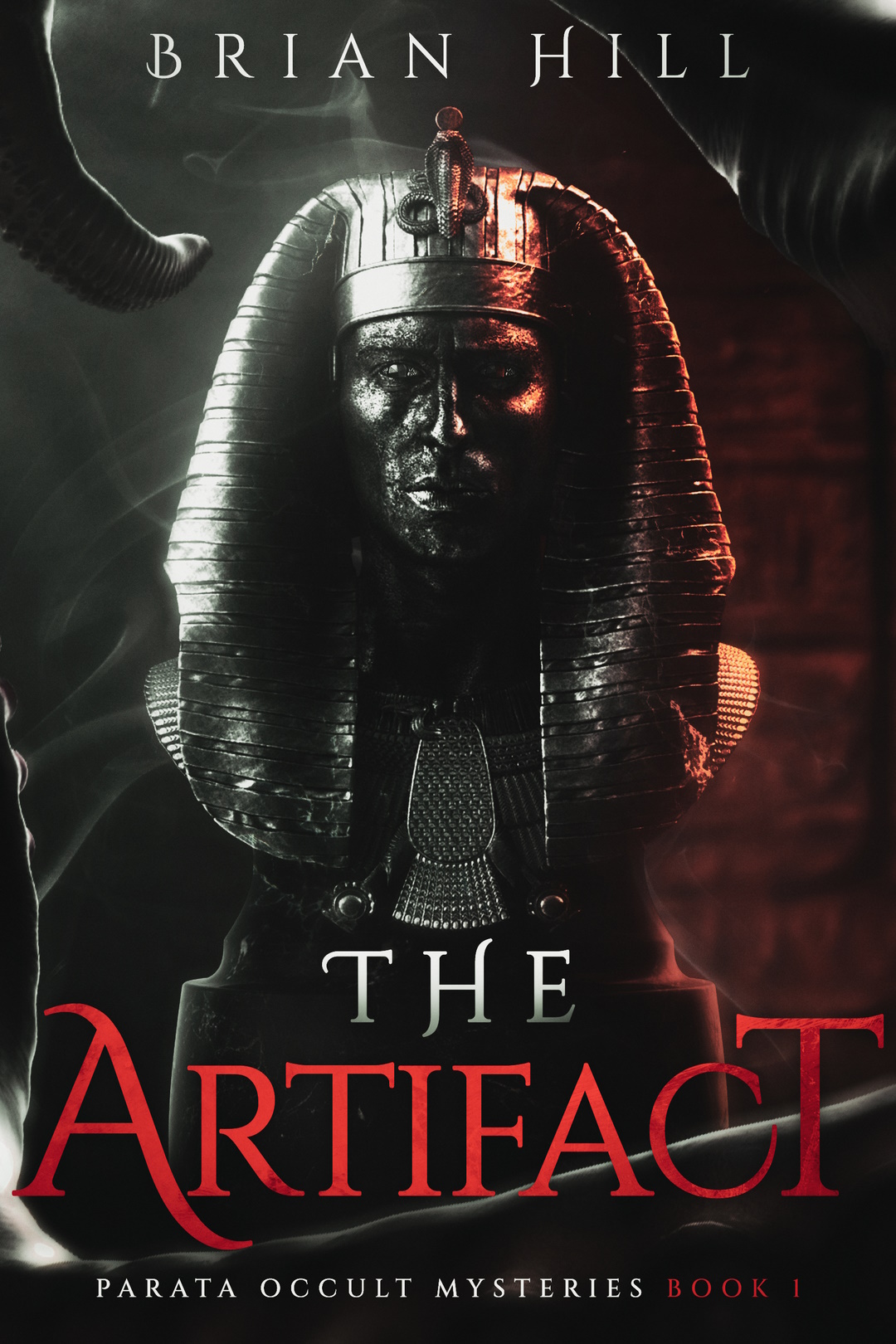
Act 1 — The Artifact (June 1984). The opening book is the simplest. Rev, broke and chasing bail-skip work, is hired by Donald Coventry III of the Cultural Preservation Society to find a stolen Egyptian canopic jar. The case starts as straight noir — a missing intake clerk named David Kinsey (real name John Calhoun) who turns out to be a fake identity, a cab driver paid in cash, a locked rural property in Lacombe — and then turns. Coventry himself is the cult leader; the jar (the Jar of Nephren-Ka) is a vessel for summoning a chitinous centipede creature (a single three-lobed central eye plus six smaller eyes in a V pattern) that incubates in a host’s body. Rev kills Randolph’s henchman “Lurch” in self-defense; Coventry’s man Barnes vanishes inexplicably during the failing ritual, leaving only a pile of sand inside his clothes. Rev escapes through luck, instinct, and what may be a coyote that he recognizes as his late grandfather, takes the jar, and walks away with two unanswered questions: what is the centipede creature now loose in the bayou, and who wanted the jar in the first place if not Coventry? The book ends with the jar locked in a chest in his office and Rev believing the case is closed.
Act 2 — The Betrayed (October 1984). Rev is hired by Father James Kelly of Saint Christina’s in New Orleans to investigate missing homeless people. He hires Rae Gordon as a partner — a former-LA PI, scarred former actress, fluent in English, Hebrew, and Russian, ju-jitsu and escrima trained. He meets Sarah Burke, an elegant blond philanthropist who sponsors Father Kelly’s outreach. Burke is a ghoul — a Homo anthropophagi in the language of the witch-hunting tract Kelly produces — a centuries-old cannibal entity who can project a glamour but whose shadow always shows what she truly is. The case ends with Burke wounded, escaped, and promising Rev she will kill everyone he cares about. Father Kelly initiates Rev into the Order of the Hidden Eye. Rev locks the Jar of Nephren-Ka in a Pensacola safe-deposit box. The book closes with Burke devouring a stranger in an alley and the centipede creature, now seven feet long, hunting in the swamp.
Act 3 — Commune (December 1984). Father Kelly sends Rev and Rae after a missing Jesuit, Father Peter Walsh, who went down to a bayou village named Psikinépikwa (locally called Skelly’s Hole, formerly the town of Tranquility, swallowed in the early 1900s by a Skelly Oil sinkhole). Walsh has been studying Las Tribus Olvidadas, a 16th-century book of indigenous rituals whose glyphs match Sumerian. The villagers worship something at the bottom of the hole; Walsh has been parasitized by a worm (a larva of the centipede creature) that crawls in the ear and operates the host like a marionette. The “thing in the hole” rises during the climax — a tentacled, fracture-of-reality being to whom even the centipede creature is a small and personal thing. Rev and Rae destroy the larva with what turns out to be its own corrosive innards, dump Walsh’s corpse into the hole, and disappear the village quietly. Rev finally tells Kelly everything about the Jar. The book ends with Rev and Rae moving toward romance, Kelly safekeeping the Jar in the Saint Christina’s safe, and the Order beginning to translate Walsh’s diary and the salvaged Bible from the village.
Act 4 — The Disturbed (February–May 1985). Burke’s promise is paid in. The book opens on the Miller home — Marcus Miller’s parents brutally murdered, with Jerome Davis (Marcus’s friend, the streetwise Rev-and-Rae fixture from The Betrayed) found at the scene covered in arterial spray, initially mistaken for Marcus and framed for the killings. Burke has come back for Marcus, her “pet.” She murders Father Kelly (crucified and flayed in the asylum chapel), bashes Rae’s skull into Terry’s Mercedes dashboard (~26-day coma, traumatic brain injury, lingering migraines), captures Freddy Guidry, his wife Janet, and his son Fred and rigs their kitchen with a flare-and-jerrycan trap, has Jerome murdered at the asylum (a bald-man cultist from her cabal twists Jerome’s head around backwards in his hospital bed), and exposes Dr. Augustin Terry — the asylum’s psychiatrist and a member of a twelve-person cannibal cabal that serves her — as her inside man. Rev kills Burke at a swamp warehouse outside the city: he brings her the Jar as a deal to free the still-captive Guidry family, and the Jar spontaneously erupts in a wave of black ants that devour her. Rev arrives home minutes later and his entry triggers the kitchen booby-trap that incinerates Freddy, Janet, and little Fred — Burke’s revenge runs on after her death. He keeps the Jar permanently in a custom pocket in his trench coat and, with the Order’s grudging help (he extorts them by demonstrating the Jar will not let him die), begins methodically hunting the surviving eleven cultists. The book ends with Rae recovered enough to work, Burke confirmed dead, Terry tortured to death by Rev (scaphism, an old Persian/Roman execution), one cultist named (David Blake), and three photographic candidates for that name to investigate. The series ends with the protagonists pointed at the next eleven targets, the war ongoing.
The shape, in a sentence: a one-off detective story (book one) inherits a permanent antagonist (book two), expands its cosmology westward (book three), and pays everything off with grief, vengeance, and a transformed protagonist (book four).
The cosmology, integrated
By the end of the four books a hierarchy has emerged. The series never quite delivers it as a chart — the characters never have the full picture, and Kelly’s order keeps acknowledging it knows less than it would like — but the pieces accumulate.
At the top sits Nyarlathotep, named for the first time in The Betrayed by Father Kelly when he identifies the spray-paint glyph Burke leaves at her abduction sites. He is described as a false god worshipped under many names; “the Black Pharaoh” is one of them, which links him directly back to the Jar of Nephren-Ka. The jar is a relic of a near-mythological Egyptian pharaoh whose tomb was found mostly destroyed by Émile Durand’s expedition in 1912 (the Egyptian Department of Antiquities consignment paperwork is dated 1913). By The Disturbed the connection is explicit: Whispers from the Nile makes clear the Jar of Nephren-Ka was one of four canopic jars, each guarded by a different Egyptian funerary deity, each holding different powers. The recovered jar is the one for the lungs — guarded by Hapi, defended by Nephthys (goddess of darkness, ritual, and magic). Rev concludes (and Kelly confirms) that the recovered jar is the most powerful of the four.
Below Nyarlathotep sit the Old Ones or Outer Gods in the Order’s translations, of which the most concretely depicted is the entity at the bottom of the Skelly’s Hole sinkhole in Commune — described by Rev as having a head the size of a boxcar, suckerless tentacles tipped with bone caps that glow blue, and the ability to fracture reality. Rev’s interior reckoning while reading the binding ritual in The Disturbed — that this kind of titan is “already like a god” and that Nyarlathotep is “like a god to it” — is the first time the scale of what is above is articulated, though the books gesture at the hierarchy without ever formally codifying it. These beings are summoned, contained, or reached through ritual; the Tranquility villagers had built a generations-long machinery for that purpose, and the Tartarus comet’s once-in-40,000-years perihelion enabled their rite.
Below them sit lesser entities. The centipede creature (called variously the “crawling one” in the conjuration chant — l’ ch’ nglui ng k’yarnak r’luh fhtagn — and “kayrevla” in the chapter heading of book one’s ritual) is a vessel-spawned being birthed in book one and growing throughout the series. By Commune it is seven feet long with nine eyes, reproducing via parasitic worm-larvae that crawl into hosts through the ear. Burke, the ghoul, sits at a similar tier: Homo anthropophagi, “once human, we believe, but through perversion, effort of will, and ritual have changed.” Ghouls eat the dead and absorb the abilities and knowledge of the living they consume. They project glamours that cameras and mirrors can pierce; their shadows always show their true forms. Burke has been alive for many centuries (originally named Pheobe Durst), and her cannibal cabal of twelve serves both her and, presumably, Nyarlathotep beneath her.
Below those are ritualists — humans who serve the higher powers. Coventry in book one. The cult of twelve in book four. The Tranquility villagers in book three. Cornelius Randolph — a rival ritualist running a parallel Atlanta cult (the Society for Esoteric Knowledge) that engineered the theft of the Jar from Coventry’s people, killed by Rev mid-book at his Quitman estate Besonwa — is the other Mythos operator on stage in book one. The lower the rung, the more disposable.
Two parallel traditions run alongside the Mythos and matter to the cosmology. First, the indigenous traditions Rev was raised in. His grandfather, a Chiricahua Apache medicine man, appears as a coyote in book one’s climax — recognized by Rev with sudden absolute certainty — and chases off the centipede creature. Rev derided his grandfather’s “medicine” as a young man and now reaches for it with grief. The implication is that the traditional indigenous understanding of the world was always closer to the truth than the Western “educated” view; modernity is the aberration, not the spirits. Second, the Sumerian-Mesoamerican parallels Walsh was investigating in Commune: Las Tribus Olvidadas recorded indigenous Louisiana rituals whose glyphs matched ancient Sumerian. The series is gentle about this — it does not announce that all these traditions are channels to the same Mythos — but it gestures hard.
The Order of the Hidden Eye, finally, is the human institution that knows. Father Kelly is the door Rev walks through; Fitzgerald, the suspected Irish-mob restaurateur revealed in The Disturbed to be a senior member, is the door Rev finds himself at after Kelly is murdered. The Order is compartmentalized to the point that no member, not even the grandmaster, knows how many members exist. Their stated purpose is to “see things as they are,” to “want to know the face of God”; their operational purpose is to keep the darkness at bay where they can. They have kill teams (former special-forces). They are not, Kelly is at pains to insist, a monster-hunting club, but they will dispatch a ghoul “with all due haste.” Their understanding of Burke and the centipede creature lags reality; the news of a living ghoul is described as “the most exciting discovery in years.”
The investigator across books
Rev Parata at the start of book one and Rev Parata at the end of book four are recognizably the same man and recognizably not.
The Rev who walks into the liquor store in Calhoun County, Georgia, in June 1984 is a recovering alcoholic ex-NOPD detective (twelve years on the force, four in homicide), four years into a marginal PI practice in Pensacola, drowning in unpaid bills, taking a bail-skip job that pays $1,500 minus expenses because rent is twelve hundred dollars overdue. He reads Stoicism — Epictetus in particular — to keep himself level. He limits himself to one scotch a night at Lili Marlene’s in Seville Quarter, against the pull of his “people” toward drink and the memory of an unspecified accident four years prior that ended his marriage to a woman named Rebecca. His office is half storage room with a cot; his only suit is from a single ruinous commission. He owns a Smith & Wesson Model 60 .357 snub-nose. He is six-foot-seven, around 325 pounds, half Apache and half Maori, raised on the reservation by his Apache mother and grandfather, with a knee that locks up after long sits and a tendency to limp. He is alone in the world except for Captain Freddy Guidry, his old NOPD friend, whom he has not spoken to in four years out of shame.
The Rev who sits in a hotel reading Moby Dick with a flask of whiskey while waiting for Rae to wake up at the end of The Disturbed has acquired and lost almost everything. He has a partner he is half in love with and cannot bring himself to name it (Rae). He has a priest mentor (Kelly) who was crucified and flayed alive in an asylum room. He has lost his oldest friend Freddy and Freddy’s wife Janet and Freddy’s son Fred (who he held as a baby) to Burke. He has lost his job in the conventional sense — the Order now funds his caseload, having absorbed his practice in The Betrayed. He is no longer in occasional brawls; he is in a war. He has tortured a man to death (Dr. Terry, by scaphism, at the Lacombe Victorian KAYREVLA — the same isolated mansion Rev investigated in book one’s Calhoun/Kinsey thread, where Kinsey/Calhoun had stashed the Jar after the theft — a structural bookend). He has discovered that the Jar of Nephren-Ka will not let him commit suicide: ten rounds in his service revolver, all aimed at his temple, all dimpled primers, all duds. He has accepted that he is the Jar’s permanent custodian per Kelly’s posthumous letter, which Kelly delivered through a safe deposit box at Hibernia Bank in New Orleans.
The cost in concrete terms across four books:
- His drinking. He starts with one scotch a night and iron discipline. By the end of The Disturbed he is drinking through fifths and routinely visiting his hospitalized partner intoxicated.
- His relationship to firearms. He starts as a careful one-revolver man. By the end he is stuffing a 12-gauge into a custom trench coat.
- His relationship to violence. In book one he refuses to shoot a fleeing suspect, returns Turbo Franklin to the police whole. In book four he zip-ties Augustin Terry into a clawfoot bathtub of corn syrup, stocks the room with Coleman lanterns to attract bugs, sets a single live water tube in the man’s mouth, lets the crows come, and returns two days later to finish him with both barrels of a shotgun out of pity.
- His relationship to lies. He hates lying to Freddy (book one); he lies to Freddy’s face about Burke (book two); he lies to Kelly about the Jar for an entire book (Commune); by book four he is lying to NOPD detectives mid-investigation while drinking spiked coffee in his partner’s hospital room.
- His relationship to the Mythos. He starts as a man who likes graveyards because if a ghost showed up it would at least prove something. By book four he is the human custodian of an apocalyptic relic, hunting a cabal of cannibal cultists, voice-hectored daily by the Jar in his head, and convinced — accurately — that he cannot be killed until the Jar is finished with him.
- His grandfather. The series’ Native spiritual thread sharpens with each book. The coyote at the climax of book one is the first appearance; by The Disturbed he is meditating his way through interrogation rooms and reaching for his grandfather’s medicine the way he used to reach for Stoicism.
What he keeps: his sense of humor (sourer, but present). His decency about children (Jerome, Marcus, Fred). His refusal to take money he hasn’t earned. His professional craft — he is, throughout, an observant detective. The deduction in book four that Marcus’s mother was killed by a right-handed adult standing on the bar (because of arterial-spray patterns, the body-fall angle, the friction-direction of a dull butcher knife severing a spinal cord) is a worked piece of detective procedure of a piece with the rest of the series.
What changes most: his certainty that he is one of the good guys. The line Rev crosses with Terry — “the precipice I must never let myself cross again” — is the one no Chandler protagonist would have crossed.
The recurring antagonist: Sarah Burke
Burke is the series’ singular antagonist. Coventry is dispatched in book one. The thing in the hole is left alive but isolated in book three. The centipede creature is a free-roaming threat, but a creature, not a person. Burke is the only opposed mind that runs across every book after she is introduced.
She enters in The Betrayed in chapter one — a wealthy, beautiful philanthropist in a stylish white dress, accent like a Katharine Hepburn movie, at Father Kelly’s church. She is Homo anthropophagi, the elder cannibal: ghoul in the colloquial term Kelly uses. Her real name (which she still thinks of herself by) is Pheobe Durst, and she is centuries old. She projects a glamour that human perception (but not cameras or mirrors) accepts; her shadow betrays her true form, which is gray-skinned, boil-covered, blue-eyed with vast pupils, long canine snout, rows of inward-curving teeth. She gains the skills and memories of the people she devours. The Burke Foundation Outreach Program — the lollipops with the open-hand logo handed out across New Orleans homeless camps in book two — was her hunting ground. Under her elegant antebellum mansion was a slaughterhouse where she dry-aged human limbs.
Her vendetta is the engine of the series after book one. She tells Rev at the end of The Betrayed: “I’m going to make you suffer. Oh yes — not fast, slow, so slow. I’m going to make you wish for death, pray for it, and deny it. You will die an old, old man, Revel Parata.” She means it. The intervening months between books two and three are described as Rev and Rae jumping at every shadow, running checks on every plausible suspect; Kelly’s order is searching as well. She has gone so deep underground that nothing surfaces.
Her shape-shifting impersonations are one of the series’ recurring devices. She wears stranger after stranger: an unidentified twenty-five-year-old man devoured in an alley at the end of The Betrayed (she steals years from him); whatever face she wore in the months between books; in The Disturbed she has murdered Captain Freddy Guidry and is wearing his voice on the phone when Rev calls. The scene where Freddy answers the phone “Guidry residence” with unnatural cheer, says “lovely little family,” and slowly drops the disguise into her ancient cruel voice is one of the book’s central horror beats.
She dies at Rev’s hand in The Disturbed, at the swamp warehouse outside New Orleans. The death is unexpected even to Rev: he has brought the Jar planning to use a grenade to kill them both, but the moment her claw closes on it, the Jar erupts into a wave of millions of black ants that devour her from outside in. The skeleton crumbles to dust at Rev’s touch. The Jar — which Rev believes he had not bound himself to, having not spoken the words — has acted on its own behalf to protect its custodian. Rev keeps the Jar from then on.
Her arc is the series’ clearest. She is introduced as the gracious hostess; she becomes the cannibal in the basement; she becomes the unstoppable revenger; she dies at the hand of the man she promised to outlast.
The supporting cast across the series
Father James Kelly. Introduced in The Betrayed as the Irish-brogue middle-aged priest at Saint Christina’s who hires Rev for the missing-homeless case. He is the Order of the Hidden Eye’s local hand and Rev’s mentor in the supernatural. He provides every key reference text in the series — the witch-hunting tract De praestigiis daemonum in book two, the Key of Solomon ward sigils, the protective pendants ritually charged from Bourbon Street voodoo shop trinkets, Whispers from the Nile in book four. He is murdered in The Disturbed — crucified and flayed alive in an asylum room by Burke, lured there by Dr. Terry on the pretext that Jerome was having a breakthrough. His posthumous letter, delivered to Rev via a Hibernia Bank safe-deposit box, names Rev as the only possible custodian of the Jar and ends with a quietly devastating instruction: when the Jar’s pull becomes unbearable, lose yourself and it together in a deep cave or a deep-sea expedition. “There is a type of living that is far more terrible.”
Captain Freddy Guidry. Rev’s twelve-year NOPD partner and lifelong best friend, runs the fourth district. The series’ closest thing to a normal-world relationship: Freddy is pure decency, Janet his wife, Fred his son. The four-year cold-shoulder in book one (after Rev’s never-fully-explained accident) thaws when Rev calls in for a record search. By book four, Freddy is calling Rev for help on cases. Burke kidnaps the family during the case and rigs the kitchen booby-trap; she also impersonates Freddy’s voice on the phone to lure Rev. Freddy, Janet, and little Fred are killed when Rev opens the front door and triggers the flare. The horror is offstage; the impact is total.
Rae Gordon. Introduced in The Betrayed. Mid-thirties, raven-haired, scarred from cheek to jaw (a former actress in LA whose career ended with the scar), trained in ju-jitsu and escrima, fluent in English, Hebrew, and Russian. Russian-Jewish, raised in Jersey. Sharp, irreverent, partial to Cuban coffee strong enough to strip paint. The romantic line between her and Rev runs the length of three books at a careful slow burn — book two flirtation, book three cohabitation after his hospital stay, book four near-confession at her bedside while she is comatose. By the end of book four they are partners in the full sense the series allows: she has woken from a roughly twenty-six-day coma (injured Feb 17, woke Wed March 13, 1985) with retrograde amnesia, persistent migraines, and a determination to keep hunting cultists with him.
Bernie. A large, gentle, intellectually disabled Black man who works the Saint Christina’s garden in The Betrayed, where he comes very close to being railroaded into a wrongful murder conviction (Burke framed him; his over-large shadow in the garden, glimpsed by Rev once, was not his — it was Burke standing close, talking to him, casting hers). Detective Stephenson, the incompetent original NOPD investigator, tries to railroad him; the manuscript leaves the consequence offstage. After Kelly’s death in The Disturbed, Fitzgerald moves Bernie into the caretaker’s residence at his estate and gives him a large garden to tend. The most quietly hopeful resolution in the series.
Jerome Davis. The streetwise ten-year-old shelter kid in The Betrayed who guides Rev and Rae through the homeless camps. The fixer for a NOLA gang in The Betrayed; his missing best friend Marcus is the case’s emotional center. By The Disturbed he is the wrongly accused at a double-homicide scene, then placed in the asylum for protective observation, and then murdered there: a bald-man cultist from Burke’s cabal twists his head around backwards in his hospital bed, the same night Kelly is killed. Rev finds the body — Kelly’s protective pendant still around Jerome’s neck “for all the good it had done him” — and leaves it for the asylum staff to discover. He is the series’ worst single casualty, and Rev’s guilt over not having protected him is one of the things that nearly drives him to suicide.
Donald Coventry III. The Artifact antagonist. British, aristocratic, director of the Cultural Preservation Society, ritualist for the centipede creature. Killed at his own ritual when the creature birthed itself out of his throat. His role in the larger cosmology stays unresolved: was the Cultural Preservation Society always a cult-aligned front, or merely a legitimate antiquities outfit Coventry annexed? Coventry and his rival Cornelius Randolph (the Atlanta-based occultist who engineered the original theft) were after the same Jar from opposing factions; whether Burke’s cabal was aware of either of them, allied with them, or opposed to them is left open by the series.
Fitzgerald. The suspected Irish-mob restaurateur who funded the original missing-homeless search in The Betrayed and reveals himself in The Disturbed to be a senior Order member. Owns the bar Arúnsearc. Compartmentalized — knows Kelly was Order, didn’t know what was in the envelope Kelly left for Rev. His enforcer “Crew Cut” / Ian carries IRA tattoos. By the end of The Disturbed, Fitzgerald is Rev’s reluctant operational handler.
Augustin Terry. Asylum psychiatrist treating Jerome in The Disturbed. Junior cult member; he lures Kelly to his death. Tortured to death by Rev. Names the only other cultist he knows — David Blake — before the end.
Cross-book threads, callbacks, and payoffs
The Jar of Nephren-Ka. The series’ single most threaded object. In The Artifact it is the McGuffin — stolen by Kinsey/Calhoun, recovered by Rev, used by Coventry in the conjuration ritual that births the centipede creature. Rev steals it back and brings it home to Pensacola, where it sits in an old chest in his storage-room office. In The Betrayed he relocates it to a First National Bank safe-deposit box in Pensacola for safekeeping after first feeling its tug — the lid loose, the jar uncovered when he had left it covered, an internal voice arguing that he should keep it close. (Hibernia National Bank, the New Orleans branch, is the separate bank where Kelly’s posthumous letter and key are lodged in The Disturbed.) In Commune he confesses its existence to Kelly and Rae and surrenders it to Father Kelly’s safe at Saint Christina’s. In The Disturbed, with Kelly murdered and Fitzgerald moving to claim it for the Order, Rev breaks into Saint Christina’s at night, finds the safe miraculously already unlocked when he reaches for it, retrieves the Jar, and from then on carries it in a custom-fitted pocket in his trench coat. The four-jar canopic-set cosmology and its identity as “the Black Pharaoh’s” most powerful relic accumulate book by book. By the end of The Disturbed Rev has bound himself to the Jar in everything but the explicit ritual — the Jar will not let him die, the Jar acts on his behalf — and Kelly’s letter has named him its permanent custodian.
Burke’s promise. Made at the climax of The Betrayed through her Marcus-puppet: “You gonna’ die down here, big man.” Then directly: she will kill everyone Rev cares about. Commune is partly a months-long search for her that turns up nothing. The Disturbed is the promise paid in full: Marcus’s parents (collateral, retrieving the pet); Father Kelly; Freddy and Janet and Fred Guidry; Rae’s near-death; Jerome’s mutilation; the bald man and Toupée detectives’ dogged investigation closing in; Rev’s near-suicide. Every promise Burke made in book two she keeps in book four.
The centipede creature. Born of Coventry’s blood and ritual at the climax of The Artifact. Disappears into the Vacherie woods, identified by Rev’s grandfather-coyote, presumed dead or distant. In the epilogue of The Betrayed it is alive in the swamp, seven feet long, nine eyes, hunting alligators. In Commune it appears in Rev’s dreams (devouring a white fisherman, dragging corpses through the muck), and its larvae — small worms that crawl into hosts via the ear and operate them like puppets — are revealed to be the mechanism of the Tranquility villagers’ parasitization. The acid-blood biology is established. The creature itself is never seen on-page in book four; it is left somewhere in the swamp, presumably still growing.
Coventry’s earlier cases / the missing tip of the iceberg. Coventry’s rival Randolph performs a parallel summoning rite in The Artifact (the basement scene at Besonwa) before being killed by Rev mid-book — establishing that the Mythos cult ecology around the Jar predates and surrounds Coventry rather than being his alone. The Cultural Preservation Society’s role, the British Lord status, and the source of Coventry’s original Egyptian-Department-of-Antiquities provenance trail are all left dangling — threads the series never picks up again.
Father Kelly’s bank box. Set up in The Disturbed but only fully understood in retrospect: Kelly knew his life was at risk, prepared a posthumous letter for Rev, lodged a key-and-address envelope with Fitzgerald to be delivered if Kelly died, and entrusted Rev with the Jar through a written handoff. The compartmentalization of the Order made this necessary — Kelly could not tell Rev directly while alive without violating his oaths.
The ritual chant in book one and the ritual chant in book three/four. The conjuration phrase Coventry uses in book one — “Llll ahfhtagnor ehye c’ tharanak…” — turns out to be in the same constructed liturgical language Rev will hear again in Walsh’s bayou village in book three (Walsh’s papered walls of indigenous-Sumerian glyphs) and again in Terry’s ritual in the Boutte barn in book four (“Goka kadishtuor l’ ymg’ nyth’drn”). The continuity of the language across three books is one of the series’ clearest signals that everything is the same cosmology.
KAYREVLA, the Lacombe Victorian. The isolated mansion in Lacombe where Rev investigated the Calhoun/Kinsey thread in The Artifact — the property where Kinsey/Calhoun had stashed the Jar after the theft, before Rev recovered it — is the same mansion where Rev tortures Dr. Terry to death in The Disturbed. The same place where Rev first recovered the Jar becomes the place where Rev becomes a torturer — a structural bookend the series uses to mark what has happened to him. (Coventry’s near-murder of Rev in The Artifact happens at a separate location, the Vacherie plantation off Oak Alley Lane.)
Jerome and Marcus. Established as inseparable in The Betrayed (Jerome three years older, took care of Marcus, the missing kid case launches the Burke arc). Jerome warns Rev in The Betrayed that Marcus’s parents lock him up and beat him; Rev defers to social services anyway. The Disturbed opens with Marcus’s parents murdered, Marcus missing, and Jerome wrongly arrested at the scene. Rev’s failure to take Jerome at his word in book two is the wound he cannot stop returning to in book four. Marcus is still missing at the series’ end.
Coventry / Randolph / Burke / the cult of twelve. Across the four books a picture emerges of a wider ecology of cultists, ritualists, and cabals serving Nyarlathotep and his lesser entities, of which Coventry’s Cultural Preservation Society and Burke’s twelve-cabal are only two visible nodes. The Order knows this; the Order also does not know how large the network is; the Order is not the only countervailing force in the world; whatever Walsh found in the Sumerian-Louisiana parallel implies older and parallel traditions besides.
Wait, that’s real? / Wait, that’s not?
The cross-book pattern matters more than the individual entries here, since the per-book casefiles enumerate them in detail.
Real: The Lovecraft Mythos vocabulary — Nyarlathotep, the Black Pharaoh, the conjuration cadence, the De praestigiis daemonum tract, the Key of Solomon, Homo anthropophagi / ghoul tradition, canopic jars and the four Egyptian funerary deities — is mostly real (Lovecraft and the witch-hunting and grimoire traditions are accurately referenced; the Egyptian-deity assignments to the four canopic organs are accurate). The Skelly Oil sinkhole disaster type, the Catholic Jesuit research culture, scaphism as a Persian/Roman execution, and the Hibernia Bank are all real. The Apache spiritual tradition Rev is reaching for is accurately treated as a living tradition his grandfather practiced, not a museum piece.
Invented: The Jar of Nephren-Ka itself is a Lovecraft invention (Robert Bloch’s “Fane of the Black Pharaoh,” elaborated through the Mythos), but the Whispers from the Nile monograph attributed to it in book four is invented for the series. Las Tribus Olvidadas and the alleged Sumerian-Louisiana glyph parallels in book three are invented. The Order of the Hidden Eye is invented (consistent with the Mythos’s many invented secret orders). Tranquility / Skelly’s Hole / Psikinépikwa is fictional. The centipede creature’s specific biology (acid blood, ear-larvae, three-lobed eye plus six smaller in V pattern, dependence on a vessel-jar to be summoned) is original to the series, though it draws on the Mythos’s general taste for incomprehensible alien forms.
Patterns of interest across books: The series consistently uses real-world elements — the Catholic witch-hunting bibliography, real grimoire traditions, real Egyptian funerary religion, real Apache spirituality — as the floor on which it builds invented superstructure. The invented elements compound: the Jar in book one becomes the Jar with a four-jar set and Egyptian-god provenance in book four. The conjuration cadence in book one becomes a recognizable language by book four.
Easter eggs that span books
The Lovecraft inheritance, distributed. Each book pays a different debt to the Mythos. Book one is the Black Pharaoh / Bloch. Book two is the ghoul tradition (Lovecraft’s “Pickman’s Model”). Book three is the deep-ones / sleeping-god-in-the-water tradition (Cthulhu in r’lyeh; the chant r’luh fhtagn directly echoes “in his house at R’lyeh dead Cthulhu waits dreaming”). Book four returns to the Black Pharaoh and Nyarlathotep directly. The series moves through the Mythos’s neighborhoods over four books.
The chant as continuity. “r’luh fhtagn” in book one and “y’ goka ya Iiahe nyth’drn l’ Nyarlathotep llll syha’h” in book four are not random word-salad — they are using the same constructed vocabulary, accumulating across the series.
Bookending chapter titles. Book one’s chapter “KAYREVLA” and book four’s chapter for the return-to-the-Victorian sequence both point at the Lacombe mansion. The Calhoun investigation in book one and Rev’s torture-execution of Terry in book four happen at the same property — separated by four books and a transformed protagonist. (The pre-editor copy of The Disturbed in manuscripts/ drops the V in the book-four chapter title — “KAYRELA” — but the body of the same chapter, the rest of the book, and book one all spell the place KAYREVLA. The chapter-title spelling is a manuscript-stage typo, corrected in the published edition.)
The noir bar as moral baseline. Lili Marlene’s in book one is where Rev is still in control — one scotch, a cigar, a five-dollar tip, the bar he loves. Arúnsearc, Fitzgerald’s bar in book four, is where Rev ends up when he is not in control — bottles instead of glasses, the Order cleaning up after him. The two bars and their contrast track Rev’s arc almost exactly.
Recurring motifs. Children in danger (Marcus, Jerome, Fred Guidry, the Vietnamese girl in Rev’s recurring memory). The grandfather-as-coyote across all four books. The recurring dream-as-true-vision (Walsh’s death foreseen, Burke’s location at the warehouse foreseen).
What’s resolved vs. what’s still open at series end
Resolved: Sarah Burke is dead, devoured by the Jar. Father Kelly is dead. Jerome Davis is dead (murdered by the bald-man cultist in The Disturbed). Captain Freddy Guidry, Janet, and young Fred are dead. Donald Coventry III is dead at his own ritual; his henchman Barnes vanishes inexplicably during the same ritual, leaving only a pile of sand inside his clothes; Randolph’s henchman “Lurch” is killed by Rev (book one). Father Walsh is dead (book three). Augustin Terry is executed (book four). The Tranquility village is empty and unreported. The bald NOPD detective and his partner cannot prove their case against Rev for Terry’s disappearance and have given up for now. Rae is recovered enough to work, with permanent migraines and some lasting weakness.
Open: Marcus Miller is still missing, presumably with whatever survived of Burke’s cabal. The Order of the Hidden Eye’s larger structure, leadership, scope, and goals are still mostly opaque to Rev. The Cultural Preservation Society of book one is never revisited; whether it continues to exist, whether it had other ritualist directors after Coventry, whether the British end of it knew what Coventry was doing — all open. The thing in the Skelly’s Hole sinkhole is still there, awaiting the next comet, presumably indefinite. The centipede creature is still alive somewhere in the swamp, larger now, and still capable of producing larvae. The Jar of Nephren-Ka itself is permanent — Kelly’s letter says it cannot really be destroyed; it can only be lost — and Rev’s solution (the cave or deep-sea expedition Kelly proposes) is acknowledged but deferred. Bernie’s life at Fitzgerald’s estate appears stable but is unguarded against the wider Mythos. Rev and Rae’s romantic line is unresolved. The eleven surviving cultists are the next operation; Terry, before his execution, named only one (David Blake) — he insisted compartmentalization kept him from knowing the others — and three photographs are candidates. The series ends as Rev and Rae sit in Arúnsearc with the photo stack and a long road ahead.
For further reading
For readers who want to chase the threads the series picks up:
-
The Lovecraft / Mythos baseline. H. P. Lovecraft, “Nyarlathotep” (1920) and “The Dream-Quest of Unknown Kadath” (1926/27) for the Crawling Chaos / Black Pharaoh figure. Robert Bloch, “Fane of the Black Pharaoh” (1937) for the original Nephren-Ka mythology. Lovecraft’s “Pickman’s Model” (1926) for the modern ghoul tradition Burke is a direct descendant of.
-
The witch-hunting / demonological tradition. Johann Weyer, De praestigiis daemonum (1563), the actual book Father Kelly cites in The Betrayed. The Key of Solomon (Mathers’s 1889 edition is the standard) for the protective sigils Kelly draws over Rev’s office threshold.
-
Egyptian funerary religion. Erik Hornung’s The Ancient Egyptian Books of the Afterlife and Salima Ikram’s Death and Burial in Ancient Egypt are reliable starting points for the canopic-jars / four-deities cosmology that book four leans on.
-
The noir tradition the series’s voice descends from. Raymond Chandler, The Long Goodbye (1953), is the closest single source for Rev’s voice. Hammett’s The Continental Op stories are the closer ancestor of the bail-skip / leg-work tradecraft.
-
Apache spiritual tradition. Keith Basso, Wisdom Sits in Places: Landscape and Language Among the Western Apache (1996) is an accessible scholarly entry into the worldview Rev’s grandfather embodied, treated by the series respectfully.