Casefile
// CASEFILEIntroduction
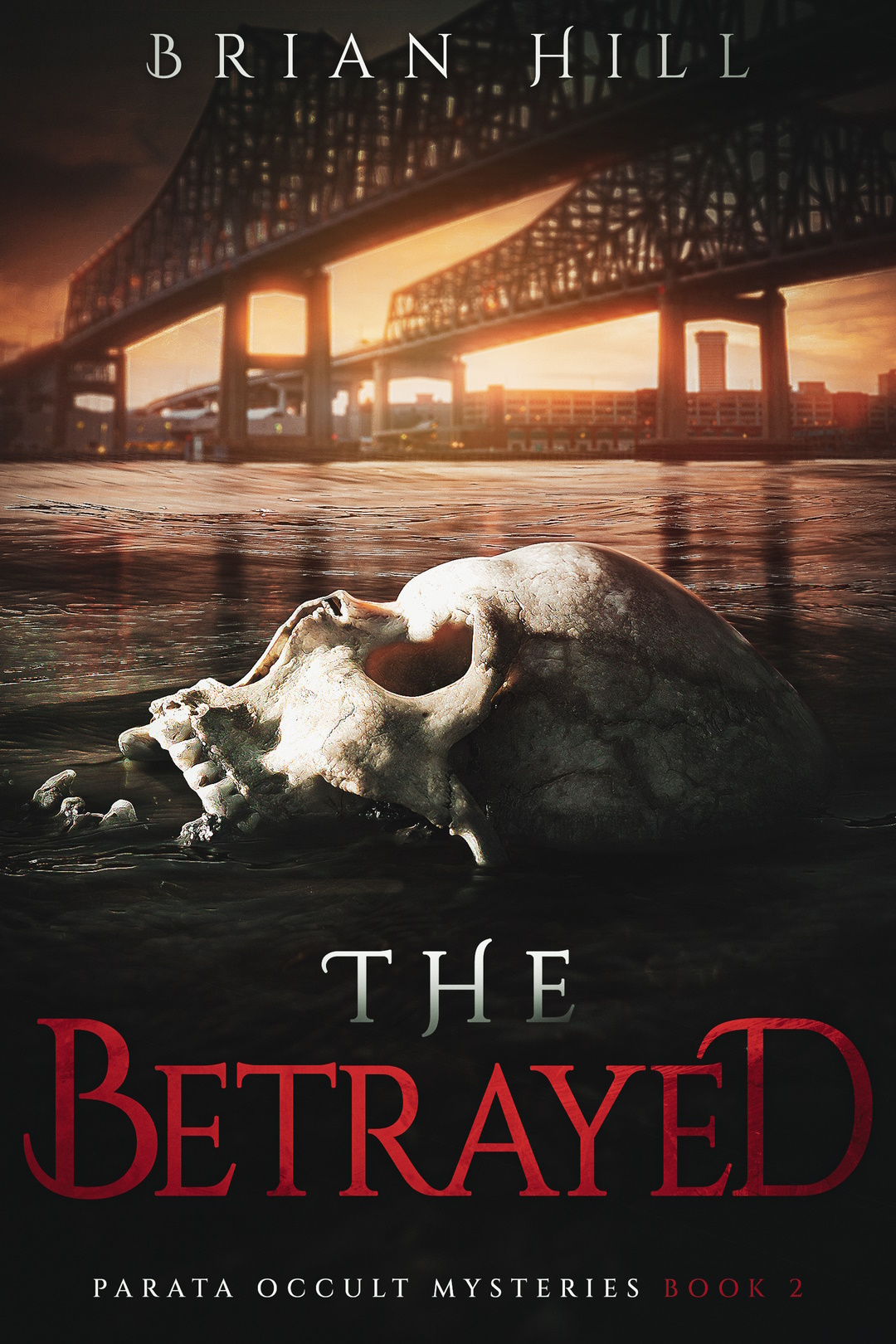
The Betrayed is the second Parata Occult Mystery — a noir-horror novel set in October 1984, mostly in New Orleans, with the homebase office in Pensacola. Revel “Rev” Parata, a six-foot-seven, 325-pound half-Maori, half-Apache former NOPD homicide detective turned private investigator, takes a missing-persons case for Saint Christina’s Catholic Church and ends up walking, almost literally, through the door of a Lovecraftian abattoir in the French Quarter. Six homeless people have vanished. So have two Irish-American teenagers. The trail leads from a tent city under the I-10 overpass to a charnel pit on the Mississippi shoreline, then under the river itself through a forgotten pipeline of pre-modern catacombs, and finally up into the cellar of a Greek Revival mansion on Chartres Street, where a beautiful philanthropist named Sarah Burke has been butchering the city’s invisible people and aging the cuts on hooks like prosciutto.
If the first book (The Coventry Job, referenced in dialogue as “the Coventry case”) established that occult horror was real and that Rev had picked up an artifact called the Jar of Nephren-Ka, The Betrayed is the book where that revelation hardens into a vocation. By the last chapter Rev has signed on, conditionally, with the Order of the Hidden Eye, an ancient witness-society Father Kelly secretly belongs to. He has also met the woman who will be his partner from here forward, Rae Gordon. And he has acquired a personal nemesis: a centuries-old ghoul who has promised, with the cold patience of an immortal, to take everything he loves before she takes him.
Tonally, the book sits at a junction. The investigative scenes — interview rounds, dumpster dives, evidence catalogues, prints on candy wrappers, kerf marks on bone — are pure noir police procedural, conducted in a 1984 New Orleans that smells of Creole cooking, wet brick, and trash. The horror, when it lands, lands in the older Weird-fiction key: an “ancient hand-dug” tunnel under the city, a half-finished painting under a black sheet, a porcelain figurine of a child leaning over an infant in a crib (and another, separately, of an adolescent boy butchering meat with a cleaver), a rune sprayed on a curb, and a host whose stew is made of the breed of pig “you are not likely to experience again.” It is descriptive, not coy: by the end you have toured the cold cellar, the meat-aging room, the desecrated vault. The companion below maps this for the curious reader, separating what is invented, what is lifted from real occult and folkloric tradition, and what is a remix of both.
A note on what is not in this book: there is no on-page magic system, no spellcasting in the D&D sense, no demon summoning ritual we ever see worked. The supernatural here is closer to folk horror with a Mythos cosmology than to ceremonial magic. There is one Solomonic warding, the only ritual worked on the page, and it is treated almost as a household pest deterrent. Almost everything else is creature, dream, vision, and inheritance.
Inventory
- Entities and cosmology — One ghoul (Sarah Burke / Pheobe Durst), the false god Nyarlathotep, the implied “Elder Ones,” the insectoid creature in the swamp, the Vietnamese-girl revenant in Rev’s visions.
- Rituals, sigils, and magical operations — The ghoul’s calling-card glyph (Nyarlathotep’s sigil), Solomonic ward circles drawn over thresholds, blessed amulets bought from a Bourbon Street voodoo shop, the ghoul’s “glamour” of perception.
- Forbidden tomes, grimoires, and texts — Father Kelly’s locked left-wall library: De praestigiis daemonum, The Magus or Celestial Intelligencer, Le Dragon Rouge, Grimoire of Pope Honorius, Malleus Maleficarum, The Key of Solomon.
- Artifacts, relics, and power objects — The Jar of Nephren-Ka (carried over from Book 1), Burke’s Japanese chef’s knife, Rae’s silver Star of David pendant, Burke’s enormous formicarium, the Burke Foundation lollipop wrappers (mundane but case-critical).
- Factions, cults, and secret societies — The Order of the Hidden Eye (Kelly’s order), the Burke Foundation (corrupt charity infrastructure), the implied historical cult of the Black Pharaoh.
- The investigator’s craft — Noir interview tradecraft (Rev’s pupil-dilation lie detection, his Sherlockian cold reads), undercover work (Rae’s “Jeanie” bag-lady persona), surveillance (Booker’s boat, binoculars, Polaroids), evidence preservation (zip-lock bags, sharpie labels), forensic logic (kerf marks, paint-fade dating, dental records).
- Cover-up infrastructure — Captain Freddy Guidry’s discreet help inside NOPD; Father Kelly’s hidden order; Rev’s own decision at the climax to lie to Freddy and excise all supernatural elements from his official statement.
- Locations and hidden geography — The shoreline pit and outflow pipe under the Greater New Orleans Bridge; the abandoned factory complex; the brick stairway behind the plywood; the trans-river pipeline; the catacombs under the French Quarter; the cellar abattoir under Burke’s Chartres Street home; the desecrated mausoleum at the end of one tunnel branch.
- Psychological and sanity costs — Rev’s nightmares, the Vietnamese-girl hallucinations, the encroaching realization that the dreams are not just dreams, the lie of the official statement, Marcus’s blank dissociation after rescue.
- Mythos vocabulary — Homo anthropophagi, ghoul, Nyarlathotep, the Black Pharaoh, the Jar of Nephren-Ka, Order of the Hidden Eye, “He that communes with the Elder Ones.”
- Case history — The Coventry case (Book 1), the Vietnam ambush at Quảng Trị Province (1965), the Marcus / Jamie / Shane file as it folds into the Burke Foundation file.
- Period and setting texture — October 1984 New Orleans during the World’s Fair on the West Bank, Pensacola’s Seville Quarter, Saints football and George Rogers, the early FBI Behavioral Science Unit being called “this new outfit,” cassettes and Bakelite phones, the Ghostbusters theme on the alarm clock radio, the Crescent City Connection’s second span under construction.
Cosmology
The metaphysics of The Betrayed are built by accretion rather than declaration. There is no chapter where someone explains how it all works. What the reader can assemble from on-page evidence is roughly this:
The mundane world we recognize is real and complete in its own terms. NOPD detectives, EMTs, the DA, Saints fans, drug addicts, social workers — they all live in 1984 as we remember it. Underneath and woven through that world is an older order: ancient powers (the Elder Ones), false gods like Nyarlathotep, and creatures like ghouls and whatever the Jar contains, who pre-date or simply ignore human history. They survive by hiding in plain sight, exploiting human inattention and human appetite. Father Kelly’s order calls itself the Hidden Eye precisely because seeing clearly — without bias — is the act on which their work depends. In the book’s own metaphor, mundane society is the ant colony; the ghoul is Burke’s Aphantochilus, the mimic crab spider that walks among the ants and eats them one at a time without anyone noticing.
The mechanics, where you can pin them down:
- Glamour. The ghoul projects an illusion that warps human perception of her but not of her environment. Photographs and mirrors are said to defeat it; paintings, because they pass through the artist’s perception, do not. Burke’s house is full of paintings and contains, conspicuously, no mirrors and no photographs of her. Shadows betray the truth — the cloaked figure’s shadow is “over-sized for their thin body.” This is the cosmology’s most explicit, testable rule, and the book is consistent with it: Rae, who has not yet “broken” the glamour, sees a 130-pound woman; Rev, who has glimpsed the truth, sees a “huge,” gorilla-built, gray-skinned, dog-headed thing.
- Sustenance. Ghouls extend their lives and inherit memory and skill by eating the flesh of the living. The book frames this as the source of Burke’s polymath reputation — she is a chef, painter, businesswoman, naturalist, polyglot because each of those skills was someone she ate. The cosmology has a moral edge: you become what you consume.
- Wardings. Solomonic protective diagrams, drawn over a threshold and consecrated by ritual, prevent a hostile entity from crossing. Portable amulets, blessed the same way, function as personal wards outside the home. The book is carefully agnostic about whether Rev believes any of it works; what it shows is that doing the ritual makes him feel safer, and Father Kelly’s frame (“Perhaps there’s a little truth in all of it”) is the closest thing to a doctrinal statement the book offers.
- Inheritance. Rev is described by Burke as having “power from your father’s people, who are much closer to my people than you might like to admit. And from your mother’s, due to the tutelage of your grandfather.” His Maori paternal line and Apache maternal line both carry esoteric weight in this cosmology, and the grandfather who tutored him (mother’s, Apache side, per Burke’s framing) is referred to with the honorific “He that communes with the Elder Ones.” The visions, the dreams, the Vietnamese girl — these are presented as the unwelcome activation of an inheritance Rev did not ask for.
- Hierarchy. Implied but not spelled out: Nyarlathotep is a “false god”; ghouls operate in his shadow; the insectoid Jar-creature is something else again, possibly older. Father Kelly’s order argues that what science cannot disprove may still be real — they are looking for “the face of God” by reading grimoires alongside cellular biology, treating both as data.
What the book does not commit to: whether the supernatural is theistic, whether the Elder Ones can be petitioned, whether magic can be performed by humans in any directed way beyond protective wards. The texture is folk-horror plus Mythos: things in the world, hungry, knowable but not negotiable.
The investigator
Revel “Rev” Parata is, on the surface, the late-period Chandler private eye scaled up to the size of a refrigerator. Six-foot-seven, 325 pounds, half-Maori (father), half-Apache (mother), reservation-raised in Arizona, served in the Army (in-country in Vietnam by July 1965), twelve years NOPD with four in homicide, now a P.I. operating out of Pensacola because something — Rebecca, an ex who left him four years back, and “the Coventry case” — drove him out of the city he loves. His office is a hot back room; he balances his checkbook by hand; he lives in motels when he is on the road, currently The Court, where he book-rotates rooms by theme.
He owes more to Marlowe than to Spade. He is kind under the bluster — gentle with Bernie, gentle with Jerome, gentle with Marcus — and his cynicism is the protective shell of a man who has seen too much and refuses to let it stop him from caring. The Chandler signature of the lone professional walking the mean streets without becoming mean is here; what is added is the half-Maori, half-Apache framing, his grandfather’s medicine, and the Marcus Aurelius quote in the Burke parlor — “Everything we see is a perspective, not the truth” — that he uses, mid-investigation, as a clearing meditation to see past the glamour on the porcelain figurines. The register is Stoic noir, not hard-boiled.
His method is hybrid. Mundane: door-knocking, the cards, the badge of his old captain’s friendship, evidence baggies, a sharpie, a Polaroid camera, dental records, the M.E.’s kerf-mark report. Supernatural-adjacent: Sherlockian observation (he reads Rae’s biography from her necklace, accent, ham-eating, and scar in their first meeting); pupil-dilation as a lie detector (“Pupils. They tend to dilate when someone lies”); a subconscious that delivers him truth in dreams that he then tries to dismiss and fails.
He carries a Smith & Wesson Model 60 .357 revolver. He drives a Chevrolet Caprice cruiser. He smokes cigars more than cigarettes. He drinks Pimm’s at Napoleon House, Powers Irish whiskey when poured, sweet tea in the daytime, Jameson never (that is Father Kelly). He eats — hugely, unselfconsciously, as a tic the book uses for both comedy and characterization. He is a man who has been on “the old Army diet” and knows what it feels like to be the last in line.
His relationships, as of the end of The Betrayed:
- Captain Freddy Guidry — best friend, mentor, NOPD captain of the Fourth District. The first person Rev calls when he needs a real cop. He lies to Freddy at the end of this book, and it eats him.
- Rae Gordon — new partner. Ex-actress (Los Angeles, until a scar), Russian-Jewish from Newark, jiu-jitsu and escrima, Polaroid camera and a 280Z, drives a hard sixty-forty deal on her first contract, eats suspect candy on the principle that “this is faster” than fingerprints. The romantic charge is present but unconsummated — Rev “shifts uncomfortably, jamming it deep down.”
- Father Kelly — client and, he reveals at the end, a member of the Order of the Hidden Eye. Irish brogue thickens with whiskey; carries a locked grimoire shelf in his office; loves Bernie like a son.
- Bernie Latour — the gentle-giant gardener at Saint Christina’s, framed for the murders, used and “missing-time”-controlled by Burke. An emotional center of the book; the betrayal that gives the title its second meaning.
- Sarah Burke / Pheobe Durst — the ghoul. New nemesis, sworn for the duration of the series.
His accumulated damage is the spine of the book. The recurring nightmare from Vietnam has, post-Coventry, multiplied into a weekly thing. He has begun seeing the Vietnamese girl he was ordered to kill and hesitated on (the chapter “‘Nam” makes the memory explicit — Sergeant First-Class Paulie “Mac” Machado is killed by shrapnel from her self-detonating vest after Rev hesitates to pull the trigger on what was, in fact, a child suicide-bomber). She appears at the I-10 tent city, in the dead factory, and possibly in the dream of the bassinet. He keeps the Jar of Nephren-Ka in a chest in his back office, and at the end of the book he locks it in a safe deposit box, having a quiet conversation with the artifact about whether to trust himself with it. He is, as Father Kelly tells him, going to need to sit down with all of this and be honest about it. He is also exactly the kind of man who will not.
Case mechanics
A Parata case in The Betrayed runs roughly like this. The reader who pays attention can use the template to anticipate the rhythm of the next book.
The hook. A working-class institution — here, a parish church — hires Rev because the police won’t. The clientele are the people the system overlooks. Father Kelly is the on-the-ground intermediary; the funding mysteriously comes from elsewhere (in this book, the Irish-pub-owning gangster Fitzgerald, who has his own missing teenagers).
The intake. Rev interviews the client, gathers the names and last-knowns, and pays a kid a crumpled dollar bill to be his street guide. (Jerome plays the role Sam Spade would have called a “stool pigeon” but here is allowed to be a child.)
The canvass. Rev walks the abduction sites with the kid, recovers personal effects, dumpster-dives for the institutional rejects. Forensic minutiae are honored — paint fade, candy-wrapper origami, a torn photograph. Rae’s contribution accelerates this once she is on board: she does the talking, he does the looking.
The first uncanny. A symbol painted on a curb, on a column, on a brick of a flood wall. Inexplicable, low-key, easy to dismiss. The book is patient — the symbol shows up three or four times before either investigator names it as a calling card.
The convergence. The cases the police think are unrelated (the homeless, the two Irish boys) turn out to share a dump site. The dump site has bones with kerf marks. The kerf marks demand a butcher’s tool. A butcher’s tool surfaces on a person who could not possibly be the butcher. The frame becomes legible, and so does the existence of a real perpetrator.
The undercover swing. Rae (eventually) goes inside the world of the victims as “Jeanie.” She gets the lead a uniformed cop never could (the Burke Foundation’s “attendance keeper,” the painted glyph in the dead of night). This is the noir tradition of the operative who can pass.
The night vigil. Rev stakes out the dump site from a fishing boat with his ex-cop bait-shop friend Booker. He sees the thing — the dog-headed gray creature with red retinal flares — and gets a wound on it. He follows the trail of blood into the underworld.
The descent. The catacombs. This is where the book becomes pure folk-horror procedural: map, compass, pace count, marks on a folded city map, blood drops in a steel pipeline that crosses the Mississippi River, candy wrapper found in trash. The investigator triangulates the lair to a specific city block in the French Quarter.
The confrontation. The villain hosts the investigator at home, plays her hand badly enough to confirm suspicion (the painting under the black sheet, the formicarium parable, the gauze patch), and then drops the glamour. Violence. Capture. Escape attempt. A cost that gets named (Rev’s vow to Marcus, kept; his promise to Bernie, kept).
The price. The book explicitly catalogs the prices paid. Bernie is freed from custody but the trauma is real. Marcus comes back hollowed-out. Jamie Gilroy is alive but a quadruple amputee whose right-leg dressing is fresh (Burke had been butchering him in installments, antemortem, the way she ages a side of beef). Shane MacQuillan was in the pit. Six homeless people were the meat in the freezer. Rev has to lie to his best friend. The villain escapes, severely wounded, into the Mississippi at the World’s Fair, and the epilogue puts her in an alley feeding on a twenty-five-year-old man and promising the long game.
The vow. The investigator accepts that this is not a one-off. Father Kelly recruits him into the Order of the Hidden Eye. Rev hides the Jar in a safe-deposit box. The next case is implicit.
The shape is a noir investigation that opens out into a Mythos confrontation, then closes back into a noir resolution where the official story bears no relation to the truth and the investigator carries the difference alone.
Deep dives
Entities and cosmology
Sarah Burke / Pheobe Durst — the ghoul
The book’s central antagonist is a creature called, variously, “the homeless snatcher” (NOPD), Sarah Burke (her social mask), Pheobe Durst (her own oldest name for herself), and Homo anthropophagi (Father Kelly’s tome). She presents in society as a 130-pound, mid-Atlantic-accented, blue-eyed philanthropist, seemingly fifty but probably much older, who runs the Burke Foundation’s outreach to the homeless of New Orleans. Under the glamour she is huge, gorilla-shaped, gray-skinned, dog-headed, with crooked overlapping pointed teeth (later described as “a row of inwardly curving teeth”), a thick upper body and long powerful arms over short squat legs, two-inch claws, and “huge, pendulous” breasts crushed against her midsection. She smells like sour milk / curdled milk. Her “necklace” is a sapphire pendant whose flash Rev sees from the riverbank on his first sighting.
Her modus: she runs a charity that feeds and tracks the city’s homeless, identifies victims through her foreman Valerie Grimes and the foot-soldier “attendance keeper” at each tent city, marks selected victims’ campsites with the glyph of Nyarlathotep, abducts them through a network of catacombs and a trans-river pipeline, butchers them in a cellar abattoir under her Chartres Street home, ages the cuts in walk-in coolers, and serves the meat at her own table — disguising it as the rare Arapawa pig, “a delicacy you are not likely to experience again.” She has been doing this in some form since 1958 (her stated tenure running the Foundation), and her grandfather’s painting in her parlor shows the same Nyarlathotep glyph as the artist’s mark, meaning at least three generations of this family have served the same false god.
Real-world antecedents. The ghoul as a body-eating, grave-robbing creature is a real folk tradition, originally Arabic — ghūl, plural ghīlān, from the Quranic / pre-Islamic shape-shifting desert demoness who lures travelers off the road. The English-language Mythos version owes most to H. P. Lovecraft, especially “Pickman’s Model” (1927) and The Dream-Quest of Unknown Kadath (1943, posth.), in which ghouls are dog-faced, grave-feeding, and capable of passing among humans. Lovecraft’s ghouls in turn descend from earlier Western Gothic appropriations of the ghul. The Latin Homo anthropophagi is real classical zoological language: the Anthropophagi appear in Pliny the Elder’s Natural History as a man-eating northern people, and Shakespeare borrows them for Othello’s traveler’s tales (“the Anthropophagi, and men whose heads do grow beneath their shoulders”). Burke’s specific habit of dry-aging the meat is a chef’s-kitchen detail the book grafts onto the folk tradition; it is not, to my knowledge, in the inherited literature.
What’s invented. The skill-and-memory-by-eating mechanic — that ghouls absorb their victims’ abilities — is presented in-story as a citation from De praestigiis daemonum, but in the real Wier text this is not present; it is original to this book and serves to explain why a corpse-eater is also a chef, painter, polyglot, naturalist, and businesswoman. The glamour-defeated-by-mirrors-and-cameras rule is also original; folk ghouls do not traditionally have a perception-magic problem of this kind. The “Pheobe Durst” backstory implied by the epilogue — a woman so old her own original name has fallen out of use — is original to the series.
Why it matters in-universe. Burke is the first named, defeated-but-not-killed antagonist of the series. She is also a pattern: a hidden predator who has built a legitimate philanthropic infrastructure as both feeding-ground and cover. The shape of the threat — a powerful person whose civic generosity is the literal disguise of their predation — is the engine the rest of the book derives its irony from.
Connections. She survives, vows revenge, and her last on-page act is to feed in a French Quarter alley. She is a series-long enemy. Her grandfather’s painting, with its forest-and-pyramid background and Nyarlathotep mark, ties her family line to the Egyptian iconography Rev has already encountered with the Jar in Book 1.
Nyarlathotep, the Black Pharaoh
Named once, in Father Kelly’s research at the close: the glyph Burke spray-paints at her abduction sites is “the symbol of some false god, known by various names in the literature, but the Egyptian name for him is Nyarlathotep.” Rev recognizes the title “Black Pharaoh” from his earlier encounter with the Jar of Nephren-Ka, and Kelly confirms it is one of Nyarlathotep’s epithets, with scholarly debate as to whether it refers to the god itself or to a historical follower.
Real-world antecedents. Nyarlathotep is a wholly Lovecraftian creation, first appearing in his prose poem “Nyarlathotep” (1920) and developed across the Mythos as the “Crawling Chaos,” a thousand-formed messenger of the Outer Gods who preferentially manifests as a tall, dark, charismatic man — often coded as Egyptian. The “Black Pharaoh” avatar is part of the inherited Mythos vocabulary, used by August Derleth and many later writers. Nephren-Ka, of the Jar, is also a Lovecraft creation (mentioned in “The Outsider” and “The Haunter of the Dark”), said in the Mythos to have been an Egyptian pharaoh whose worship of Nyarlathotep got him erased from the historical record. So the connection the book draws — the Jar-creature, the Black Pharaoh, the glyph Burke is painting — is Mythos-canonical lineage.
What’s invented. The specific glyph (which the book renders visually but cannot easily be reproduced in text) is original to the series. The cult-of-Nyarlathotep-running-a-charity setup is original. The implication that the Burke family line are hereditary servants of this god is the series’ contribution to the inherited Mythos.
Why it matters. The book does not introduce Nyarlathotep on the page in person. He is the explanatory frame for the connection between books: the Jar-creature is his, the ghoul is his, and probably so is whatever comes next.
The insect-creature in the swamp (the Jar’s spawn)
Carried over from The Coventry Job. Rev describes it in flashback: “innumerable legs, articulated mouth parts dripping with secretions, and the horrible, three-lobed red eye.” The epilogue confirms it has grown — now nearly seven feet long, with nine eyes and four sets of mandibles, mound-dwelling under a cypress, hunting alligators. It is associated with the Jar of Nephren-Ka, which Rev recovered in Book 1 and now keeps locked in a safe-deposit box.
Real-world antecedents. The “three-lobed burning eye” is Lovecraft’s image, from “The Haunter of the Dark” — the avatar of Nyarlathotep summoned by the obsidian Shining Trapezohedron. The book borrows the iconography directly: the Jar is functionally analogous to the Trapezohedron, an artifact that calls or contains a chthonic emissary of Nyarlathotep. The general silhouette — many-legged, mandible-faced — also echoes Mythos chitin-things like the mi-go and the byakhee.
What’s invented. The aquatic / Louisiana-bayou setting and the alligator-eating predation cycle are original. The growth-by-feeding rule, where the creature acquires more eyes and larger size as it consumes apex predators, mirrors Burke’s flesh-absorption mechanic — the same cosmological law operating on a different organism.
Why it matters. The epilogue’s last paragraph explicitly returns us to the swamp creature, telegraphing that it is a series-long thread, not just a Book 1 monster.
The Vietnamese girl
Rev sees a small Vietnamese girl in tattered olive shirt and long jet-black hair three times in the present-day narrative — at the I-10 tent city while watching Grimes, in the abandoned factory near the basement door, and (more obliquely) in the dream of the bassinet. The chapter “‘Nam” reveals this is the child suicide-bomber from Quảng Trị Province, July 1965, whom Rev was ordered to kill and hesitated to. She self-detonated; Mac died of shrapnel. Rev has been carrying her for nineteen years.
Real-world antecedents. Child-suicide-bomber tactics in Vietnam are documented historical practice on both sides. The PTSD “ghost” of someone the soldier did or did not kill is a long literary tradition, going back to Macbeth and through the Vietnam-vet canon (Tim O’Brien’s “The Things They Carried,” Larry Heinemann’s Paco’s Story).
What’s invented. Her return as a recurring apparition that may or may not be supernatural is original, and the book does not commit on which it is. Rev himself wonders whether the dream that explained “what happened to Kinsey” in Book 1 was just his subconscious; “they never did find Kinsey’s body, though.” The reader is invited to keep the question open.
Rituals, sigils, and magical operations
The glyph (Nyarlathotep’s sigil)
Burke spray-paints this symbol on or near most of her abduction sites — Washington Square, the Poydras Street curb, the I-10 tent city support, the bridge support at the dump site, and (eventually) near Rae’s sleeping spot when Rae is taken. Rae correctly dates the paint by fade-rate: less than three months in full sun. The mark is consistent enough that Rev calls it a “calling card.”
In the story, the ritual function of the sign is dual. It is a marker — a way for whoever does the actual snatching (one of Burke’s people, or Burke herself in glamour) to know which sleeper has been pre-selected. It is also implied to be a consecration: it dedicates the killing to Nyarlathotep, the way a hunter’s tag dedicates the kill to the licensing authority. Notably, victims whose campsites carried the glyph (Thomas, Kurt, Lewis) were unknown to Bernie when Rev interviewed him, while victims who did not have a glyph (Marcus, Alisha, Fanny) were people Bernie did know — suggesting the glyph marked outsiders that Bernie’s social circuit was not used to filter.
Real-world antecedents. Sigils as the signature of a deity or as a ritual mark of dedication are pan-cultural. Specifically Mythos: the symbols of the Old Ones, especially the Yellow Sign (Chambers/Lovecraft), function exactly this way — a glyph that marks territory or victims for a particular cosmic patron. The notion that consecrating a kill makes it into an offering is older than written history; it is the structural basis of every sacrificial rite from the korban of the Hebrew Bible to the xenia-violation sacrifices of Greek epic.
What’s invented. The visual design of Burke’s glyph is original. The procedural use — “graffiti” that hides in plain sight as urban tagging until you realize the spacing is wrong — is a 1980s-urban application of an old idea.
The Solomonic ward and the consecrated amulets
At the climax, Father Kelly opens The Key of Solomon to a “complex diagram” of “strange scripts” set in circles, identifies it as “an incantation of protection against malevolent spirits,” and instructs Rev to draw it over the entrances of his home and office. He then improvises: the same symbol, mass-produced as cheap silver pendants and hawked in the back of The National Enquirer, can be ritually consecrated and worn as portable wards. They buy three at a Bourbon Street voodoo shop. Kelly chants over them, and Rev, who reports he felt the ritual was a waste of time, admits “I had to admit that I felt better with the little doodad.”
Real-world antecedents. The Key of Solomon (Clavicula Salomonis) is a real grimoire, the foundational Solomonic text of Western ceremonial magic, in circulation since at least the late medieval period and surviving in many Latin, Italian, and French manuscripts; the standard English-language reference for over a century has been S. L. MacGregor Mathers’s 1889 translation. It does contain protective pentacles and instructions for inscribing them on parchment, metal, and the threshold. The lesser companion text, Lemegeton or Lesser Key of Solomon, contains the famous Goetia. Drawing protective sigils over doors and windows is a real folk practice across multiple traditions — the Jewish mezuzah, the chalk inscriptions of the Epiphany blessing (C+M+B over Catholic doors), the hamsa, the cold-iron horseshoe, the veve on Haitian Vodou altars.
What’s invented. The specific incantation Kelly performs is generic; the book does not give us the actual Latin or the specific pentacle chosen. The National Enquirer-amulet detail — that the same protective sigil can be bought for $4.99 plus shipping from the back of a tabloid — sits in the long real history of mail-order occultism (the Rosicrucian AMORC ads, the back-of-comic-book sea monkeys and X-ray glasses, the Llewellyn catalog).
Why it matters in-universe. This is the only ritual worked on the page in the entire book, and it is a household-defense rite, not offensive magic. In this series the heroes do not learn to cast spells. They learn to ward their doors and identify their enemies. The Order of the Hidden Eye is not a school of wizardry; by Father Kelly’s own definition, it is “first and foremost, witnesses.”
The ghoul’s chant
Burke speaks, at the climax, in a non-English ritual language to Marcus:
ph’lloig vulgtmoth ahaimgr’luhh, Gokln’gha, Ahthrodog, nogephaii l’ ya!
It is the only rendered passage of the inhuman language in the book. Marcus understands and obeys. Rev recognizes its register from a similar chanting in the auditorium scene of the Coventry case.
Real-world antecedents. This is plainly R’lyehian — the constructed pseudo-language of the Lovecraft Mythos, with its characteristic apostrophes, doubled consonants, and “ya”/“l’” particles. The most famous line in this register is “Ph’nglui mglw’nafh Cthulhu R’lyeh wgah’nagl fhtagn” from “The Call of Cthulhu” (1928).
What’s invented. The specific lines are original composition in that idiom; “Gokln’gha” and “Ahthrodog” do not, to this casefile’s knowledge, appear in canonical Lovecraft or in the long tradition of pastiche.
Forbidden tomes, grimoires, and texts
Father Kelly’s left-hand bookshelf
When Rev visits Father Kelly’s office for the second interview, he takes a long look at the bookshelves. The right wall is conventional theology — “Bibles of all description, several copies of the Quran and Kabbalah, and numerous thick treatises on theology.” The left wall is behind locked glass, and on it: The Magus or Celestial Intelligencer, Le Dragon Rouge, Grimoir of Pope Honorius, Malleus Maleficarum, plus older volumes too weathered to read.
Each of these is real and worth a paragraph for the curious reader.
- The Magus, or Celestial Intelligencer. Francis Barrett, 1801. The English-language gateway grimoire of the nineteenth century, a synthetic compilation drawn from Cornelius Agrippa’s Three Books of Occult Philosophy and other sources. It revived ceremonial magic for an English Romantic-era readership and influenced everything from the Hermetic Order of the Golden Dawn to modern Western esotericism.
- Le Dragon Rouge (“The Red Dragon”). A French grimoire dating in printed form to the late eighteenth or early nineteenth century, also called Le Grand Grimoire. It instructs the operator in pact-making with the demon Lucifuge Rofocale, who under the right circumstances is forced to deliver wealth. Notorious in the French-speaking world; a standard reference for any folk magician working in the Caribbean and Louisiana French-Creole milieu.
- Grimoire of Pope Honorius (Liber juratus Honorii, conflated with the later Grimorium Verum tradition). Attributed (falsely) to Pope Honorius III, with a circulation history going back to the seventeenth century and earlier antecedents. A reference for operative ceremonial magic, especially demon constraint.
- Malleus Maleficarum (“The Hammer of Witches”). Heinrich Kramer, 1486. The ur-text of the Catholic witch-hunt, a manual not for working magic but for prosecuting witches. Father Kelly’s possession of it is character-coded: he is in the witch-hunting tradition, not the witch tradition.
The selection is plausible for a Catholic priest who is also a member of an esoteric order, and historically realistic for a private collection of grimoires that a working occult librarian in 1984 might actually have. The fact that they are behind locked glass is exactly correct: rare-book conservation, but also restricted access.
De praestigiis daemonum
The book Father Kelly produces at the end to identify Burke. He cites it as “one of the oldest witch-hunting manuals we have,” and reads from its appendix to give the in-story canonical entry on Homo anthropophagi / ghouls. He also reads from it the passage on the flesh-eating-grants-skills mechanic.
Real-world. De praestigiis daemonum is a real text by the German physician Johann Wier (also Weyer or Weier), first published in 1563. Father Kelly’s in-book framing of it as “one of the oldest witch-hunting manuals we have” is historically inaccurate: Wier’s book is one of the earliest skeptical works on witchcraft, arguing that accused witches were largely mentally ill rather than actually in pact with the Devil. Wier is a foundational figure in the anti-witch-hunting tradition, not the prosecutorial one. The book also contains an appendix, Pseudomonarchia daemonum, listing demons and their offices, which is a clear ancestor of the Goetia. The casefile flags Kelly’s framing as a factual error in-character (whether intended as a misreading by Kelly or as a slip in the text is left to the reader). The ghoul-as-anthropophagus passage and the flesh-grants-skill passage Kelly reads from the appendix are also not in any edition of Wier this casefile has verified; they are invented for the book.
The Key of Solomon
The protective-pentacle book that gives them the ward. See “Rituals” above. It is real, it has a thousand-year tradition behind it, and the modern English reader who wants to look at it can find Mathers’s translation in print or on archive.org. Father Kelly’s possession of it on the open shelf with the wards, while keeping the Honorius and the Dragon Rouge in the locked case, is doctrinally consistent: Solomonic protective magic is theologically defensible inside Catholic tradition (King Solomon as a holy magician), while pact-making grimoires are not.
Artifacts, relics, and power objects
The Jar of Nephren-Ka
Carried over from Book 1, kept in a chest in Rev’s back office, transferred at the end of The Betrayed to a safe-deposit box. Described by Rev as “The base, with that rounded, vase-like shape, formed of black onyx with occasional bands of silver running through it like streaks of lightning. The top was the carved head of a pharaoh, looking regal and intense out of two sparkling, iridescent, black pearl eyes.” Touching it gives Rev a vision of the swamp creature. It is implied to be alive in some sense — Rev finds it uncovered in the chest where he had left it covered. Burke explicitly knows about it: “with the tutelage of your grandfather” is a tipoff that she knows what Rev’s family line connects to.
Real-world antecedents. Nephren-Ka is a Lovecraft creation, the “Black Pharaoh” of “The Haunter of the Dark” and “The Outsider,” a fictional Egyptian king said to have served Nyarlathotep. The Jar in this series functions as a Mythos artifact in the Trapezohedron lineage — a sealed black-stone container associated with a specific Outer-God avatar. The aesthetic also clearly draws from the long tradition of canopic jars in Egyptian funerary practice (the jars that held the organs of the deceased, each topped with a god’s head). The combination of “canopic jar shape” with “summons a chthonic many-eyed thing” fuses real archaeology with Mythos invention.
What’s invented. The specific Jar’s onyx-and-pearl design and its silver-lightning bands are original. Its emergent agency (uncovering itself in a locked chest) is a series-original supernatural-object trope.
Why it matters. It is the Chekhov’s gun on the mantelpiece for the rest of the series. Rev knows it, hates it, will not destroy it (“the fucking thing could stay hidden”), and locks it away where neither Burke nor anyone else can reach it without legal access. The fact that he goes to retrieve it before warding the office, and considers carrying it, suggests he is more attached to it than he wants to admit.
Burke’s Japanese chef’s knife
The framed murder weapon. Imported from Japan, “a real special piece” by Detective White’s reckoning. Bernie has been told never to use it; he keeps it on his shrine, under the crucifix and beside the photo of him with the late Father Duncan, “so’s God can keeps people from taking it.” Burke gave it to him. It is a perfectly chosen frame because the kerf marks on the bones really do match (Burke is the actual butcher; Bernie’s prints on the wrappers and the knife are her doing).
Real-world antecedents. Japanese chef’s knives — gyuto, santoku, deba, yanagiba — entered the high-end American restaurant world in the 1970s and 1980s. By 1984 a serious imported Japanese chef’s knife (Masamoto, Misono, Aritsugu) was the kind of object that could indeed cost as much as a working person’s monthly rent and would be implausible in the kit of a church gardener. The book uses this fact for its forensic logic: this knife points up the social ladder, not down.
What’s invented. The plot use is original. There is no occult tradition of magical Japanese chef’s knives; this is a noir McGuffin, not a relic.
Rae’s Star of David
A small silver pendant Rae wears under her blouse. Rev clocks it on first meeting and uses it (with her ham-eating) to deduce her lapsed Russian-Jewish background. Later, after Rae has been taken by Burke, Rev finds the pendant on her abandoned blanket — the chain ragged, snapped — and pockets it. Burke later mocks Rae by smelling her: “It has been so very long since I last enjoyed the flavor of the tribes of Israel.” Whether the mezuzah-adjacent symbolism of the Star of David offers any actual protection against the ghoul is left ambiguous; the chain is broken, after all, but Rae herself survives.
Real-world. The Magen David as a Jewish identifier is real. As a protective amulet within Jewish folk practice it is more recent and less central than the mezuzah, the hamsa, or the inscribed kameot; its modern apotropaic associations are more cultural-identity than ritually defensive. The book does not claim it is a working ward — it is an emblem, and the breakage is signal, not magic.
The formicarium
Burke’s ant-farm-with-mimic-spider, “made by the inventor, Frank Eugene Austin.” Two large ant farms have been part of the Western popular-science imagination since the early twentieth century. Burke uses it as a parable: the Aphantochilus mimic spider walks among the ants, smelling like them, until it strikes. Rev shatters the formicarium against her at the moment the glamour breaks; her grief at “my experiment, my creatures” is the closest she comes to a recognizably human reaction.
Real-world. Frank Eugene Austin (1873–1964) of Dartmouth College was an American inventor and physics professor who patented and popularized the modern ant farm in the early 1930s; the commercial “Uncle Milton’s Ant Farm” came later (1956). Aphantochilus is a real genus of ant-mimicking crab spiders (Thomisidae), Neotropical, that prey on ants by closely resembling them in shape, behavior, and chemical signature. The ecological and behavioral details Burke gives are largely accurate and specific.
What’s invented. The size of the farm (four feet by two feet) is exaggerated; real Austin-design farms were tabletop scale. The use as a symbolic set piece is original.
The Burke Foundation lollipops
Mundane object, case-critical. They appear at every campsite of every victim. Father Kelly hands them out, as do Foundation volunteers; Bernie is given handfuls of them by Burke herself to distribute. Marcus folds the wrappers into origami animals — a habit that turns up among Bernie’s hidden possessions, helping break the frame. Print-bearing surfaces lift forensic prints, which is how the police trail Bernie. Rae eats them on first encounter to test for drugs (they are not drugged; they are tracking devices in the social sense, marking who has had Foundation contact).
Real-world antecedents. Charity outreach via small free items is a common practice. The use of a candy distribution as a clientele tracking system is a believable 1980s cover and is not, as far as this casefile knows, drawn from any specific real scandal.
Factions, cults, and secret societies
The Burke Foundation
A philanthropic non-profit, c. 60 years old, founded by Burke’s grandfather “just before his untimely death” in the wake of the 1927 Mississippi flood. Funds the city’s East Side homeless shelters in partnership with the City of New Orleans. Headquartered at 707 Perdido in a high-rise. Publicly led by Sarah Burke, day-to-day-managed by Valerie Grimes (the “stout, older white woman” with the iron grip on Bernie) with a cadre of administrative staff and a layer of volunteers; in the field, it operates an “attendance keeper” model where individual residents (the fat man at the I-10 tent city) are paid small stipends to track who comes and goes.
The horror of the Foundation is structural: it is functioning, by every external measure, as a competent and necessary social-services backbone, “the system would probably collapse without them.” The shelters are real, the volunteers are real, the budget is real. The director of the city-run Gravier Street shelter, Theresa Collins, is a sympathetic professional who genuinely cares about Fanny Gareau. The Foundation’s infrastructure is benign; its purpose, from the founder’s generation onward, is to maintain a stocked larder.
Real-world antecedents. The pattern of a charitable institution functioning as predator-cover is a sad, real category. (The Catholic Church’s own twentieth-century scandals are an obvious near-reference; Father Kelly’s order has to be read against that backdrop, and the book does not flinch from naming the church’s torture history when Rae throws it back at him.) The 1927 Mississippi flood, which displaced over 600,000 people in the Lower Mississippi Valley, is real; charitable foundations did emerge from it.
What’s invented. The Burke Foundation itself, its ghoul ownership, and its three-generations-deep occult dedication are original to the book.
The Order of the Hidden Eye
Father Kelly’s secret society. Revealed in the post-climax discussion. A research order whose members “see, but are ourselves hidden,” “first and foremost, witnesses,” researching ancient esoteric texts alongside cellular biology and astronomy in the search for “the face of God.” Members are scattered (“my contacts,” “one of my colleagues”); membership crosses Catholic clergy at minimum, possibly other faiths. Will fund Rev’s investigations going forward in exchange for his cooperation.
Real-world antecedents. The “secret order with monastic-research character that fights cosmic evil” is a fictional commonplace — the Hellboy comics’ Bureau for Paranormal Research and Defense, the X-Files Syndicate (inverted), the Jesuit-coded organizations of countless thrillers, Charles Stross’s Laundry. Older non-fiction antecedents: the actual Hermetic Order of the Golden Dawn (1888), the Theosophical Society (1875), and earlier the Rosicrucians and the various Catholic confraternities. The “Hidden Eye” iconography is also a real long-standing motif (the Eye of Providence on the U.S. one-dollar bill, the Eye of Horus, the Buddhist trinetra). The specific name “Order of the Hidden Eye” is, as far as this casefile knows, original.
What’s invented. The order itself, its size, geography, doctrine, and methods are not pinned down beyond Kelly’s brief sketch. The reader is told as much as Rev is — “almost nothing” — with later books presumably opening the door further.
The cult of the Black Pharaoh
Not directly on stage, but threaded throughout. Burke spray-paints Nyarlathotep’s symbol; her grandfather’s painting bears the same mark; Rev’s grandfather is “He that communes with the Elder Ones” and his Apache lineage matters somehow; the Coventry case involved cultists chanting in the same R’lyehian language; the Jar is a Black Pharaoh artifact. The book hints at a multi-generational human service-cult of Nyarlathotep, of which Burke is one node and the Coventry-case villains were another. None of this is pinned down. It is texture for the next book.
The investigator’s craft
Mundane tradecraft
The book is unusually generous with concrete investigative procedure for an occult-noir novel. Worth cataloguing because the reader can use it as a checklist for what a “Parata case” looks like operationally:
- Cards and the friendly-cop bridge. Rev pays for everything in business cards. He has Captain Guidry as the inside man. Both are classic 1940s P.I. infrastructure (Marlowe and Bernie Ohls, Spade and Tom Polhaus).
- The kid as guide. Jerome on a crumpled-dollar tip and the promise of McDonald’s. A direct lineage to the Baker Street Irregulars and to every street kid in 1940s noir.
- Evidence handling. Sharpie on zip-lock, gloves on first touch, Polaroid for symbol photographs, the “don’t contaminate the scene” discipline carried over from his homicide years.
- Forensic literacy. Rev knows what kerf marks are, knows what the Behavioral Science Unit is (this is 1984 — the unit had only been formally established in 1972 and was still novel enough for Freddy to call it “this new outfit”), knows how to date spray-paint by sun fade.
- The cold read. The Rae interview is a textbook noir set piece in the Sherlock register: clothes, accent, jewelry, food choice, scar age, posture.
- Pupil-dilation lie detection. Rev catches Fitzgerald lying about his motive for funding the search. This is presented as a real technique. It is not a reliable real-world lie-detection method, but it has folk-belief and pop-psychology currency and was actively studied by behavioral psychologists in the 1970s and 1980s. The book uses it as a noir-detective trick more than a serious forensic claim.
Occult tradecraft
The genre fusion is crisp. Where a standard noir P.I. would have the stake-out, the Betrayed P.I. has the stake-out plus:
- Reading dreams as data, while distrusting them. Rev’s dream of the bassinet — a tattered-rags girl feeding raw meat to an infant — predicts, in encoded form, the wooden carving he later finds in Bernie’s shed (a duplicate of the dream tableau, alongside other carved copies of Burke’s parlor figurines). He explicitly compares it to his Coventry-case dream of Kinsey (“They never did find Kinsey’s body, though”). The procedure he develops is to use the dream as a hint without trusting it as evidence.
- Seeing through illusion via the Marcus Aurelius technique. He literally invokes the Stoic injunction in the Burke parlor and uses non-judgmental observation to see what is wrong with the figurines. This is the cosmology’s “Hidden Eye” doctrine in practice: see, do not interpret, then trust what you see.
- Trusting smell and sound when sight is glamoured. When deciding whether to peek up through the manhole into the maintenance tunnel, he listens for changes in the foot-traffic noise above and sniffs for Burke’s curdled-milk scent. The body’s lower-bandwidth senses are less easily deceived.
Cover-up infrastructure
Captain Freddy Guidry of the NOPD Fourth District is the load-bearing pillar. Rev’s mentor. He looks the other way (lets them see the Gilroy file, holds Stephenson off Bernie, files Rae’s missing-persons quietly). At the end he believes Rev’s edited story even though Rev knows he’s lying, which is the cost of the relationship.
Within NOPD, there is also Detective Stephenson — incompetent, glory-hunting, the comic-relief antagonist among the cops, who would have railroaded Bernie if he’d been allowed to. There is Detective White, the partner, who is “alright,” a competent grown-up. The book is fair to the institution: cops are mixed.
The Order of the Hidden Eye is the supernatural-side cover. “I’ll tell my contacts.” “One of my colleagues found a reference.” “We have the order on the lookout for news related to Burke.” This is the structural guarantee that the supernatural side of the case will be acted on, even though the legal side never can be.
The third cover-up node is Rev himself. He decides at the end to lie to Freddy, omitting all supernatural content from the official statement. This is presented as a genuine moral compromise, not as a cool spy move: “it made me feel dirty inside.” It is the inheritance of being a Hidden Eye operative — you carry the truth and you cannot share it.
Locations and hidden geography
The book is heavily set in New Orleans. Real streets: Chartres, Royal, Ursulines, Governor Nicholls, Perdido, Poydras, Camp, Saint Charles, Brooklyn, Madison, Magellan, Claibourne, Canal, Gravier. Real institutions: Tulane School of Medicine, the Louisiana State Penitentiary subtext, the World’s Fair (the 1984 Louisiana World Exposition on the West Bank, which was indeed running October 1984 and was financially struggling). Real restaurants: Dookie Chase’s (the legendary Treme Creole institution of Leah Chase, with its real history as a civil-rights meeting place — MLK is correctly invoked, though “Al Davis” is anachronistic; Thurgood Marshall and other movement figures actually used it), Napoleon House (real, in business since 1914, with the Bonaparte-exile legend the book cites). Real bridges: the Greater New Orleans Bridge (now the Crescent City Connection) and the construction of the second span (correct; the second span opened in September 1988). Real prison-and-poverty geography: the McDonough neighborhood, the I-10 overpass tent city, Jackson Square’s six-PM lockup.
The hidden geography is layered on top:
- The Mississippi shoreline pit under the Greater New Orleans Bridge support, accessed by a flood-wall drainage pipe.
- The factory complex — five abandoned mid-century industrial buildings around an old drainage holding pond with weeping factory pipes.
- The catacombs. The book’s largest piece of geographic invention: an east-west pipeline (originally industrial, of indeterminate purpose) running under the Mississippi River from the West Bank factories to the French Quarter; a hand-dug branch network that connects to a brick-vaulted older tunnel system under the Quarter itself; vertical “manhole” portals concealed at the top of the trans-river pipe; and brick stairways that surface into specific cellars (Burke’s at Chartres, others into desecrated mausolea). Rev triangulates his position with a pace count and a folded city map until he places the lair at the center of a French Quarter block.
Real-world antecedents. Underground New Orleans is a complicated subject. Most of the city sits below sea level and below the water table, which makes traditional catacombs effectively impossible — this is why New Orleans has its famous above-ground cemeteries (St. Louis No. 1, Lafayette No. 1). The book directly addresses this: Freddy says “Water table in that area is thirty-five feet down, tops.” Rev replies with, in effect, “yeah, but it’s there.” The explanation the book offers — that the brick passages are old, weeping with clammy dew, mortared in two layers of progressively older brick — frames them as something anomalous, possibly older than the modern city, perhaps colonial-French, perhaps older still. There is real urban myth about French Quarter underground rooms (storage cellars, voodoo rooms, smuggling tunnels to the river); the truth is mostly that the high water table and frequent flooding have erased most pre-twentieth-century basements. The book treats this as the cosmological signature: the catacombs are wrong, they should not be there, and that is the point.
A particularly grim location detail is the desecrated mausoleum found at the end of one tunnel branch. Burke has been tunneling under cemeteries and breaking into the wall vaults from below, dragging out corpses to feed her dogs. This is consistent with the cemetery infrastructure of New Orleans, where wall vaults (the “ovens” along the cemetery walls) are real, common, and famously vulnerable to theft and decay.
Psychological and sanity costs
The book is unusually direct about the trauma price. The chapter “‘Nam” is the load-bearing flashback: Rev’s hesitation cost his mentor Mac his life and made him, ever after, an “if I had just trusted him” man. The Coventry-case fallout — the Jar, the dream of Kinsey, the creature in the swamp — has metastasized into weekly nightmares he does not remember. The Vietnamese girl shows up on the street. He cannot get back to sleep when she wakes him.
The new costs from The Betrayed:
- Rev survives but with a dislocated shoulder, a cut hand, a beaten body, the knowledge that he ate human meat at Burke’s table, and the curse of an immortal predator who has promised the long game.
- Rae survives and steps into partnership with eyes open, having seen it.
- Father Kelly outs himself as Hidden Eye, with all that implies for his future risk.
- Bernie gets out of jail, but the implied trauma is acute: in Stephenson’s hands, the man who was framed was a Black, intellectually disabled, deeply religious gardener who rocks like a beaten puppy in his cell.
- Marcus comes back hollow. The book’s closing scene with Jerome is bleak: Marcus’s blank eyes, his refusal of the embrace until Jerome breaks, his “I want to go” to his abusive birth parents. Whatever Burke did in the catacombs — and the chant in R’lyehian over him at the climax suggests something specific — has not left him. The text leaves open a series-long thread: Marcus may be a sleeper.
- Jamie Gilroy is alive, a quadruple amputee, with one leg dressing fresh-bloody from an installment Burke was still taking. The book does not turn away from the physical reality. He is rocking in the cage.
- Shane MacQuillan is dead in the pit.
Mythos vocabulary
A short reader’s glossary of terms a new reader needs.
- Ghoul — In this series, a corpse-eating, flesh-stealing, glamour-projecting humanoid; Homo anthropophagi per Father Kelly’s tome. Tradition: Arabic ghūl; Lovecraftian dog-faced grave-feeders.
- Glamour — A perception-warping illusion projected by the ghoul that makes humans see her as a normal-looking woman; defeated by mirrors, photographs, sufficient familiarity, and (in Rev’s case) inherited supernatural sensitivity.
- Nyarlathotep — A “false god”; in the Mythos, the Crawling Chaos, messenger of the Outer Gods.
- The Black Pharaoh — One of Nyarlathotep’s avatars, possibly also a historical human follower (Nephren-Ka).
- Jar of Nephren-Ka — Black-onyx canopic-style artifact, top carved as a pharaoh’s head, contains or summons or empowers a many-eyed, many-legged predator. Recovered by Rev in The Coventry Job; now in a safe-deposit box.
- Order of the Hidden Eye — Father Kelly’s witness-and-research order, the supernatural-side institutional sponsor.
- R’lyehian — Common-shorthand name for the inhuman ritual language Burke chants in. The actual term comes from the city of R’lyeh in Lovecraft’s “The Call of Cthulhu.”
- He that communes with the Elder Ones — The honorific for Rev’s grandfather (Apache, mother’s side, per Burke’s framing of the “tutelage” line). A loaded inheritance.
Case history
Two prior cases bear on The Betrayed:
- The Coventry Job (Book 1). Mentioned by name several times. From context: Rev came across the Jar of Nephren-Ka, encountered an obelisk-bound chant in R’lyehian, fought cultists, may have killed a man named Kinsey whose body was never recovered, came face to face with the swamp creature, and walked away with a windfall and the Jar. The financial windfall funded the Times-Picayune ad campaign that brought him this much business. It also broke his nose at some point.
- The Quảng Trị Province ambush (1965). The flashback in chapter “‘Nam.” Rev (then SGT Parata) was attached as a recon sniper to a special-forces unit. Tasked with eliminating a child-bomber approaching an open-air pho restaurant where ARVN officers were lunching. He hesitated. The bomber self-detonated. The explosion produced shrapnel that killed Rev’s mentor Mac. Rev carried Mac twenty kilometers back to camp on a wounded leg, talking to him the whole way, not realizing Mac had died on his shoulder. This is the source of the bum knee, the Vietnamese-girl visions, and the moral grammar by which Rev measures every later choice (“trust the man who knows more than you do; do not let your scruples get someone else killed”).
Both prior cases are referenced in the climax. Burke deliberately invokes the Vietnam memory to break Rev. Rev consciously refuses to repeat the Coventry-case mistake of letting his subconscious do the explanation work for him.
Period and setting texture
October 1984, the Ghostbusters alarm-clock-radio joke at chapter “Trail” (“a rock song about ghosts with some guy asking ‘Who you gonna call?’” — Ray Parker Jr.’s “Ghostbusters” peaked at number 1 on the Billboard Hot 100 for three weeks in August 1984, period-correct), the Saints’ real running back George Rogers (number 38, traded after the 1984 season), the G.I. Joe: A Real American Hero cartoon (“real American heroes, G.I. Joe is there” jingle) on Freddy’s son’s Saturday-morning television, Pimm’s at Napoleon House, jambalaya, Powers and Jameson Irish whiskey, the World’s Fair on the West Bank (real, October 1984; financially troubled, closed in November), the Crescent City Connection second-span construction (real and underway), the FBI Behavioral Science Unit being explicitly novel, single-use insulin syringes for Fanny’s diabetes, The National Enquirer in the trash with its mail-order amulets. The book is well-grounded in the texture of its year.
Wait, that’s real?
- Ghouls as a folk creature — Real, originally Arabic ghūl, picked up by the European Gothic and then by Lovecraft.
- Anthropophagi — Real classical zoology; in Pliny’s Natural History, in Shakespeare’s Othello. The Latin name Father Kelly uses is genuine.
- De praestigiis daemonum — Real, by Johann Wier, 1563. (The actual book is more skeptical of witch-hunting than Father Kelly portrays it.)
- The Key of Solomon — Real grimoire tradition, with Mathers’s English translation as the standard reference.
- Malleus Maleficarum — Real, 1486, the witch-hunting manual.
- The Magus, or Celestial Intelligencer — Real, Francis Barrett, 1801.
- Le Dragon Rouge / Le Grand Grimoire — Real, French ceremonial-magic tradition.
- Grimoire of Pope Honorius — Real (in the sense that the text exists; the attribution to the Pope is, of course, false).
- Solomonic protective pentacles drawn over thresholds — Real folk-magic practice across many traditions.
- Aphantochilus crab-spider ant-mimics — Real, Neotropical genus, predates ants behaviorally and chemically.
- Frank Eugene Austin’s ant farms — Real Dartmouth physicist who patented and popularized the modern ant farm.
- Arapawa pigs — Real, an actual feral breed on Arapawa (Arapaoa) Island in New Zealand’s Marlborough Sounds, extremely rare. Burke is correct that they are conservation-significant.
- The 1927 Mississippi flood that birthed regional charity foundations — Real and devastating.
- The 1984 Louisiana World Exposition on the West Bank — Real, October 1984.
- The Behavioral Science Unit at the FBI — Real, established 1972, still novel-feeling in 1984.
- Dookie Chase’s as a civil-rights movement waystation — Real, with Leah Chase at the helm; MLK and many other civil-rights figures genuinely used it.
- Napoleon House’s Bonaparte-exile origin myth — Real legend, of contested historicity.
- Mid-Atlantic accent (“Manhattan and England, like an old Katharine Hepburn movie”) — Real, the now-extinct “Transatlantic” accent of the American upper class through the 1940s.
Wait, that’s not?
- The specific glyph Burke spray-paints — Invented for the book, presented as Nyarlathotep’s symbol.
- The specific R’lyehian chant Burke speaks over Marcus — Composed for the book in Lovecraft’s invented register.
- The skill-and-memory-by-eating mechanic for ghouls — Series elaboration on the inherited ghoul tradition. Father Kelly attributes it to Wier; the actual Wier text does not contain it.
- The mirrors-and-cameras-defeat-the-glamour rule — Invented for the book. Folk ghouls don’t have this property.
- The Burke Foundation, Sarah Burke / Pheobe Durst — Invented.
- The Order of the Hidden Eye — Invented.
- The trans-Mississippi pipeline catacomb network — Invented. New Orleans’s water table makes traditional catacombs essentially impossible, which is partly why the book is forthright that these are anomalous tunnels.
- The Jar of Nephren-Ka’s specific design (onyx-and-pearl, lightning-band, pharaoh-head lid) — Original to the series, though the canopic-jar shape and the Black Pharaoh association are inherited from Lovecraft’s Mythos.
- Bernie Latour’s “missing time” as a Burke-controlled state — Invented. The appearance of dissociative phenomena is real; the supernatural causation is fictional.
- Pupil-dilation as a reliable lie-detection technique — Plausible-sounding, popular in detective fiction, but not a robust real-world forensic method.
Easter eggs and callouts
- Chapter “Saints” opening with the George Rogers jersey — A real Heisman-winner Saints running back of the 1981–84 era; the gang colors-and-numbers framing is period-perfect, and “yo, Tonto” is the noir-era racialized greeting that also tags Rev’s Apache identity for the reader before he gives them his name.
- Father Kelly’s name as a wink — “Kelly” is so resoundingly Irish-Catholic-priest-coded it almost reads like a self-aware noir choice; he is also, the book reveals, Hidden Eye, which adds a second layer.
- Saint Christina the Astonishing — Real medieval saint (1150–1224), known for floating to the rafters at her own funeral and being unable to bear the smell of human sin. Father Kelly’s nave fresco accurately depicts her resurrection levitation. The choice of patroness for a church that hosts a homeless outreach fits the saint: Christina spent the rest of her life destitute and accepting any torture in atonement for the suffering souls.
- “Yo, Tonto, you lost?” — The Lone Ranger reference racializes Rev within the first two sentences and tells you immediately that the noir voice will be the period-honest 1984 version, not a sanitized one.
- The auditorium flashback — A reference back to the climax of The Coventry Job, which the reader of Book 1 will recognize; the chant-in-R’lyehian register of the cult is the same.
- Marcus Aurelius quote in the Burke parlor — “Everything we see is a perspective, not the truth.” This is from the Meditations, used here as an epistemological tool against the glamour. Rev’s Stoic clearing technique aligns with what Father Kelly later articulates as the Hidden Eye doctrine.
- The mimic-spider parable — Burke explicitly tells Rev the meaning of her experiment (“you misunderstand, Mr. Parata, this is an experiment”). She is not just hosting him; she is monologuing her own modus and watching to see if he gets it. He gets it ten minutes too late.
- The Hepburn-accent description — Sarah Burke’s voice as “an accent that was almost a mash-up of Manhattan and England, like an old Katharine Hepburn movie” is a period-ID for the now-extinct upper-class American Mid-Atlantic.
- Booker’s bait-shop scene — A fairly direct noir tradition borrow: the shot-up ex-cop friend who runs a marginal small business and helps the protagonist with a side errand. Hammett did versions; Chandler’s Bernie Ohls is the same archetype.
- “Adjutorium nostrum in nomine Domini” / “Qui fecit caelum et terram” — Real opening of the Tridentine Latin Mass (the pre-Vatican-II rite). That a 1984 New Orleans Catholic parish is still doing Latin mass on Sundays is plausible — by 1984 it would have been the rare traditionalist parish, which fits Father Kelly’s character: an Irish priest of the older school, with a locked grimoire shelf, who is comfortable in the older language.
- The Sea-Wolf in the cruiser — Rev re-reads Jack London’s The Sea-Wolf (1904) “for about the fifth time.” Wolf Larsen is a literary study of charismatic predatory intelligence. The choice of reading material lines up with the case Rev is about to face: he is reading about Burke before he knows Burke exists.
- “I was always at the back of the line” (Army diet) — A small stand-alone moment, a compact character beat: he has been hungry his whole life.
For further reading
A short, durable shelf for the curious reader, organized by what hooked them.
- The horror canon for ghouls and the Mythos. H. P. Lovecraft, The Dream-Quest of Unknown Kadath (1943) and The Whisperer in Darkness (1931); The Call of Cthulhu (1928) for R’lyehian and the cosmological frame; The Haunter of the Dark (1936) for Nephren-Ka and the Trapezohedron lineage that the Jar belongs to. Lovecraft’s letters are useful for understanding what the Mythos was actually meant to be (less a worship-system, more a set of recurring atmosphere-pieces).
- The horror canon outside Lovecraft. Robert W. Chambers, The King in Yellow (1895), for the precedent of the marker-glyph (the Yellow Sign) and the corrupting text. Arthur Machen, “The White People” (1904) and The Great God Pan (1894), for the older British weird tradition the Mythos draws from. Algernon Blackwood, “The Willows” (1907) for the foundational creep. Caitlín R. Kiernan’s Threshold (2001) and Low Red Moon (2003), and Laird Barron’s collected stories, for what the present generation of weird-fiction writers does with this material.
- The noir canon. Raymond Chandler, The Long Goodbye (1953) and Farewell, My Lovely (1940), for the Marlowe voice the book is in dialogue with. Dashiell Hammett, The Maltese Falcon (1930) and the Continental Op stories, for the harder-boiled, less sentimental ancestor. Ross Macdonald, The Galton Case (1959), for the family-secret structure of investigation.
- Real grimoire tradition. S. L. MacGregor Mathers’s English translation of The Key of Solomon the King (1889), Joseph H. Peterson’s modern editions of Solomonic and pseudo-Solomonic texts (the Lemegeton, the Lesser Key, the Picatrix), and Owen Davies, Grimoires: A History of Magic Books (2009), for the durable scholarly history of how these texts actually circulated.
- Real ghoul folklore. Robert Lebling, Legends of the Fire Spirits: Jinn and Genies from Arabia to Zanzibar (2010), for the pre-Islamic and Islamic ghūl tradition the English-language ghoul descends from. Ahmed Al-Rawi has academic articles on the ghūl in Arabic folk literature for the more rigorous reader.
- Lovecraftian Egyptology and the Black Pharaoh tradition. Jason C. Eckhardt’s The Cthulhu Mythos in Egypt type material (in the small-press Mythos scholarship), and for primary Lovecraft on Egypt, Imprisoned with the Pharaohs (1924, ghost-written for Houdini).
- For the New Orleans setting. Lawrence N. Powell, The Accidental City: Improvising New Orleans (2012), for the geographic and architectural history that explains why the catacombs of The Betrayed must be presented as anomalous. Tom Piazza, Why New Orleans Matters (2005), for the city as character.
- For the Vietnam half of Rev’s psyche. Tim O’Brien, The Things They Carried (1990), and Karl Marlantes, Matterhorn (2009), for the long literary tradition of the soldier carrying the dead. Michael Herr, Dispatches (1977), for the period-true voice.
- For Solomonic protective ritual as practiced (vs. as published). Aaron Leitch, Secrets of the Magickal Grimoires (2005). Modern but methodologically careful and grounded in primary-source comparison.
- For the historical Catholic confraternity / esoteric-research order tradition that the Order of the Hidden Eye fictionalizes. Christopher McIntosh, The Rosicrucians (rev. ed. 1997), and R. A. Gilbert’s work on the Hermetic Order of the Golden Dawn, for the documented end of the tradition the Order of the Hidden Eye is invented within.