Casefile
// CASEFILEIntroduction
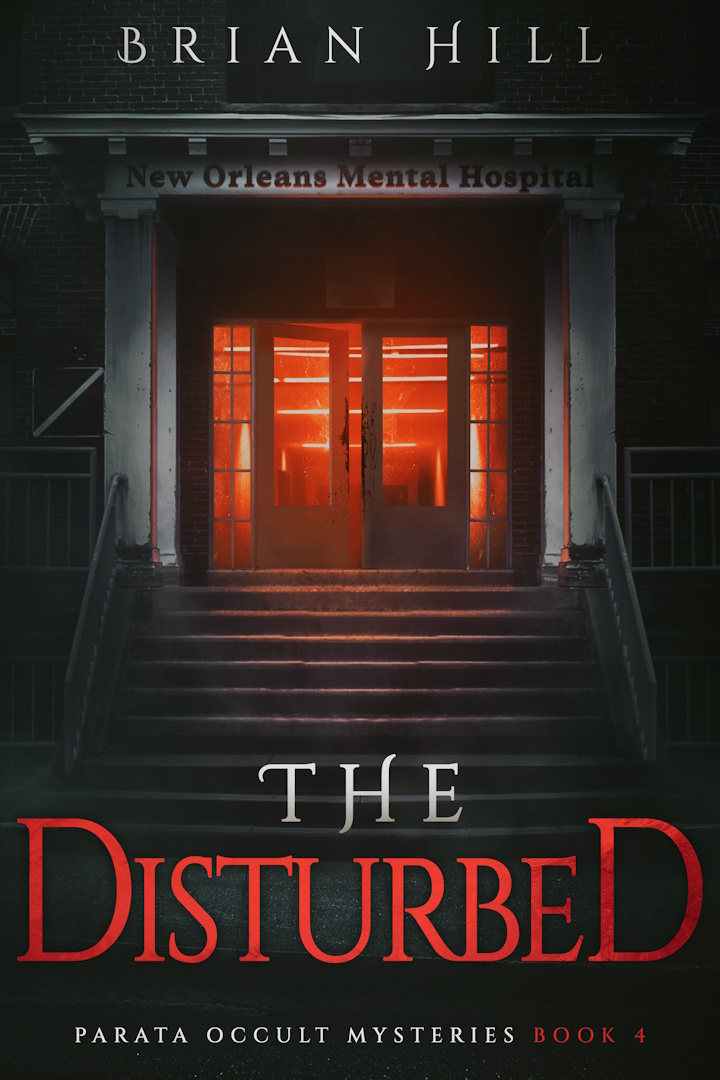
The Disturbed is the fourth Parata Occult Mystery, a tightly-wound urban-occult thriller set in New Orleans during Mardi Gras week, February 1985. Where the genre conventions of cosmic horror tend to live in remote villages, dusty libraries, or doomed scholar’s studios, this book plants its flag in police interview rooms, a derelict crack house in Marrero, a marine-hospital-turned-asylum on Tchoupitoulas, an Irish pub off Decatur, and the rain-warped wood of an abandoned Victorian deep in the Lacombe pinewoods. The detective work is mostly the unglamorous procedural kind — knocking on doors, reading splatter patterns, lifting names off business cards in dead men’s pockets — and the occult work mostly happens in the gaps between scenes, in dreams, in the subtle wrongness of a thing that should be inert but isn’t.
The book belongs to Rev Parata: ex-Vietnam recon, ex-NOPD detective, half-Chiricahua Apache, half-Maori (named earlier in the series; The Disturbed itself only refers to his father’s people as living “on the other side of the world”), mid-fifties, bourbon-pickled, bad knee, kept upright by a discipline most people would call grim and a few of his closer friends would call fatalism. He carries a snub-nosed five-shot Smith & Wesson Model 60 in a holster at the small of his back, a Seecamp LWS .32 on his ankle, and — by the end of the book — a sealed Egyptian canopic jar in a custom-tailored gabardine trench coat. His partner is Rae Gordon, dual-knife-fighter, ex-something-she-doesn’t-talk-about, and the closest thing he has to a moral compass after Father Kelly is murdered in chapter “Kelly.”
The book pivots on the canopic jar — already established in earlier Parata books as the surviving artifact from a 1912 Egyptian tomb — and on the creature called Burke, who is established as the antagonist of an earlier homeless-cannibal case. The Disturbed is the book where the jar stops being a McGuffin and starts behaving as a character; where Burke pays out the threat she made at the end of an earlier book (“I will hurt everyone you care about”); and where Rev crosses a line he doesn’t entirely come back from. The mythology — Nyarlathotep, the unspeakable language fragments, the cult of twelve, the “Great Mother” — is borrowed wholesale from the Lovecraft Mythos and rendered as an actual operating cosmology rather than a literary atmosphere.
Readers coming here from earlier books expecting more of the same investigator-vs-monster rhythm should be prepared for a structural shift: the monster dies at the center of the book, and the back half is a much darker story about what Rev does next. The casefile below is organized to help you map the moving parts.
Inventory
- The Jar — the onyx-and-precious-metal canopic jar of Hapi/Nephthys; the central artifact of the entire Parata series and the book’s animating object.
- Burke / the Great Mother — the antagonist creature; appears as a beautiful blonde millionaire, a junkie, Father Kelly, and impersonates Captain Freddy Guidry’s voice on the phone; her true form is something gorilla-loping with claws, gray boil-pocked skin, and feeding teeth.
- Whispers from the Nile: Nephren-Ka’s Legacy — the 1914 in-world tome that documents the tomb’s hieroglyphs and contains the binding ritual for the jar.
- The Order — the secret society Father Kelly belonged to and Fitzgerald is a member of; the Catholic-adjacent occult cabal opposing entities like Burke.
- The cult of twelve — the cabal of Burke worshippers who eat raw human liver in moonlit groves; one of them is Dr. Augustin Terry; another is a man called David Blake; the others are unidentified at book’s end.
- Father James Kelly — the murdered priest-psychologist-occult-investigator, Rev’s mentor and friend; killed in this book.
- The Sapphire pendant — the blue gem Rev recovers from Burke’s ash pile after the ant-swarm dissolves her, and later uses against Terry as proof Burke is mortal.
- Nephren-Ka tradition / Egyptian funerary cosmology — the four-canopic-jars system of Hapi, Imseti, Duamutef, and Qebehsenuef and their guardians, mapped onto the in-world hierarchy of powers.
- The unspeakable language — fragments of “Y’ goka ya Iiahe nyth’drn l’ Nyarlathotep llll syha’h” (the binding ritual) / “Goka kadishtuor l’ ymg’ nyth’drn” (Terry’s chant in the barn) / “Llll fahf s’uhn Y’ uaaah ahazath l’ nyth’drn” (the cult-of-twelve communion phrase) — the in-world ritual tongue.
- Nyarlathotep — the alien god whose sigil Burke leaves at her crime scenes; the entity the cultists serve.
- The investigator’s craft — Rev’s mix of scene reconstruction (blood-spatter analysis, defensive-wound reading, body-fall geometry), informant work (Freddy at NOPD, Red at the railyard, Jerry the tailor), and the more reluctant occult tools (dreams that show him the past or future, the jar’s pull, sleepwalking through a fated landscape).
- Cover-up infrastructure — Freddy Guidry as Rev’s badge-shaped firewall against the law; Fitzgerald and the Order as legal-and-political fixers; the willingness of the press and the police to let labels like “the Homeless Cannibal” (Burke’s prior case) and “the Bayou Butcher” (Devereaux’s separate gator-farm killings) stand as mundane explanations for things they can’t otherwise process.
- Locations and hidden geography — Saint Christina’s church/rectory, the Covington antique-book shop (Antebellum Books), the New Orleans Mental Hospital on Tchoupitoulas (a former marine hospital, per Freddy and Rev), Freddy’s house on Chippewa Street, the Marrero crack house on Urbandale, the alley off the McDonough industrial park, the swamp warehouse with its abattoir room, KAYREVLA — the abandoned Victorian in Lacombe — and Arúnsearc, Fitzgerald’s pub.
- Sanity and damage costs — Rev’s drinking; his Russian-roulette suicide ritual at The Court motel; Rae’s coma and brain injury and chronic post-injury migraines; little Jerome’s dissociative collapse; the jar’s slow corruption of whoever holds it.
- Mythos vocabulary — Nephren-Ka, Nyarlathotep, Cthulhu-adjacent terms; “the Great Mother”; “the Order”; “the cabal”; the symbol/sigil left by Burke; KAYREVLA (the haunted house’s name).
- Case history — the homeless cannibal case (Burke’s prior arc); Skelly’s Hole and the “ten-story monstrosity”; the tomb of Nephren-Ka discovered by Émile Durand in 1912; Calhoun and the bedroom upstairs at KAYREVLA; the Bayou Butcher / Victor Devereaux’s gator-farm killings.
- Period and setting texture — Mardi Gras 1985; rotary phones, payphones with dimes, bump keys, magnetic light bubbles for unmarked cruisers; pre-CCTV fly-by-night hardware stores; smoking indoors; Reagan-era NOPD; the Times-Picayune; The Court motel with sixties-psychedelic decor.
Cosmology
The Parata cosmology, as it appears in The Disturbed, is essentially the Lovecraft Mythos taken at face value and operated as a working metaphysics. The book does not invent a parallel system; it uses the existing one. The headline entity is Nyarlathotep, the Egyptian-flavored Outer God of the Mythos, whose sigil Burke leaves at her killings and to whom the cult of twelve is dedicated. Above the local creatures are gods; above those gods, Outer Gods; and Rev’s own interior reckoning while reading the binding ritual — that even the “ten-story monstrosity that had risen from the hole” at the climax of the previous book is merely “like a god” to entities like Burke, with Nyarlathotep ranking above all of them — articulates a hierarchy the books gesture at but never formally codify.
Within this framework the canopic jar is a power object whose origin maps onto a specific in-world myth: it is one of four jars from the tomb of Nephren-Ka, each protected in life by one of the four sons of Horus and in turn by a higher Egyptian deity. Hapi (the lung jar) is guarded by Nephthys, goddess of darkness, ritual, and magic — and the surviving jar, the one Rev carries, is hers. This is consistent with how the jar behaves: it deals in protection, in forbidden knowledge, in fated dreams.
The rules, as they emerge, are these. The jar can be bound to one person at a time, by life, via a ritual phrase from Whispers from the Nile invoking Nyarlathotep; once bound it offers protection — but the stories in the book suggest its bound owners always die in “freak accidents” eventually, and Rev’s reading of the lore in Whispers from the Nile leaves him with the unsettled thought that even death may not release a true binding. The jar chooses. Even without the ritual it will attach itself, as it does to Rev, who never says the binding phrase but is nevertheless protected — to the point that his suicide attempt with five .357 magnum hollowpoints fails because every cartridge silently turns into a dud. The jar corrupts. Kelly’s letter and Rev’s read of Fitzgerald confirm it: men of power lust for it, men of conscience are corrupted by their good intentions for it. Only Rev seems to resist the lust, possibly because he has already lost so much that he has nothing the jar can promise to give him back.
The cult-of-twelve ritual depicted in Rev’s prophetic dream — twelve hooded figures in a ring, a nude female sacrifice, a small bowl of burning herbs and a small bowl of raw liver, each cultist eating a strip of liver and reciting a phrase in the unspeakable tongue — is the Mythos consumption rite distilled. It echoes the Eucharist in inverted form: the body of the victim consumed by the worshippers, transferring vitality (and, presumably, divine attention) outward instead of inward.
Burke herself is one of these middling powers. She is immortal in the colloquial sense — Terry calls her “ancient, truly an immortal godde—” before the sentence is cut off — but she is not invulnerable. The jar kills her. She bleeds. Her bones can be touched into dust. What she had instead was very long survival, the ability to wear borrowed faces (an unnamed junkie, Father Kelly; she also impersonates Captain Freddy Guidry’s voice on the phone — even her own face, “Sarah Burke,” may be borrowed), and immense physical strength: she rips a man’s arm off cleanly at the shoulder, she severs a woman’s neck with a single drag-cut, she bashes Rae’s skull through a Mercedes dashboard with one swipe.
Crucially, the cosmology is not symmetric. The Order does not have access to anything as powerful as the jar; their assassins, drawn from former special-forces, are described as bodies on the heap. Justice, in this world, is something the protagonist will not get. As Fitzgerald puts it: “Justice? Nah. No such thing, Rev. You, as a former cop, ought to know that better than anyone.”
The investigator
Rev Parata is mid-fifties in 1985. Half Chiricahua Apache (mother’s people, White Mountain reservation, with a memory of his grandfather taking him to see Salt River Canyon as a small child) and half Maori (father’s people; The Disturbed alludes to them only as “on the other side of the world,” but earlier books — The Artifact Ch. “Initial Inquiries” and The Betrayed — name them outright). Vietnam recon — chose recon, by his own account, partially to avoid the stalking-while-being-stalked stress of being the prey rather than the predator. Former NOPD detective. Currently a private investigator with Rae Gordon under the firm name Parata and Gordon, with offices in Pensacola; he also keeps an apartment in Pensacola where he stores ordnance, and his Pensacola tailor (Jerry Whitmer of J. Whitmer and Sons, Fine Clothing on Palafox) is a longtime acquaintance who lives above his own shop. New Orleans is his beat by history and contacts, not residence.
He is a physically intimidating man — large enough to stop two NOPD detectives mid-stride when he stands up, large enough that Jerry the tailor needs custom dimensions for the trench coat. His knee is permanently injured, presumably from Vietnam; he works it loose like an arthritic mechanic with a balky carburetor. He hits the gym to stay capable, eats anything sweet that crosses his path, and metabolizes alcohol like a furnace.
His method is layered. The procedural layer is detailed — this book contains a sustained worked example of reading a knife murder in a kitchen (the body falls toward the dominant hand of the slasher; cabinets show a body-shaped gap of clean white where Jerome stood while arterial spray painted around him; the absence of crowbar divots on the shed door rules out the police as the source of the broken latch). The informant layer is Chandler-textbook: Freddy at NOPD, Red at the railyard, the Order via Fitzgerald, a willing tailor, a willing gun-shop owner who knows not to ask. The occult layer is reluctant. Rev does not embrace dreams or premonitions. He treats them as data, the way a cop treats an anonymous tip. He follows up on his dream of the alley because the geography is too specific to dismiss; he memorizes the cultists’ faces in the cult-of-twelve dream because the dream gave him the only target list he is going to get.
His code, before The Disturbed, was a working detective’s code: do the job, protect the innocent, don’t lie unless lying serves the job. By the end of the book that code is in pieces. He kidnaps a man, transports him in the trunk of his cruiser, and executes him by scaphism — which Rev frames in-text as a Roman method (he describes the Persians as having been outdone by the Romans on execution craft; historically the practice is attributed to the Persians and described by Plutarch in the Life of Artaxerxes II) — modified with corn syrup and a five-gallon container of spring water to extend the suffering. He returns three days later and shoots Terry once with a sawed-off shotgun, “for what it’s worth, I’m sorry,” and goes home. The book makes Rev sit with the fact that he is not so different from the monsters he has put away over the years; the catharsis of the murder does not lift his mood, only confirms what he is now able to do. Rae’s hospital monologue — overheard while she was supposedly comatose — pulls him back from the brink, but the book is clear: a line has been crossed, and the next case will start from the other side of it.
His tools, in addition to his weapons: a leather day bag of bump keys (lock-picking), a flashlight he can hold one-handed against the pistol grip in the Harries technique, a flask, a Vietnam-era M67 fragmentation grenade kept in an apartment storage chest in Pensacola, and — by book’s end — the gabardine trench coat with weighted custom pockets for shotgun, jar, buckshot, and slugs.
His relationships: Rae (his partner, the person he carries when she can’t walk, the person he kisses on the bruised forehead in the dark of a hospital room and tells he is not coming back); Father Kelly (mentor, friend, killed); Freddy Guidry (best friend at NOPD, killed by Burke’s rigged gas trap in his own kitchen; Rev opens the front door and triggers the flare); Janet and little Fred Guidry (Freddy’s wife and son, killed in the same blast; little Fred, who would wrap his arms around Rev’s knee and squeal “Rev!”, and whom Rev considers the closest thing he is ever likely to have to a son); Bernie (Kelly’s intellectually-disabled ward, now Fitzgerald’s gardener, still alive); Fitzgerald (Irish mob, Order member, cautious ally); Ian / Crew Cut (Fitzgerald’s enforcer); Jerry the tailor (Vietnam-vet sympathizer in Pensacola).
His accumulated damage at the close of this book: alcoholism (active, daily, a flask he keeps topping up); chronic guilt from Vietnam (the unnamed little girl he has been “haunted by for nearly twenty years”); fresh guilt from the entire homeless-cannibal arc and the pet-kid Marcus he failed; failed suicide attempts at The Court motel (one to five rounds in a five-shot J-frame Model 60, all duds, then a fresh speedloader of five also dud); the realization that the jar will not let him die; and the moral weight of having tortured Terry to death.
Case mechanics
A Parata case, in the shape this book gives it, follows a recognizable rhythm. A mundane hook arrives first: Freddy Guidry calls about a kid found at the scene of his parents’ murder. The hook is presented as a favor, leveraged on friendship — Freddy needs Rev because the kid won’t talk to anyone else. Rev shows up expecting to spend an hour, recognizes the case immediately as continuation of an old one (the wrong-kid: it’s Jerome, not Marcus, in the interrogation room), and is already neck-deep before the second cup of coffee.
The investigation proceeds through scenes, each titled with a single noun — Acquisition, Delivery, Freddy, Scene, Revelation, Explanations, Kelly, Jerome, Reexamination, Dream, Discovery, Body, Examination, Release, Railyard, House, Victim, Realization, Freddy’s, Bernie, Asylum — and each scene is dated and time-stamped to the minute. The pacing is procedural-horror: a forensic discovery, a follow-up at a peripheral location (the bookshop, the railyard, the crack house), a dream that re-routes the next morning, a check-in at a safe location (the church, the hospital), and back out again. The pattern is scene → revelation → realization → next location. The mood is always darker than the last scene.
The clientelle and inciting events in this book are nominally the Miller murders, but the real client is the priest (Kelly, indirectly) and the real case is Burke. The mystery the protagonist solves first — who killed the Millers — is a feint; the real engine is what is Burke now planning, and the real climax has nothing to do with whodunnit and everything to do with what price the protagonist pays.
Climaxes tend to land in physical confrontation in claustrophobic spaces. The asylum sequence (Floors 2, 3, 4) and the warehouse-meeting are this book’s two centerpieces. The asylum is a slow vertical ascent through escalating tiers of madness — second floor (mild but chronic), third floor (severe), fourth floor (violent, isolated) — with a single locked door at the top behind which something terrible has happened. The warehouse confrontation is the one Rev expects to die in; he carries the grenade with the explicit intent of dying with Burke. He doesn’t get to die. The jar acts in his place.
Who pays what price: in this book, almost everyone Rev cares about. Kelly is flayed and crucified to a chapel wall. Jerome is murdered with his head turned around. Freddy, Janet, and little Fred are blown apart by jerrycans tied to wire-bound chairs. Rae is bashed unconscious into a Mercedes dashboard. Bernie is the only one Rev cares about who survives intact — saved by Fitzgerald, redirected to garden duty. Rev himself pays in sanity, in alcoholism, in the planned execution of Terry, and in the recognition that the jar will not let him out.
The series rhythm also includes a structural feature: a coda after the climax. The book does not end at Burke’s death. It ends with Rev recruited (by his own pressure) into a new mission — hunting the eleven remaining cultists — and with Rae back in fighting shape, three months later, holding a stack of forty-two PI photos of David Blake candidates. The case ends; the war doesn’t.
Deep dives
The Jar
What it is in the story
The jar is a canopic jar from the tomb of the in-world Egyptian heretic-priest Nephren-Ka, recovered by the (in-world) French expedition led by Émile Durand in 1912 and described in the only book ever printed on the tomb’s contents, Whispers from the Nile: Nephren-Ka’s Legacy (1914, six hundred copies, two hundred extant). It is onyx-bodied, with streaks of silver and gold running through it, sealed by a small-pharaoh-headed lid (described as “the little pharaoh’s eyes judging me”) meant to represent one of the four sons of Horus. By process of elimination over Kelly’s deductions in the chapter “Delivery,” it is the lung jar, protected in life by Hapi (the baboon-headed son of Horus) and in turn by Nephthys, goddess of darkness, ritual, and magic. Of the four jars from this tomb, this is the most powerful.
In The Disturbed the jar does several things. It produces prophetic dreams in the holder (Rev dreams the alley where the homeless victim’s body lies, then walks to the alley and finds it the next morning; he dreams the cult-of-twelve liver feast and wakes with the cultists’ faces memorized). It generates a swarm of millions of black ants — the chitinous insects we will return to — which devour Burke alive in seconds, leaving a pile of bones that crumbles to dust at a touch. It silently neutralizes lethal threats to its possessor: on the fifth night of his Russian-roulette ritual all five .357 magnum hollow-point cartridges loaded in his Model 60 are rendered duds, and the fresh speedloader of five replacement cartridges fares the same — ten rounds, ten dimpled primers, no ignition. It seems to want Rev. Whether this is cause or effect — was he chosen, or did proximity bind him? — the book does not commit either way.
The jar can also be bound by deliberate ritual, using the unspeakable language phrase from Whispers from the Nile: “Y’ goka ya Iiahe nyth’drn l’ Nyarlathotep llll syha’h.” Rev considered the binding, decided against it, and was bound by the jar anyway. Once bound, by the lore Kelly summarized for him, the binding lasts until death, possibly past it.
Real-world antecedents
Several. The canopic jars themselves are real Egyptian funerary objects, one for each of four organs (liver, stomach, intestines, lungs) protected by the four sons of Horus (Imseti, Duamutef, Qebehsenuef, Hapi) and in turn by four goddesses (Isis, Neith, Serket, Nephthys). Kelly’s recitation of these correspondences in chapter “Delivery” is accurate to actual Egyptian funerary religion. The book preserves this perfectly.
Nephren-Ka is not historical Egyptian — he is an invention of H.P. Lovecraft, the Black Pharaoh of the Mythos, first appearing in “The Outsider and Others” / “The Haunter of the Dark” (1936), serving Nyarlathotep. The tomb-discovered-in-1912, expedition-leader-died-mysteriously plot device echoes the mythology around the 1922 Tutankhamun “curse” — the so-called Curse of the Pharaohs — and is exactly the genre furniture of late-Victorian and early-twentieth-century weird fiction: Sax Rohmer, Bram Stoker’s The Jewel of Seven Stars (1903), Conan Doyle’s “Lot No. 249.”
The bound-artifact-that-uses-its-bearer trope is older than horror fiction: the cursed-treasure cycle in folklore (the Nibelung gold, the Hope Diamond), the Tolkien Ring, the Krzyz of various medieval Christian relics. The specific notion that the artifact selects its own bearer and refuses to be discarded is closer to M.R. James’s “Casting the Runes” than to anything in the Lovecraft canon, which tends to treat its artifacts as inert dangers rather than willful agents.
What’s invented
The specific identification with the lung jar of Hapi/Nephthys is the book’s structuring choice; there is no real-world canopic-jar-of-power tradition. The black-ant swarm as a defense mechanism is original — it nods to the Egyptian scarab cult (insects as agents of the divine), but the specific image is unique to this series. The phrase “Y’ goka ya Iiahe nyth’drn l’ Nyarlathotep llll syha’h” is constructed in the manner of Lovecraft’s Aklo — using the Mythos name Nyarlathotep correctly, with surrounding syllables that follow invented phonotactics rather than any real ritual language.
Why it matters in-universe
The jar is the engine of the entire Parata series. It is what Burke wanted from the previous book, what Kelly was secretly studying when he was killed, what Fitzgerald and the Order want now, what Rev cannot escape, and what makes Rev — for the foreseeable future — unkillable. It also corrupts. Kelly’s posthumous letter is explicit on this point: men of power and men of good intention alike are corrupted by it; only Rev seems immune; even he may be corrupted in ways he hasn’t noticed. The chapter “Understanding,” in which Fitzgerald sees the jar and admits its pull, confirms the corruption.
Connections and cross-references
Forward into future books, the jar’s protection of Rev sets up an obvious dramatic problem: if he can’t die, what is the source of tension in the next mystery? Kelly’s letter offers one answer (the jar can be lost, perhaps in a deep-sea expedition or unmapped cave); Fitzgerald’s offer (the Order will look into “dampening” it) is another. Backward, the jar is the throughline that connects the homeless-cannibal arc, Skelly’s Hole, Nephren-Ka’s tomb in 1912, and now the cult of twelve.
Burke / the Great Mother
What it is in the story
Burke appears, by the time of The Disturbed, as a ghost-presence: the antagonist of the previous case is still loose in the city, hunted but uncaught. She is the creature that opened the back of Marcus Miller’s shed, slit Ms. Miller’s throat from the bar-counter, gutted Mr. Miller and watched him bleed out, ripped a homeless man’s arm off in an alley off the McDonough industrial park, posed as a junkie on a crack-house couch in Marrero, posed as Father Kelly to bash Rae’s head into Terry’s Mercedes dashboard, posed as Freddy on the phone, and rigged the jerrycan trap in Freddy’s kitchen.
Her true form, glimpsed in moonlight in chapter “Encounter” and again in chapter “Meeting”: gorilla-loping, palms-and-feet locomotion, mottled gray skin festooned with boils, huge blue eyes with impossibly wide pupils that reflect red, long canine-snouted face, multiple inward-curving rows of teeth, claws large enough to palm Rae’s head like a tangerine. She is described as “ancient” by Terry, as the “Great Mother” by her cult.
She dies in chapter “Meeting” when Rev brings her the jar as a deal to free Freddy and the family. She breaks the lid off, accepts the jar with a lustful grin, and is engulfed from the elbow up by a swarm of ants that pour from the open jar and devour her in seconds. Her bones are vaguely ape-like but alien; touched, they crumble to dust. Her blue sapphire pendant remains; Rev pockets it and uses it weeks later as proof to Terry that “the Great Mother” is mortal after all.
Real-world antecedents
Burke is built from at least three traditions. The first is the shapeshifter of folklore: the Scottish baobhan-sith, the Slavic vila, the Russian Baba Yaga; predators who wear human shape to lure prey. The second is the Lovecraftian human-passing avatar: Asenath Waite of “The Thing on the Doorstep” (a body-jumper hiding her true form), the Innsmouth hybrids, the various human-faced vessels of Nyarlathotep himself, who appears as “the Black Man” in “The Dreams in the Witch House” and as Nyarlathotep proper in his own prose poem. The third is the noir-genre serial killer escalating to taunt the detective, a pure-noir character template — Hannibal Lecter is the post-war canonical example, and the homeless-cannibal flavor (the “Burke” name itself nods to the historical Edinburgh body-snatchers Burke and Hare) reaches back to Victorian penny-dreadful sensationalism.
Specifically, “the Great Mother” is a real religious-studies term: the prehistoric mother-goddess archetype proposed by Marija Gimbutas and others, surviving in figures from Cybele to Kali to the chthonic Demeter. The book uses the term to position Burke’s cult in this archetypal slot — a primordial maternal predator-goddess, devouring her own offspring, fed by raw human flesh.
What’s invented
Burke’s specific physiology — gorilla-locomotion, multiple rows of curving teeth, gray boil-pocked skin — is original to the series. Her relationship to Nyarlathotep (worshipped by his cult) makes her one of his lesser servitors in the Mythos hierarchy, which is a structurally Lovecraftian move but not a specific borrowing from any one Lovecraft story. The ant-devouring death is unique to this book.
Why it matters in-universe
Burke is the engine of the entire pre-jar arc. Her threat — “I will hurt everyone you care about” — is paid off in The Disturbed in full, almost ruthlessly. Even after she is dead, her trap kills Freddy and his family. The book is structured so that her death is not the climax; it is the event that sets up the real climax (Freddy’s house) and the long aftermath (Rev’s suicide attempts and the hunt for the cult).
Connections and cross-references
Forward, Burke’s death does not end the cult. Eleven members remain at book’s end; Terry is killed (executed) in this book; David Blake is the next named target. The pattern is clear: future books will work down the list of twelve. Backward, every face Burke ever wore — the millionaire, the priest, the captain — leaves an unanswered question for the reader: how many other people in Rev’s life over the years were Burke at some point, and he never knew?
Whispers from the Nile: Nephren-Ka’s Legacy
What it is in the story
The 1914 hand-bound book Rev and Rae buy at Antebellum Books in Covington at the start of The Disturbed — a black-cloth-bound first edition, one of six hundred printed, copyright 1914, no author named, documenting the hieroglyphs from the 1912 expedition into Nephren-Ka’s tomb. The author was suppressed because the discoverer (Émile Durand) and his expedition’s notes had already met “tragic circumstances” — anyone publishing under their own name, even a pseudonym, would be the next victim. Kelly studies the book; his marginalia in a spiral notebook turn out to contain the binding ritual phrase for the jar. After Kelly’s death Rev recovers the book from the church safe.
Real-world antecedents
This is a textbook example of the Lovecraftian forbidden grimoire trope. The Necronomicon (invented by Lovecraft, mythologized by his correspondents Clark Ashton Smith, Robert E. Howard, and August Derleth) is the canonical model: a privately-printed, suppressed-edition occult text, very few extant copies, dangerous to read and more dangerous to copy. Real-world precedents that grimoire fiction draws on include the Picatrix (Latin translation 1256, Arabic original 10th–11th c.), the Lesser Key of Solomon / Lemegeton (17th c.), the Sworn Book of Honorius (medieval), and the Greater Key of Solomon (medieval-Renaissance) — all real grimoires with restricted-circulation reputations and complicated transmission histories.
The “discoverer dies before publication” framing has a real-world echo in the curse mythology around Lord Carnarvon’s death after opening Tutankhamun’s tomb (1923); the “expedition notes go missing” framing is a classic of Victorian-Edwardian weird fiction.
What’s invented
The book itself is fictional, in the genre of fictional-grimoires-named-and-described. Nephren-Ka is Lovecraft’s invention, not Egyptian history; he never existed as a historical heretic-priest. The 1912 Durand expedition is fictional. The specific binding-ritual content is invented for the book.
Why it matters in-universe
The book is the bridge between the artifact and operations on the artifact: without the book, the jar is just a power-radiating object. With the book, you can do things to it (bind it, theoretically un-bind it, possibly destroy it). Kelly’s notebook of marginalia is therefore a McGuffin Rev must keep — and indeed grabs from the desk along with the jar.
Connections and cross-references
The book has three other jars’ worth of unread content: rituals for the liver-jar, the stomach-jar, the intestine-jar, each presumably with different cosmological correspondences. If those jars also exist somewhere in the world, future Parata books have a built-in plot engine.
The Order
What it is in the story
A secret society dedicated to opposing entities like Burke. Father Kelly was a member; Fitzgerald is a member; the grandmaster is unknown. The Order operates with strict compartmentalization — each member knows only the small handful of other members necessary to do their assigned work, so no one captured or insane member can compromise more than a handful of others. Their resources include money (high-end criminal defense lawyer Robinson Parks of Parks, Mason, and LeBlanc — the lawyer who walks Rev out of NOPD interrogation — is in their employ), kill teams of former special-forces operators who can be sent after entities like Burke, sketch artists, photographers, public-records analysts (the forty-two-PI photo array on David Blake), and apparently considerable institutional reach in the Catholic Church (Kelly’s status as priest-psychologist trained at Oxford under Dr. Claridge).
The Order’s stated purpose, as Fitzgerald frames it: “to stop creatures like Burke, but I dare say we aren’t terribly effective at it. We do what we can, though, to keep the darkness at bay.” The Order does not deal in justice; Fitzgerald is explicit. They deal in containment.
Real-world antecedents
The Order is built from at least three real-world traditions. The first is the Catholic anti-occult hierarchy — exorcists, the historical Inquisition’s oversight of witchcraft, and the modern Vatican-sanctioned International Association of Exorcists (founded 1990, but whose existence and structure was open conjecture decades earlier). The second is the secret-society templates of the Knights Templar, the Knights Hospitaller, the Society of Jesus (the Jesuits’ compartmentalized intelligence reputation in the 17th–19th centuries was real and fed conspiracy fiction for centuries), and the Opus Dei. The third is the fictional hunters’ organization template of pulp horror: Bram Stoker’s loose Crew of Light in Dracula, the Watchers’ Council in Buffy, the Brotherhood of the Wolf in folklore-thriller cinema.
The compartmentalization principle Fitzgerald describes is real intelligence-tradecraft (cellular structure, “need-to-know”) and predates the modern era; it appears in the Carbonari, in the IRA’s own Active Service Units (consistent with Fitzgerald’s IRA background), and across the spectrum of clandestine organizations.
What’s invented
The Order itself is fictional, but built from real institutional patterns. The specific link to the IRA via Fitzgerald and Crew Cut (Ian, with the “tiocfaidh ár lá” — “our day will come” — Gaelic IRA slogan tattooed on his neck) is original to the series, and suggests that the Order’s network draws from groups already practiced in operating outside the law.
Why it matters in-universe
The Order is what stands between Rev and the consequences of his more felonious decisions — without Robinson Parks, Rev would have spent the night of February 16 in a cell on a grand-theft-auto charge, missing his deadline with Burke. The Order is also what Rev coerces, in the chapter “Purpose,” into pointing him at the eleven remaining cultists. The Order’s failure to be effective is what makes Rev’s vigilantism morally available.
Connections and cross-references
Fitzgerald’s promise to “talk to the Order, see what can be done to dampen” the jar’s effects is an open thread. The Order’s grandmaster is unidentified. The Order’s relationship to the cult of twelve — they are functional opposites but operate in the same dimensional layer — implies future inter-organizational conflict.
The cult of twelve
What it is in the story
A cabal of twelve worshippers of Burke / the “Great Mother” / Nyarlathotep. They take a vow of secrecy that prohibits them from knowing each other’s identities (Terry insists he knows only David Blake’s name, and only because Blake violated the vow with his own narcissism). They meet in remote groves (the cult-of-twelve dream Rev experiences shows them in a clearing in moonlit woods, surrounded by trees, with Burke as the celebrant in white robes). They eat raw human liver as a Eucharistic ritual. They wear black hooded robes with the sigil of Nyarlathotep on the back.
Real-world antecedents
The structural model is the Black Mass as imagined in late-Victorian and Edwardian occult fiction (J.K. Huysmans’s Là-Bas, 1891, is the canonical literary source); the inverted-Eucharist-with-human-flesh trope is older still, going back to the medieval blood-libel slanders against Jews and the early-modern witch-trial confessions extracted under torture (where supposed witches confessed to eating babies in inverted-Mass settings). The twelve-member coven is a folkloric number drawn from inverted-apostolic symbolism; the historical reality of European witch-cults is contested (Margaret Murray’s “witch-cult hypothesis” of 1921 has been largely debunked by modern historians), but the fictional twelve-coven is well-established.
The eating of raw organs as a power-transfer ritual is an actual ethnographic motif — in some cultures (the Aghori sect of Kapalika Hindu tantra, certain South Pacific traditions), consumption of human flesh by initiates is real religious practice, though far less Black-Mass-shaped than fiction depicts.
What’s invented
The specific cabal-of-twelve serving Burke, with Terry as a member and Blake as another, is original to the series. The unspeakable language fragment Terry chants (“Llll fahf s’uhn Y’ uaaah ahazath l’ nyth’drn”) is constructed in Mythos style.
Why it matters in-universe
The cult is the back-half engine of the entire remaining series. With Burke dead, the cult is what Rev is going to hunt, one member at a time, from book to book. The book ends with three plausible candidates for David Blake; the next case begins with that file.
Father James Kelly
What it is in the story
Irish Catholic priest at Saint Christina’s, New Orleans. Trained in psychology at Oxford under Dr. Claridge, ten years before the events of the book. Member of the Order. Mentor to Bernie (the intellectually-disabled ward who lives in the rectory). Friend, partner, and in some sense conscience to Rev. Killed in chapter “Kelly” — flayed, his skin “peeled back like an orange,” and crucified with railroad spikes through his wrists to the chapel wall in the New Orleans Mental Hospital’s treatment-center chapel. His clerical collar lies in a pile of his black clothes beside the body.
His posthumous letter, retrieved from Hibernia Bank Box 10407 with a key Fitzgerald passes Rev in the back of a Mercedes, is the most important single document in the book. It tells Rev: keep the jar, you alone can resist it, the Order cannot be trusted with it; if your will ever fails, find a way to be lost with it (a deep cave, a deep-sea expedition); there are worse things than dying.
Real-world antecedents
Kelly is a synthesis of two well-established figures. The first is the Catholic priest as occult investigator — the Father Brown stories (G.K. Chesterton, 1910 onward), the Vatican exorcist tradition, the late-twentieth-century cinematic Father Karras of The Exorcist (William Peter Blatty, 1971), and the priestly-investigator subgenre that runs from Susan Howatch through Andrew Greeley. The second is the Oxford-trained gentleman-occultist, a Victorian and Edwardian type — M.R. James himself was a Cambridge medievalist who wrote ghost stories on the side; the figure of the academic priest-scholar with one foot in scholarship and one in the supernatural is a long-standing fictional archetype.
Kelly’s death — flayed and crucified — invokes the martyrdom of Saint Bartholomew (traditionally flayed alive, depicted in Michelangelo’s Last Judgment holding his own skin) and the universal Christian iconography of crucifixion. The combination — flaying plus crucifixion — reads as a staged martyrdom, presenting Burke’s killing as a desecration of the priest.
What’s invented
Dr. Claridge of Oxford is fictional; the specific Order Kelly belongs to is fictional. The Saint Christina’s parish in New Orleans — author’s invention.
Why it matters in-universe
Kelly is the moral center of the protagonist’s emotional landscape. His death is the wound that drives the back half of the book. His letter is the operating manual for the jar going forward and also the source of Rev’s eventual escape valve (be lost with it). His prior conversations about the jar — the Egyptian funerary correspondences — are also the only systematic occult exposition the book provides.
The investigator’s craft
What it is in the story
Rev’s investigative method, in this book, is the most visible procedural in the series so far. Three substantial scenes are essentially detective-work tutorials: the kitchen reconstruction at the Miller house (chapter “Revelation”); the alley examination of the homeless victim (chapter “Body” / “Examination”); and the crack-house search (chapters “House” / “Victim” / “Realization”). Each follows the same logic: physical observation, hypothesis, prediction, second-pass confirmation.
The set pieces of his craft worth noting: blood-spatter pattern reading (the clean spot on the cabinets that maps to Jerome’s silhouette), arterial-spray geometry (which way the body falls under a single carotid slice, given the friction of a dull blade pulling the body in the cutter’s slicing direction — Rev’s stated rule in the kitchen reconstruction is: a right-handed killer cutting left-to-right pulls the body to the right; a left-handed killer cutting right-to-left would pull it left), defensive-wound analysis (no wounds on Ms. Miller’s hands or forearms means she didn’t see the attack coming, which means she trusted whoever was behind her with the knife — therefore the killer was someone close enough to her or short enough to have struck from atop the bar), lock-and-latch forensics (the absence of crowbar divots on the shed door means the latch was torn off by hand, ruling out the police), estimating time of death by smell intensity, estimating cause of death from the structure of the wound (the difference between an intestine that fell out and an intestine that was pulled), and comparing weapon marks to known weapons (the chef’s knife’s Japanese kanji match Burke’s known knives from the previous case, serialized special-orders from Japan).
The occult layer of the craft is the prophetic dream, used twice. The first dream sends him to the alley where the homeless victim’s body is. The second dream sends him into the past to witness the cult-of-twelve liver-feast. He treats both as data, follows up procedurally, confirms what he can.
The third layer is the interrogation by leverage — the chapter “Interrogation” (poking Terry’s broken ribs to extract names), and later the chapter “Scaphism” (much darker leverage). The book is honest that these are not detective-work but torture, and that they yield only one usable name (David Blake).
Real-world antecedents
Blood-spatter analysis is a real and contested forensic specialty (see the work of MacDonell and Bevel; the field is now scrutinized for the same kinds of overclaiming that bedevil bite-mark and hair-comparison evidence). The procedural reconstruction Rev performs is essentially the same logic the FBI’s Behavioral Analysis Unit refined in the 1970s and 1980s — close-reading a scene to back-derive offender characteristics.
The noir detective monologue Rev runs internally is direct Chandler / Hammett / Macdonald tradition: Marlowe in the Sternwood greenhouse in The Big Sleep (Chandler, 1939), the Continental Op in any Hammett story, Lew Archer’s case-by-case forensic carefulness in Ross Macdonald.
The dream-as-investigative-data trope is older — used by Sherlock Holmes (rarely), by the Father Brown stories (as intuition rather than dream), and most thoroughly in the modern occult-detective subgenre (Jim Butcher’s Harry Dresden, Charlaine Harris’s various series).
What’s invented
The specific reading of the dull-knife slice as a body-direction predictor is plausible biomechanics, but the exact precision Rev claims is detective-fiction-grade certainty rather than peer-reviewed forensic science.
Why it matters in-universe
The procedural work makes the occult parts feel earned. Rev never invokes the supernatural to solve a problem the procedural work can solve. He uses the dream only when the procedural work has run out — which is also when the reader is most willing to accept the supernatural.
Cover-up infrastructure
What it is in the story
The book pays close attention to how mortals deal with occult events they can’t admit to. Freddy Guidry, NOPD captain, is Rev’s primary firewall: he calls Rev in on cases, accepts implausible explanations to close cases (the medical examiner’s report rules out little Marcus as the slasher because no eight-year-old has the strength; the file is closed; Burke as the actual killer is never written down), and books illegally-obtained evidence into the official chain of custody when needed (the business card Rev took off the alley body). Freddy’s death removes this firewall. Toupee and Mr. Clean (Detectives Hines and Cohen) are not Freddy and they don’t trust Rev; the back half of the book treats their presence as ongoing legal pressure.
Fitzgerald and the Order are the second cover-up layer. Robinson Parks, the high-end criminal defense lawyer, materializes in Rev’s interview room in the chapter “Council” with the fee taken care of and sufficient confidence in his own competence to walk Rev out within the hour. The Order also funds Rae’s hospital care.
The third layer is the institutional willingness not to look too closely. The press accepts “the Homeless Cannibal” as the mundane label for Burke’s prior arc, and “the Bayou Butcher” as a separate label for Devereaux’s gator-farm killings — two cases the public never connects. The asylum administration is content to attribute Devereaux’s escape and the murder of Kelly to Devereaux himself, and Terry’s complicity is — initially — not visible to detectives. The medical examiner does not test for whatever it is that gives Burke superhuman strength.
Real-world antecedents
This is the standard mechanism by which occult-investigator fiction handles the “why hasn’t this hit the front page” question. Lovecraft’s stories explicitly invoke it (“the most merciful thing in the world… is the inability of the human mind to correlate all its contents”); X-Files-era fiction systematizes it. The procedural-cop-as-firewall motif has a Chandler ancestor (Bernie Ohls, Marlowe’s friend on the DA’s staff, in The Big Sleep); Harry Bosch and Jerry Edgar at LAPD are the modern continuation.
What’s invented
The specific Order/Catholic-Church/IRA blend is original to the series. The structure is borrowed; the personnel are new.
Why it matters in-universe
The cover-up infrastructure determines what kinds of crimes Rev can commit and not be caught for. With Freddy alive, he can drive a body around in his trunk and survive it. With Freddy dead, every interaction with NOPD is hostile and the Order becomes the only protective layer. This restructures what the next book’s Rev can plausibly do.
Locations and hidden geography
KAYREVLA — the Lacombe Victorian
The big abandoned Victorian house in the woods outside Lacombe, Louisiana. Rev visited it in the previous case (the Calhoun bedroom, with horrific mushrooms growing under the comforter in the room where a boy had bled out — Rev does not pull the comforter back). It is gated, chained, fountainable, ornate, and “the photo negative of what it should be” — every cheery quality inverted into menace. Its name, KAYREVLA, is rendered in all caps and never explained in this book; it appears to be a proper noun for the property (an estate name, a creole transliteration, or an occult designation carried forward from book one, where the place is established with the same spelling). (Note: the pre-editor copy of The Disturbed used to generate this casefile drops the V in the chapter title for the return-to-the-Victorian sequence — “KAYRELA” — but the body text of the same chapter, the rest of the book, and book one all consistently spell the place KAYREVLA. The chapter-title spelling is a manuscript-stage typo and has been corrected in the published edition; treat KAYREVLA as canonical.)
In The Disturbed, Rev uses it as the execution site for Terry. He chooses it because it is remote, it has no plumbing or wiring he needs to disable, it has frosted-glass windows that admit insects, and it is already associated with horrors that any future investigator will read as ambient background rather than fresh evidence. He covers his tracks with a hairnet, oversized boots, and a clean change of clothes; he chains the gate back with the original rusted padlock to suggest no entry; he disposes of the trash bag of evidence in a Slidell Kmart dumpster; he buys a matched set of used tires (slightly larger than his Caprice’s stock size, on rims identical to the originals) at a junkyard to defeat tire-print evidence, and stashes the old wheels under brush down a dirt road in the swamp.
The house works as a location because it carries the weight of the previous book without on-page summary. It is a site of accumulated narrative dread.
The New Orleans Mental Hospital
Located on Tchoupitoulas Street, in a former marine hospital — this is a real place: the U.S. Marine Hospital at New Orleans, built in 1933, used for various medical and institutional purposes in subsequent decades. The book’s repurposing as an asylum is fictional but plausible. The four-story layout, the courtyard with the Jackson Treatment Center, the locked fourth floor reserved for violent patients (Victor Devereaux, the Bayou Butcher), the magnetically-locked doors that fail open when the power is cut — all of this is the standard architecture of the deinstitutionalization-era American state asylum, of which Louisiana had several in the 1980s.
The asylum sequence — Rev, Rae, and Terry climbing the stairwell from floor to floor as the patients become more disturbed — is the book’s most direct horror set-piece, a vertical pilgrimage through American madness.
The Marrero crack house
Urbandale Street, Marrero, Louisiana. A two-story shotgun house, condemned by the city’s Bureau of Code Enforcement, occupied by addicts. The scene of the unconscious junkie on the couch — who turns out to have been Burke in disguise — is one of the book’s misdirection setpieces. The crack house is also the location of the second Burke victim (a man with both legs amputated at the knee, syringe jammed into his carotid, decomposed for at least a month).
Freddy’s house on Chippewa Street
The site of the book’s emotional climax. The trap Burke leaves there — a flare on the back of the front door, a strip of sandpaper on a foyer table, a gasoline trail soaked into the carpet leading to three jerrycans tied to the kitchen table where Freddy, Janet, and little Fred sit gagged — is a piece of Vietnam-vet sapper craft (Rev recognizes it instantly from booby-trap experience). It is a compact betrayal-by-rushed-rescue setup.
Arúnsearc
Fitzgerald’s pub. Arúnsearc is Irish for “secret love” or “covert affection” — an apt name for a meeting place where a mob boss confers with an Order member about a Catholic-Egyptian-Lovecraftian artifact. The pub is the recurring meeting point with Fitzgerald and Crew Cut.
Psychological and sanity costs
Rev’s drinking and Russian-roulette ritual
Rev’s alcoholism is depicted as a working alcoholism — he is functional, he is a “professional” who “goes to meetings and everything,” and he is also progressively destroying himself. The book traces the descent: the morning bourbon (“I drove like a complete asshole to the hospital”), the daily flask refills, the multiple empty handles of whiskey on the nightstand at The Court motel, the spiked coffee at Rae’s bedside.
The Russian-roulette sequence (chapters “The Court” and “Awakening”) is the book’s longest sustained scene of self-harm. Rev decides to “let the universe decide my fate” — one cartridge in a five-shot revolver night one, then one additional cartridge each night, until on the fifth night the cylinder is full. Each night the gun fails to fire. On night five, with all five chambers loaded and the certainty of death, every cartridge silently turns into a dud. When he reloads with a fresh speedloader, those rounds also dud out. The blasting caps are dimpled but the propellant fails. The jar is intervening to keep him alive.
The ritual is the literalization of the noir-detective death-wish. Marlowe and Spade flirt with self-destruction at the level of taunting the wrong people; Rev moves the ritual into the literal-suicide register and finds out his death is not his own to give.
Real-world antecedents
The detective-as-functional-alcoholic is a noir staple — Marlowe drinks; Spade drinks; Lew Archer drinks more carefully; Matthew Scudder (Lawrence Block) is the canonical recovering-alcoholic-detective. Rev fits in this tradition without ironizing it.
The Russian-roulette imagery has its own horror lineage: The Deer Hunter (1978) made it the iconic American Vietnam image; the actual practice as a duel form is older and reasonably well-attested in Russian military folklore. Rev’s variant — adding cartridges over multiple nights — is original to the book and, this casefile believes, original in fiction.
What’s invented
The specific accumulating-cartridges ritual; the specific way the jar intervenes (silent dud-cartridges, no metaphysical pyrotechnics).
Why it matters in-universe
This sequence settles the book’s central question about the jar: it has its own purposes, it does not consult the bearer, and the bearer is not free to refuse. Rev’s autonomy is gone. His remaining choices are: serve the jar’s purposes, or find a way to be lost with it. Kelly’s letter framed this in advance; the suicide ritual confirms it.
Mythos vocabulary
The proper-noun layer the book uses, with quick gloss: Nyarlathotep (the Outer God served by Burke’s cult, drawn directly from Lovecraft, where he is the “Crawling Chaos,” the messenger of the Outer Gods, a thousand-formed avatar of the alien); Nephren-Ka (the Black Pharaoh, also Lovecraft’s, originally from “The Outsider and Others”); Hapi / Imseti / Duamutef / Qebehsenuef (the four sons of Horus, real Egyptian); Nephthys / Isis / Neith / Serket (the four protective goddesses, real Egyptian); the Great Mother (the cult’s title for Burke); the Order (the in-world Catholic-adjacent cabal); KAYREVLA (the proper name of the Lacombe Victorian — meaning unspecified); the unspeakable language phrases (“Y’ goka ya Iiahe nyth’drn l’ Nyarlathotep llll syha’h” — the binding ritual; “Goka kadishtuor l’ ymg’ nyth’drn” — Terry’s chant; “Llll fahf s’uhn Y’ uaaah ahazath l’ nyth’drn” — the cult-of-twelve communion phrase).
The phrases are constructed in the manner of Lovecraft’s Aklo / R’lyehian — heavy on apostrophes, glottal stops, repeated consonants — without being identical to any real Mythos text. They are designed to be unpronounceable.
Wait, that’s real?
- The four canopic jars and their guardians — Hapi, Imseti, Duamutef, Qebehsenuef as the four sons of Horus, each protecting a specific organ; Isis, Neith, Serket, Nephthys as the four guardian goddesses. This is straight out of Egyptian funerary practice as documented in the Pyramid Texts and the Book of the Dead.
- The structure of the Black Mass / inverted Eucharist — the ritual of consuming flesh as a power-transfer act, with twelve participants and a celebrant, draws on real medieval and early-modern accusations against suspected witch covens (largely propaganda, but propaganda with a real literary tradition).
- The Persian / Roman execution method “scaphism” — also called “the boats.” Plutarch describes it in his life of Artaxerxes II (4th century BCE), as the death inflicted on Mithridates the soldier who killed Cyrus the Younger at the battle of Cunaxa. The historical method involved milk and honey, force-feeding, and the slow death by infestation and bacterial decay Rev describes. (The exact historicity is contested by some classicists, but the method is at least as old as Plutarch’s description of it.)
- Compartmentalization in clandestine organizations — the cellular structure Fitzgerald describes is real intelligence tradecraft, used by the IRA’s Active Service Units (consistent with Fitzgerald’s background) and historically by the Carbonari and many resistance groups.
- The tomb-curse / dead-discoverer trope around Egyptian expeditions — not Egyptian belief, but a real cultural panic in the 1920s following Lord Carnarvon’s death after Tutankhamun’s tomb opened in 1922; Doyle and others wrote essays defending the curse as plausible.
- The U.S. Marine Hospital on Tchoupitoulas — there really was such a hospital in New Orleans, repurposed at various times. The book’s “New Orleans Mental Hospital” in the same building is fictional but the real building’s history makes the choice plausible.
- Honey’s antibacterial properties — Rev mentions, correctly, that honey is naturally antibacterial; this is real, well-documented food science (low water activity, hydrogen peroxide release on dilution, low pH). His substitution of corn syrup is accurate from a microbiological standpoint.
- The Sleeper / blood choke — Rev applies a vascular choke (compressing the carotid arteries, not the trachea) on Terry. The distinction is real and important: a blood choke produces unconsciousness in seconds with low risk of permanent injury; an air choke takes longer and risks crushing the trachea. Rev’s description is correct.
- The Harries technique — a real two-handed flashlight-and-firearm grip taught widely in police and military training, named for Michael Harries who developed it in the 1970s.
- “Tiocfaidh ár lá” — real IRA slogan, Irish Gaelic for “our day will come.” Crew Cut’s neck tattoo is genuine subcultural marking.
Wait, that’s not?
- Nyarlathotep and Nephren-Ka — both invented by H.P. Lovecraft, not Egyptian historical figures or deities. Real Egyptian religion does not include either.
- Whispers from the Nile: Nephren-Ka’s Legacy — fictional book. There is no 1914 hand-bound first edition with these specifications; the Émile Durand 1912 expedition is invented.
- The Order — fictional Catholic-adjacent secret society. Real Vatican-affiliated occult-investigation structures exist (the International Association of Exorcists is real, founded 1990) but the in-book Order is invented.
- The cult of twelve — fictional cabal. The “twelve as inverted apostles” is a literary motif, not a documented historical witch-coven structure.
- The unspeakable language fragments — constructed for the book in Mythos style. Not real Aklo (which is itself fictional), not real R’lyehian (also fictional), not derived from any real-world ritual language.
- Burke’s specific physiology — gorilla-locomotion, multiple rows of inward-curving teeth, gray boil-pocked skin, eyes that reflect red — this is an original creature design, not a folkloric or mythological figure.
- Ant-swarm devourment as a canopic jar’s defensive mechanism — pure invention, though it draws on the Egyptian iconographic association of insects (scarabs especially) with divine agents.
- KAYREVLA — fictional location and proper name, meaning unspecified in this book.
- Saint Christina’s parish in New Orleans — invented; Saint Christina is a real saint (several, in fact) but no parish of this name exists in the book’s New Orleans diocese in 1985.
- The specific accumulating-rounds Russian-roulette ritual — invented for the book. The standard one-round-six-chamber form is older and culturally embedded; Rev’s accumulating variant is original.
Easter eggs and callouts
- Chapter “Acquisition,” in the Covington bookshop — “Antebellum Books” with peeling gold lettering and an “antique chandelier” that does little more than deepen shadows is a near-direct nod to the bookshop scenes in M.R. James and the antiquarian-horror tradition. The proprietor is a Jamesian liver-spotted custodian-figure.
- Chapter “Delivery” — Rev’s interior thought that “when it came to the Grail, it was hard to think of a more dangerous class of people than the Catholic Church” is the noir-detective’s private skepticism toward his own clerical patron, in the Marlowe-on-the-rich tradition. (Kelly’s actual remark in the same scene gestures at “a distinctly more dangerous class of people” — the artifact’s hunters, not the Church.)
- Chapter “Freddy” — “Dependable Answering Service” with “Cindy” the operator: the rotary-phone-and-answering-service infrastructure is not just period color; it is a love letter to the Hammett / Chandler procedural where the detective lives entirely on payphones and dimes. Rev still uses dimes for payphones throughout the book.
- Chapter “Scene” — Rev’s “vintage homicide” smell-test is the noir voice doing forensic pathology in slang; Chandler-Hammett line economy.
- Chapter “Reexamination” — the bump-key entry is ostentatiously procedural; Rev specifies the type of key to a level of detail real-world locksport practitioners would recognize. The book treats lock-picking as a professional skill with named tools.
- Chapter “Stakeout” — Rev’s reference to a Fuzzbuster (consumer radar detector, popular in the 1980s) is exact period color and also a small joke about his ongoing friction with traffic enforcement.
- Chapter “Body” — “Bob Ross with Billy Gibbons’s beard” is Red the railyard worker’s description of the missing employee; Rae completes the joke. The characters are self-aware about pop-culture image-making, in the way Ellroy and modern noir often work.
- Chapter “Asylum” through “Top Floor” — the slow vertical climb from second floor (mild) to fourth floor (Devereaux, the Bayou Butcher, is invoked as the official cover story for the escape; the bald-man cultist Rev shoots at the top floor carries Burke’s signature kanji-marked chef’s knife, leaving the in-text identity ambiguous) echoes the Lovecraft house-as-hierarchy story: the basement-or-tower-room as the location of the worst horror. Specifically it echoes the layering of “The Shadow over Innsmouth” and Poe’s “The Fall of the House of Usher.”
- Chapter “Sight” — the woman with her eyes scooped out reciting the nursery rhyme (“Feathers ruffle, hearts beat fast / Fly away, little ones / The die is cast”) is a Mythos-style invented children’s verse. It sits in the broader tradition of ominous nursery rhymes in folk horror (the “Hobyahs” of British folklore, the “Boogie Boogie Man” cycles).
- Chapter “Fitzgerald” — Fitzgerald’s traditional Irish toast (“To Kelly, a man too good for this world… the joy of our memories will stay forever”) is a real wake-tradition formula. Placing it in an IRA mob-boss’s mouth points toward the Irish-Catholic-American funerary culture that produced both organized crime and a particular kind of Catholic-mystical worldview.
- Chapter “Saint Christina’s” — Rev breaking into the church via the priest’s-side door at night, with the murals “depicting vaguely sinister scenes,” shifts the book toward the Gothic register (Walpole’s Castle of Otranto, Lewis’s The Monk); the priest-investigator’s church becomes uncanny when the priest is dead.
- Chapter “Awakening” — The five-cylinder revolver detail is correct: Smith & Wesson’s J-frame Model 60 holds five rounds, not six. Rev’s loadout uses the actual capacity rather than the cinematic six-shot Hollywood default.
- Chapter “Saying Goodbye” — the kiss on Rae’s bruised forehead in the dark hospital room is staged exactly as the climactic Hollywood detective-leaves-the-girl scene from late noir (e.g., the closing scene of The Maltese Falcon film 1941, inverted). The romantic line that runs underneath the entire investigative partnership is allowed to surface here, just before what Rev believes will be his death.
- Chapter “Meeting” — “Mama, making three sisters’ soup in her tiny kitchen, singing an old song in Apache” is Rev’s pre-grenade-pull memory cycle; the Three Sisters being the corn / beans / squash agricultural triad of many Indigenous North American traditions, including some Apache communities.
- Chapter “Council” — Robinson Parks of “Parks, Mason, and LeBlanc” — three names with no further detail — is the noir convention of the never-fully-explained big-firm fixer; appearance, work done, gone.
- Chapter “Friends” — Rev waking up in a strange motel room with no memory of how he got there is the genre’s standard “blackout” beat, played for genuine concern about his alcoholism rather than for slapstick.
- Chapter “KAYRELA” — “I bought a bunch of seemingly random shit” — the meticulous shopping-list scene is in the Donald Westlake / Richard Stark tradition (the Parker novels) of competent-criminal-procedure-as-narrative, where the planning phase gets more pages than the act. The list reads like a Stark setpiece.
- Chapter “Recovery” — Rev reading Moby Dick “for about the seventh time” at Rae’s bedside places his literary baseline. Moby Dick is the great American novel about obsession, doomed pursuit, and a wounded man hunting the thing that wounded him; the structural parallel to Rev’s hunt for the cult is plain.
For further reading
- The Lovecraft Mythos canon — start with the original H.P. Lovecraft (any of the standard Penguin Classics or Library of America volumes; the LoA edition edited by Peter Straub is excellent). Specifically, “The Haunter of the Dark” (Nephren-Ka), “Nyarlathotep” (the prose poem), “The Dreams in the Witch House” (Mythos-and-magic operations), and “The Shadow over Innsmouth” (cult-of-fish-people structural template for cult-of-twelve readings). For why Lovecraft matters even when Lovecraft is bad, S.T. Joshi’s biography I Am Providence (2010) is the standard.
- Egyptian funerary religion — for the canopic jars and the four sons of Horus done right, Rosalie David’s Religion and Magic in Ancient Egypt (Penguin, 2002) is solid and nontechnical. For the heretic-pharaoh tradition Nephren-Ka is built on, Donald Redford’s Akhenaten: The Heretic King (Princeton, 1984) — Akhenaten, not Nephren-Ka, was the historical heretic-pharaoh and a major source for the fictional one.
- Real grimoires — the Joseph Peterson editions of The Lesser Key of Solomon (Weiser, 2001) and The Picatrix (translated by Greer and Warnock, 2010-11) are the most reliable scholarly editions in English.
- Hardboiled noir for the procedural-and-voice — Raymond Chandler’s The Long Goodbye (1953) is the place to start; Hammett’s The Maltese Falcon (1930) for the moral economy; Ross Macdonald’s Lew Archer novels — The Galton Case (1959) is the canonical entry — for the close-reading-of-evidence detective method that Rev most closely resembles. James Ellroy’s L.A. Confidential (1990) for the cop-with-monstrous-capacities register that the back half of The Disturbed steps into.
- Occult-detective fiction — Algernon Blackwood’s John Silence stories (1908) are the Edwardian template; William Hope Hodgson’s Carnacki the Ghost-Finder (1913) is the rationalist-procedural variant. Modernizing it: Tim Powers’s Last Call (1992) for occult-Americana with strong noir bones; Caitlín R. Kiernan’s The Drowning Girl (2012) for what the Mythos can do in a contemporary literary register.
- The recovering-alcoholic detective lineage — Lawrence Block’s Matthew Scudder novels, starting with The Sins of the Fathers (1976) and finding their groove in When the Sacred Ginmill Closes (1986). Block writes the meeting-attending alcoholic detective with more compassion than anyone else in the genre.
- The history of scaphism and Persian execution methods — Plutarch’s Lives (any modern translation; the Penguin Classics by Ian Scott-Kilvert is fine), specifically the Life of Artaxerxes II, paragraphs 16-17, for the original description. Carlin Barton’s Roman Honor (California, 2001) for the broader cultural meaning of Roman methods of execution.
- The Catholic-priest-as-investigator tradition — G.K. Chesterton’s The Innocence of Father Brown (1911) for the unaltered original; William Peter Blatty’s The Exorcist (1971) for the Vatican-trained-exorcist subgenre that Father Kelly draws on; Andrew Greeley’s Bishop Blackie Ryan mysteries for the pastoral-investigator with academic credentials.
- For New Orleans as a haunted city — Lyle Saxon’s Fabulous New Orleans (1928) for the period-flavored myth-bank; Anne Rice’s Interview with the Vampire (1976) for the gothic-modern register; Tom Piazza’s Why New Orleans Matters (2005) for the post-Katrina cultural defense.
- For the Gulf-Coast-noir register — James Lee Burke’s Dave Robicheaux novels, starting with The Neon Rain (1987). Burke’s New Orleans / New Iberia setting, his alcoholic-detective protagonist, his attention to Louisiana landscape, and his willingness to allow the genuinely supernatural to creep in around the edges of procedural cases is the closest direct kin to the Parata books in contemporary American detective fiction.