Casefile
// CASEFILEIntroduction
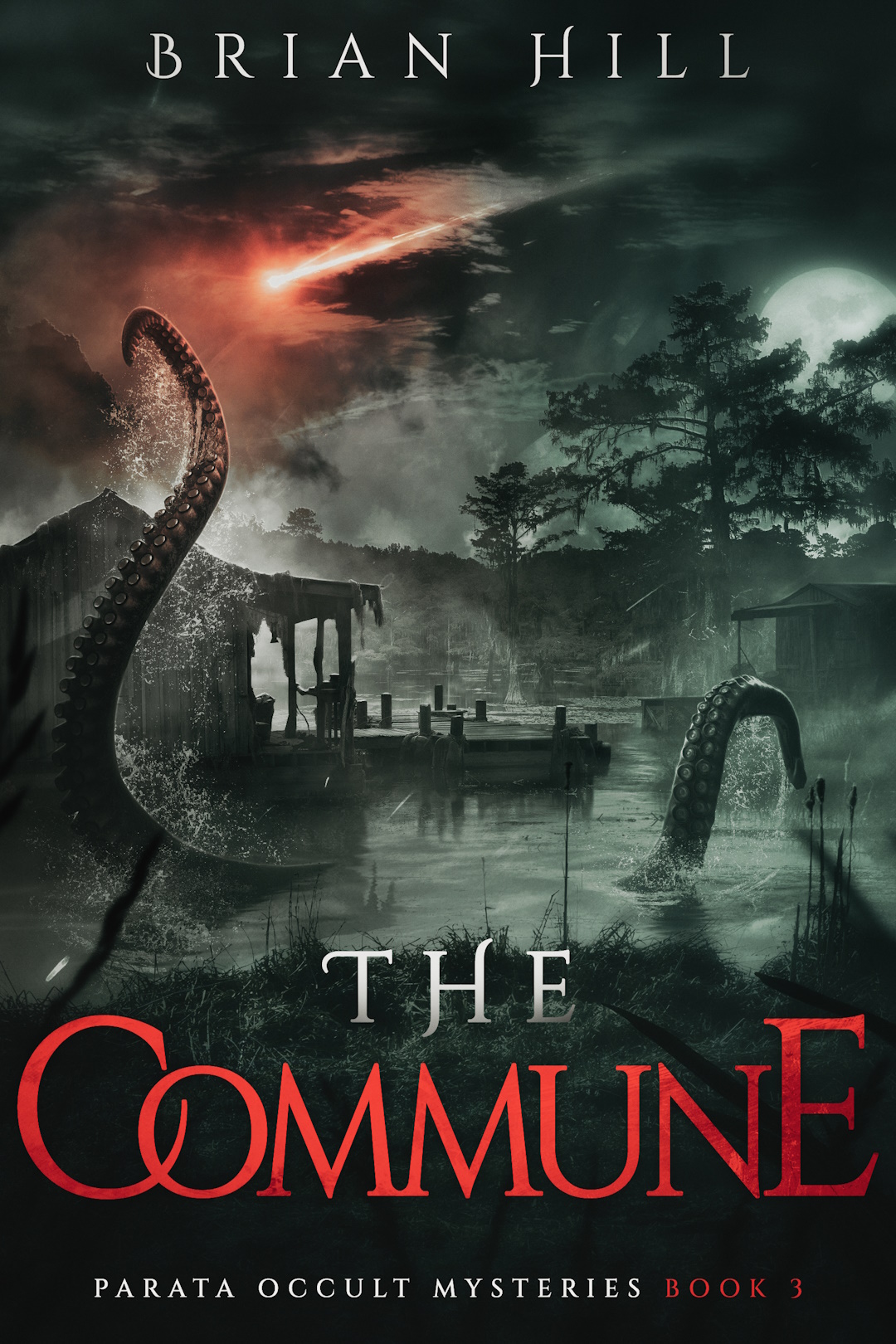
Commune is the third installment of the Parata Occult Mysteries — a noir-PI book that drops Rev Parata, his partner Rae Gordon, and their handler-priest Father James Kelly into the bayou south of Houma, Louisiana, in December 1984. On the surface it’s a missing-persons case (find Father Peter Walsh, who went into the swamp to look at an old book and didn’t come back). Underneath, it’s the second clear sighting in this series of the cosmology that the Parata books are quietly building: a Cthulhu-mythos cosmology, in which a sleeping titan in a bottomless sinkhole is fed villagers under a rare comet so that something larger can be summoned, briefly, to feed.
The book is patient. It spends its first half in classic gumshoe mode — door-knocking, library work, a Cajun fixer with an airboat, a wary village elder, a doddering Jesuit who is plainly hiding something. Then the supernatural starts bleeding through in the cracks: a prescription bottle for an antipsychotic, sketches that ripple on a wall, a Bible with water-damaged pages that briefly aren’t water-damaged, dreams that come with smell. The escalation is structural — first you see the symbol, then you learn its name, then you watch what it was warding against come up out of the water.
Where the previous Parata cases (referenced here in passing as “Coventry” and “Burke”) established that there are people in this world who serve hostile cosmic powers, Commune is where the curtain comes down. Rev sees a Great Old One in the flesh. He hears Walsh shout the canonical Cthulhu-cult chant (“Ph’nglui mglw’nafh Cthulhu R’lyeh wgah’nagl fhtagn”). He learns the name of the protective ward he’s been seeing for two cases — the Elder Sign — and learns that the order he works for has known this whole time, in a polite Jesuit way, that the universe has teeth. The book ends with him telling his partner and his priest the full truth about the Jar of Nephren-Ka he has been hiding from them for months. That last beat is what gives the title its second meaning: the commune is the village’s bargain with the thing in the hole, but it’s also the long-overdue act of communing among Rev, Rae, and Kelly.
This guide walks through what the book is actually doing — the entities, the sites, the inherited mythology, the procedural rhythm — and tries to be honest about which pieces are invented and which are imported, sometimes verbatim, from the Lovecraft canon.
Inventory
- Entities and cosmology — A Great Old One slumbering in Skelly’s Hole; the parasitic centipede (the “Crawler”) and its blind acid-blooded grub larvae; the named figure Nyarlathotep invoked across cases; an off-screen “Lord” the village serves.
- Rituals, sigils, and magical operations — The weekly Friday bonfire-dance; the four-century-old Tartarus-perihelion ritual at the Dec 21 closest approach of the comet; the off-key hymn that uses notes between notes; the Cthulhu cult invocation in the R’lyehian language; the persuasive mind-control gaze.
- Forbidden tomes, grimoires, and texts — Las Tribus Olvidadas (the de Pineda hoax-history); the village’s water-rotted Spanish Bible from the de Pineda expedition; Walsh’s coded diary; the unnamed grimoire flown in from Pensacola that names the Elder Sign.
- Artifacts, relics, and power objects — The Jar of Nephren-Ka (still off-stage, kept in safe-deposit boxes that ants invade); the church chest of de Pineda papers Walsh is cataloguing; the Smith & Wesson Model 60 .357 and Skeeter’s Model 29 .44.
- Factions, cults, and secret societies — Father Kelly’s anonymous Jesuit-adjacent order; the Tranquility/Psikinépikwa villagers as a four-century inherited cult; the historical Yalu̱s/Atakapa “blood drinkers”; the Coventry/Burke cells from earlier cases.
- The investigator’s craft — Cold interviews of librarians and academics; old-map work; pretextual ride-alongs with local fixers; subject surveillance; recon-trained countersurveillance and bushcraft; meditation as a defense against psychic intrusion.
- Cover-up infrastructure — Father Kelly’s order acts as a funder/director and decides what makes it to police; Rev’s decision to dispose of Walsh’s body in the Hole rather than try to explain to a homicide detective.
- Locations and hidden geography — Skelly’s Hole / Tranquility / Psikinépikwa, the unincorporated cypress-swamp town in Terrebonne Parish; the symmetrical hill where the 19th-century church sits (the in-book Blood Rituals of the Atakapa identifies the Yalu̱s as mound builders, though Rev and Rae never explicitly identify this hill as a mound on the page); the Baton Rouge boarding house and Franciscan Missionaries of Our Lady University; the Pensacola bank vaults that won’t hold the Jar.
- Psychological and sanity costs — Recurring vivid dreams of the Crawler; concussion and physical degradation as a real cost of the climax; the “voice” inside Rev that argues for the Jar; Felix’s burned face and missing tongue as a model of what surviving close contact looks like.
- Mythos vocabulary — Psikinépikwa, Mecikenäpikwa, Las Tribus Olvidadas, the Yalu̱s, Nyarlathotep, Cthulhu, R’lyeh, the Elder Sign, the Eye of Ra, Tartarus (the comet).
- Case history — The Coventry case (Randolph, the chalk-circle ritual, the killing Rev hid from the police, and the first sighting of the Elder Sign); the Burke case (an ongoing pursuit of a shapeshifting predator, source of the protective pendants Rev and Rae wear); the Bernie subplot (a wrongful arrest in an earlier book).
- Period and setting texture — December 1984. Louisiana and the Gulf Coast. Pay phones with operator overage charges, MREs and C-rations, Polaroids, Walkmans, fax machines, big-block Holley-fed V8s on airboats, Casio digital watches, the WWL-AM news jingle.
Cosmology
The Parata books, as of Commune, run on a flatly Lovecraftian cosmology with a polite Catholic gloss. The world the daylight half of humanity sees is real, but it is the surface skin of a deeper reality in which immensely old, immensely powerful entities exist and are mostly asleep. Father Kelly puts the structure plainly when he finally explains the Elder Sign: there are “Great Old Ones” who are addressed as gods by their cultists, “variously called demons, gods, spirits, and even, it is said in these modern times, aliens.” Beneath them are lesser servitor entities — ghouls, the Crawler, things that “go bump in the night” — who are essentially the staff. The Great Old Ones do not need to act through the world directly very often, because they have human cells who do their bidding for them.
The mechanics, as the book establishes them, are these:
- Power lives in objects and places. Holy relics carry energy you can feel by touch (Walsh says the Spear of Destiny does and other genuine relics do; he’s “ninety-percent certain” the Shroud of Turin is a fake). The Jar of Nephren-Ka calls to its bearer like a voice in the head. The de Pineda Bible has shifted into something more than a Bible after four centuries on the island. The Hole itself is a place of power — its water is “pure” because the current pulls everything down forever, never to come back.
- Power is acquired through prolonged exposure. Both Kelly and Walsh state that practitioners of forbidden arts grow more sensitive over time, while scientists and skeptics stay psychically deaf. Walsh worries that someone with as little exposure as Rev shouldn’t be having visions. The reader knows what Walsh doesn’t: Rev is carrying the most-hunted occult artifact of the last 4,000 years around in his trunk, then in safe-deposit boxes, then in Kelly’s church safe.
- Words and rhythms are containers. Kelly tells Rev that the symbols on the Solomonic pendants have no power in themselves; they are containers for incantations. The Cthulhu cult chant, the village’s hymn (“notes between notes”), and the chants Randolph used in the Coventry case all do work in the world. Counter-spells work by the same mechanism: Rev defends himself from Walsh’s mental intrusion by deliberately summoning the cedar smell of his cigars, his grandfather’s Sunrise Ceremony, the voice of his mother, his memories of Rebecca and Rae.
- Cosmology is timed to astronomy. The climax requires the comet Tartarus, on a 40,000-year orbit. The de Pineda expedition went to Psikinépikwa specifically because it knew the comet was coming back. The Lord can come up “only this one time” — until the next return.
- Cosmology is layered with native ground. The original inhabitants were the Yalu̱s, an Atakapa-related cannibal-and-bloodletting offshoot, identified in the in-book Blood Rituals of the Atakapa as mound builders. The Hole was their original sacred site and was rebranded around the same Lord under Spanish Catholicism in the 1500s. The current ritual is a four-century syncretic chimera: “ritualistic but not a ritual,” Rev thinks, watching the bonfire-dance — closer to a powwow than to a Mass, with elements of Cajun French rosary patter dropped on top.
The hierarchy, as you can read it from this book alone:
- The Lord in the Hole — a Great Old One, still un-named in this volume but very obviously a Cthulhu cognate (R’lyeh-language invocation, sleeping titan in deep water, calls a comet to the sky to wake briefly).
- Nyarlathotep — explicitly named by Walsh in the climax invocation and by Kelly in connection with the Elder Sign and the Burke case. In Lovecraft this is the messenger of the Outer Gods; here it is a recurring antagonist and apparently a different power than the Lord in the Hole.
- The Crawler — a giant centipede-like servitor whose larvae can implant in a human ear and ride the host as a meat puppet. The Hole-creature uses tentacles; the Crawler uses dreams, parasitism, and acid blood. They appear to be allied or at least co-located.
- Lesser servants — ghouls (referenced from earlier books); Burke (a shapeshifter still loose); whatever pulls Walsh’s strings once the grub is in him.
- Human cults — the Tranquility villagers, who have inbred over four centuries into a recognizable Innsmouth-style stock; isolated cells like Coventry’s; lone agents like Burke.
The ward against all of this is the Elder Sign. Felix scrawled it in crayon on the church windows to try to keep Walsh in. It didn’t work for long, because Walsh was already infected from the inside.
The investigator
Rev Parata is the series anchor and is the only POV the book gives you. By Commune he is a known quantity, but the book deepens his portrait substantially.
Background: Native American (the manuscript only confirms he isn’t Chiricahua and grew up on a reservation; specific tribal affiliation is not stated in this book), grew up “on the rez,” went to community college, joined the Army at twenty, served as Recon in Vietnam — twenty-three when he first saw combat. Caught a 7.62mm round in the knee. Came home to the standard postwar reception for Native Vietnam vets. Moved to New Orleans after separating from the service in ‘67. Six-foot-seven, three hundred-plus pounds. Built his career as a New Orleans private investigator. Drinks. Smokes cigars. Reads nautical fiction (Hornblower, HMS Ulysses, Mutiny on the Bounty, Robinson Crusoe, Hemingway’s The Old Man and the Sea).
Family losses inform him constantly: a mother who was an anthropologist and a “woman of science” — the source of his stubborn evidence-based default — who was killed by stress; a grandfather who tried to teach him the rituals of his people, which young Rev refused to take seriously and now wishes he had; a lost love named Rebecca, neglected because the job came first; an Army buddy named Mac and a little girl, both lost in Vietnam, whose deaths he carries as a private wound.
Method: standard PI craft layered over Recon training. He’ll spend a day under fluorescent library lights with a magnifying glass on township records; he’ll also pick a lock with bump keys, hot-wire a marine ignition, count rounds in a firefight by reflex, and walk silently from tree to tree through Louisiana hardwood. He’s a careful interviewer who watches for fidgeting and breaks eye contact. He notices nail-rust differential to date a sabotaged board. He knows that an electric fuel pump whines like an auto-shop lift and listens for it.
Code: he will not abandon a client he’s been paid to protect, even after the client refuses extraction. He will lie to a priest by omission about an artifact he should not be carrying. He will commit a felony to cover up a justified killing rather than try the truth on a jury. He treats women he’s working with as colleagues; he is openly contemptuous of Detective Stephenson, the racist arresting officer in the Bernie subplot. He is uncomfortable being cared for.
Tools (mundane): A snub-nosed Smith & Wesson Model 60 in .357 Magnum in a pancake holster at the small of his back, with speed loaders. A Polaroid. A pad. A 1980s Caprice cruiser. A pair of bump keys. Combat boots from the Army. A meditation practice that he relies on more in this book than in earlier ones.
Tools (occult): A Solomonic pendant from Kelly’s order, paired with one Rae also wears, originally given for protection against Burke. Memories of the Sunrise Ceremony, his grandfather’s tribal rites, used as a self-grounding anchor against psychic intrusion. The Jar of Nephren-Ka, which he is hiding from everyone, including himself.
Relationships: Rae Gordon, his partner, is a city girl with engine knowledge and a knife collection; this book is the one where the long-running romantic undercurrent is finally named on the page (the kitchen scene in Rae’s apartment after the hospital). Father James Kelly is his case-handler and the only client who matters; the book ends with Rev confessing the Jar to him. Cindy at Dependable Answering Service is his message line. The Jesuit Walsh becomes, briefly, a friend and a fellow combat veteran (Walsh fought in WWII, lied about his age at sixteen) — and the cost of that friendship is what makes the climax work.
Accumulated damage by the end of Commune: a broken hand badly set in a fiberglass cast; a serious concussion he will not let the hospital observe overnight; nightmares he can’t stop; a confirmed parasite-host species that thinks of him; a confirmed cosmological enemy; and a spreading internal voice that argues, in his own head, on behalf of the Jar.
Case mechanics
A Parata case as practiced in Commune runs in five movements.
-
The summons. A worried client — almost always Father Kelly — provides a documentary scrap (here, a letter from Walsh) and a name. The case is described as a welfare check on a person, not an investigation of a phenomenon. Kelly is forthright that “everything Kelly’s order has its hands in is terrifying,” but the cover story is always mundane.
-
Document and interview pass. Rev and Rae work the city: state archives, university libraries, dioceses, boarding-house keepers, expert academics. Here Diaz the historian, Martha the goth research assistant, the Black landlady at the Baton Rouge boarding house, and the local guide Skeeter all get pulled in. The objective is a place name and a route.
-
Excursion to the liminal site. Some place that is on no current map — condemned, abandoned, evacuated, off the grid. Travel there is described as a gauntlet (the airboat ride; the washed-out highway; the muddy landing; the unfriendly local elder gatekeeping the village). The site has a single uncanny feature that seems almost natural — here, the unnaturally clear, perfectly circular sinkhole that swallows everything dropped into it and never returns it.
-
The slow turn. In a Parata case, the supernatural doesn’t kick the door down — it leaks under it. Crayon symbols on a window. A water-damaged page that briefly isn’t damaged. A dream that comes with a smell. A prescription bottle for chlorpromazine — the same antipsychotic Hollywood villains palm and the patient palms back. Rev and Rae document it, share it, and worry openly about whether they’re losing their grip. By the climax, the question of “is this real?” is no longer in dispute, but it has been treated seriously by the text.
-
The detonation and the cover-up. A ritual converges with an astronomical or calendar event. People die. Rev sustains real injury that doesn’t heal in a chapter. The cover-up afterward is one of the series’ running themes: there is no version of “we tell the police” that survives a homicide detective’s interview. The body goes into the Hole. The boat is taken, the firearm thrown into deep water, the village’s surviving paperwork burned. The only honest report goes to Father Kelly, in his office, the next day.
The series-level structural choice is that Rev’s debrief with Kelly is itself the closing scene — not the action climax. Each book ends with a confession at a desk in a Catholic priest’s office. Commune doubles down on this by making the confession itself the dramatic climax: Rev finally tells Kelly and Rae about the Jar.
Deep dives
Entities and cosmology
The Lord in the Hole
What it is in the story: A Great Old One sleeping at the bottom of Skelly’s Hole, awakened briefly during the chant in “The Awakening” while the comet Tartarus passes within a million kilometers of Earth. It surfaces only as a head — described as “the size of a boxcar, but almost perfectly round,” capped with protuberances “that might have been horns, or might have just been bony ridges,” two enormous oval black orbs of eyes that reflect the comet’s red, and “five huge suckerless tentacles” sprouting where the nose should be (the upper five each ending in triangular tips that radiate intense blue light), plus a sixth tentacle that sprouts from under the mouth-pit and hangs limp. It feeds by squeezing villagers like toothpaste tubes; the squeeze concludes in a sound like “a bullwhip amplified through the PA system at a rock concert,” a sonic-boom-class pressure wave. It also broadcasts a non-local pressure wave that lets Rev “see into the foundations of the universe, into a strange foam of possibility and chaos.” Villagers walk willingly off the cliff into its embrace. Walsh’s invocation (“Ph’nglui mglw’nafh Cthulhu R’lyeh wgah’nagl fhtagn”) names it on the record.
Real-world antecedents: This is unambiguously a Cthulhu cognate from H.P. Lovecraft’s “The Call of Cthulhu” (1928). The first line Walsh shouts is the most famous single sentence in the Cthulhu Mythos, traditionally translated as “In his house at R’lyeh, dead Cthulhu waits dreaming.” The architecture of the scene — sunken titan, congregation on a lonely shore, ritual that requires a calendar event (“when the stars are right”), human sacrifice in a watery sinkhole — is direct Lovecraft, with surface details echoing Lovecraft’s “Dagon” and the underwater cult passages of “Call of Cthulhu” and “The Shadow Over Innsmouth.” The “five suckerless tentacles” differ from Lovecraft’s flabbier face-tentacles — closer to an Outer God morphology than a strict Cthulhu — but the scene logic is Lovecraft’s, performed straight.
What’s invented: The bioluminescence on the tentacle tips — not a Lovecraft detail; the book borrows from real deep-sea anglerfish and siphonophores to give the apparition a working biology. The sixth slack tentacle and the bone-cap triangle on each tip are original. The pressure wave that warps spacetime is more in the register of newer Mythos writing (think Laird Barron’s late-period fiction) than the original. Tying the sleep-cycle to a specific named comet on a 40,000-year orbit is tighter clockwork than Lovecraft generally used.
Why it matters in-universe: This is the Parata cosmology stating itself for the record. Up to this point in the series, supernatural threats have been weird humans, parasitic ghouls, and shapeshifters. With the Lord in the Hole, the books commit to the position that real Lovecraftian cosmic horror is the underlying engine of every case, and that the “Great Old Ones” are not metaphors. Kelly’s order has known. Walsh knew. Rev now knows.
Connections: The Lord is invoked alongside Nyarlathotep (“Nyarlathotep ng’fhalma geb ahornah ah’mglw’nafh!”) in the climactic chant, suggesting an alliance or hierarchy across the series’ antagonist roster. Rev’s Coventry-case dreams, in which a Randolph-figure invoked Cthulhu, are now seen retroactively as previews. The Jar of Nephren-Ka, hidden by Rev throughout, is tied to this cosmology by name (see below).
Nyarlathotep
What it is in the story: A name only, in this book. Walsh shouts it in the invocation. Kelly cites it as one of the Great Old Ones the Elder Sign protects against, and links it to the Burke case from an earlier book. The reader is meant to recognize it as a recurring antagonist whose body has not yet appeared.
Real-world antecedents: Lovecraft’s “Nyarlathotep” prose-poem (1920) and The Dream-Quest of Unknown Kadath (1927). In Lovecraft, Nyarlathotep is the Outer Gods’ messenger and the only Mythos entity who walks the human world in a recognizably human form (“the Crawling Chaos”). He is the natural fit for the role of a recurring antagonist who can show up wearing different faces in different cases — exactly what a noir-mystery series would want.
What’s invented: As of this book, almost nothing is committed to about the local Nyarlathotep beyond name. Whether the series’ Burke is a Nyarlathotep avatar or merely a servant is, on the evidence of Commune alone, ambiguous.
Why it matters: Nyarlathotep is the through-line villain. The Lord in the Hole is a one-book antagonist, dispatched for now by Walsh’s death and the comet’s recession. Nyarlathotep is open business.
The Crawler
What it is in the story: A giant centipede-like predator that Rev tells Kelly has been on his mind “since the Coventry case.” In Commune, Rev dreams it across multiple chapters — first in the opening dream, where it ambushes a fisherman, then later sequences of the same predator. The recurring visual is “the creature’s burning three-lobed red eye, with six smaller orbs surrounding it in a V pattern,” and “thousands of legs.” The dream-creature’s mating-feeding behavior includes stomping the corpse like a vintner crushing grapes, with the corpse spawning “fat maggot” larvae — pinkish-white grubs with retractable lightning-branched tongues that secrete a yellowish fluid which liquefies flesh on contact (the bird’s eye dissolves to smoke when struck by it). One of those larvae is what was actually inside Walsh’s ear, riding him like a meat puppet, exposed only when the spell broke at the climax and the grub emerged onto Walsh’s face, dissolving his skin to expose the muscle as it tongue-attacked Rae.
Real-world antecedents: The three-lobed burning eye is one of the most distinctive single visual details in Lovecraft, recurring in The Haunter of the Dark and elsewhere as a Nyarlathotep signifier. The general shape — many-legged, arthropod, predatory — recalls both Frank Belknap Long’s “Hounds of Tindalos” and the chthonic many-legged things in folk horror generally. Body-horror parasites that ride hosts have a long pulp lineage (Heinlein’s “puppet masters,” Jack Finney’s pod people, real-world parasitic wasps and cordyceps fungi); the specific “drilled in through the ear, controls the host, exits and tries to find a new host” pattern is closest to Star Trek: The Wrath of Khan’s Ceti eels (1982 — two years before this book’s setting, deliberately or not), but the acid-blood biology is closer to the Alien franchise (1979 onward).
What’s invented: The acid blood that dissolves the larva-corpse from inside out so cleanly that no remains can be examined. The retractable side-tongue that branches like lightning. The stripping behavior in which Walsh’s face dissolves to expose muscle. The integration of the Crawler into the Cthulhu-mythos cosmology as a servitor; in classical Mythos it would be its own oddity, not a cousin of Cthulhu’s.
Why it matters: This is the closer-to-home horror of the series. The Lord in the Hole is one rare comet away from being a problem. The Crawler is breeding now, in the swamp, and any one of its larvae can take a human. The book ends with Rev, Rae, and Kelly in a quiet office calculating that an apex predator with a parasitic larval stage that can infect humans could realistically take over a continent. That is the unresolved threat the series can pick back up at any time.
The Yalu̱s as ancestor cult
What it is in the story: The Atakapa-related “blood drinkers,” documented in Blood Rituals of the Atakapa: a Louisiana mound-builder offshoot that practiced ritualized bloodletting and cannibalism, taking victims from captured enemies, occasionally from inside the tribe. The casefile parses the in-book sources thus: in Blood Rituals of the Atakapa, “Atakapa” is glossed as Choctaw for “people eaters,” with the Yalu̱s as a particularly violent offshoot. Separately, in Tribes of the West Indies — Volume Three, an island called Mecikenäpikwa is occupied by a tribe the Choctaw dubbed the Ishko-Oka-Hanta, ostracized by neighbors and possessing a well with “infinite supply of crystal-clear water” — almost certainly the Hole, and treated by the book as the same population as the Yalu̱s, though the in-book text doesn’t explicitly equate the two names. Their site became the Spanish-Catholic village of Tranquility after the de Pineda expedition spent a year there. The current Tranquility villagers’ physical deformities (bulging eyes, scaly skin, slack lips) suggest four centuries of inbreeding among a small community whose ritual practice has continued unchanged.
Real-world antecedents: The Atakapa were a real Indigenous people of the Texas-Louisiana coast. The “people eaters” gloss is widely cited in the popular and older ethnographic literature (Choctaw hattak “person” + apa “eat”), and Spanish and French explorers did record cannibalism allegations — but the etymology and the cannibalism reputation are both contested in modern scholarship, where many treat the gloss as a Choctaw exonym carrying colonial slander rather than reliable ethnography. The book treats the reputation as historical fact for fiction purposes. The Mississippian mound-builder culture (which the Yalu̱s are framed as an offshoot of) is real and had genuine ceremonial mound-building, ritual deposit of grave goods, and an extensive iconography. The Álvarez de Pineda expedition (1519) is a real Spanish voyage along the Gulf coast — the first European mapping of the northern Gulf.
What’s invented: The Yalu̱s as an Atakapa offshoot, the name “Mecikenäpikwa” / “Psikinépikwa,” and Las Tribus Olvidadas are inventions. The plot device of de Pineda’s crew having stayed a year in a single spot to learn rituals from a local cult, then taking the cult Catholic, is invented (de Pineda’s actual expedition was a coastal mapping run, no extended landfall on record). Rae’s reading of a “fountain of youth” callback as a possible source for Ponce de León’s quest is fictional speculation framed as a real scholar’s aside.
Why it matters: This is the book’s deep-time setup. The cult is older than the United States, older than the Catholic veneer it wears. The villagers’ physical traits set up the suggestion that prolonged contact with the Hole’s water is itself doing something biological to the line — either the Lord is reshaping its servants over generations, or the Crawler larvae have been part of this ecosystem for centuries. Either reading feeds into the Innsmouth-style template the book is borrowing from.
Felix the Wax Man
What it is in the story: A burned, deformed villager who is afraid of Walsh and tries repeatedly to keep him bottled in the church. Felix scratches the Elder Sign in crayon on every accessible window. His skin is shiny with long vertical wax-like scars down his face. He was Rev’s original suspect for the gator attack. By the climax he is revealed as the only human in the village still trying to fight the Lord in the Hole: at the climax he stabs Walsh in the back with an old butcher knife; Walsh manages one last chanted syllable and falls. Felix is immediately seized by a tentacle and pulled into the depths.
What he probably is, in cosmology terms: Felix is the survivor template the series uses for “what happens if the cult takes you and you live.” His burns and visible deformity read as evidence of a previous failed sacrifice or a previous attempted possession. The reader is meant to wonder whether Felix is a former cultist who lost his nerve, a former intended host who survived because the Crawler larva failed to take, or an outsider who was punished for trying to break the village’s bargain.
Why he matters: He’s the moral centerpiece of the village half of the book. Rev’s casual nickname for him — “Wax Man” — is rebuked twice on the page (by Walsh and by Rae) until Rev concedes and uses Felix’s actual name. The book is making a point about who the actual victim of a cult is.
Rituals, sigils, and magical operations
The Friday bonfire-dance
What it is in the story: A weekly ritual on the muddy shore beside the Hole. The villagers form a circle around a fire; an old bass drum is pounded on the offbeat; the singers chant in unison in a discordant overlapping mishmash; arms rise and undulate like waves. Rev watches it through binoculars and is sucked into a trance-vision in which he descends into the Hole, sees five blue lights swimming in concert, and recognizes them as the bone-cap tips of the Lord’s tentacles. He surfaces violently and finds Felix appearing to stare directly at him from across the fire — at a distance through which he should be invisible.
Real-world antecedents: The contrast Rev draws — “ritualistic, but not a ritual” — is the book noticing a real distinction between liturgical practice (Mass, formal Catholic rites) and shamanic-trance practice (powwow dances, voodoo possession ceremonies, Sufi dhikr, Pentecostal speaking-in-tongues services). The dancing-around-a-fire weekly cycle is generic folk-horror; the specific overlap with Cajun Catholicism in the bayou is grounded in the actual syncretism of South Louisiana religious practice, where Catholic, French folk, and Afro-Caribbean elements have layered for centuries. The trance-induction-by-watching is a real psychological phenomenon associated with prolonged staring at firelight and rhythmic sound.
What’s invented: The specific musical structure (notes between notes, uncountable rhythms in lockstep) is the book’s metaphor for “alien but coherent.” The remote-viewing effect through which Rev descends mentally into the Hole is straight Mythos invention.
Why it matters: This is the book’s first explicit demonstration that the cult’s practice produces effects on a witness, not just on participants. Rev is a non-believer with no training. The ritual still gets in.
The de Pineda Bible sermon
What it is in the story: For four hundred years the village has had exactly one Bible — a Spanish translation carried in by the de Pineda expedition, now mostly water-damaged into illegibility. The villagers will only accept a sermon read from this Bible, never from a modern one. The water damage is selective: large portions of Job survived unscathed, along with parts of Psalms and Daniel; in the New Testament, only Revelation is even remotely legible. Walsh constructs his pre-Christmas sermon (delivered Sunday Dec 16) out of the legible passages and finds it has gone “fire-and-brimstone” — Revelation 13’s beast rising out of the sea, then Job 41 lines on Leviathan (“when he raises himself up, the mighty are afraid… his breath kindles coals… terror dances before him”). The villagers receive it with rapt focus and pound the pews on the beat.
Real-world antecedents: Job 41 is an actual Old Testament chapter about Leviathan that Kelly correctly identifies as a literary descendant of Lotan, the seven-headed sea serpent slain by Baal in Ugaritic Canaanite mythology — this is a real piece of comparative-religion scholarship. Revelation 13’s beast from the sea is a real apocalyptic image with a long history of cultic and millenarian reading. The pattern of a small isolated congregation having a single Bible carried in by a missionary and reading it as their unique scripture is real (it’s how Christianity propagated in many remote settings).
What’s invented: The conceit that the water damage on a four-hundred-year-old Bible could “select” the Old Testament theophany passages. The page that briefly stops being water-damaged and shows Rev a moving image of the Lord rising from the sea is invented; on this casefile’s reading it functions as a literal demonstration that the relic is not “really” a Bible anymore but has become something else, a scrying surface dressed as Scripture.
Why it matters: It’s the answer to “how does an old Catholic priest end up shouting R’lyehian under a comet?” Walsh has been reading and re-reading a possessed object for weeks. The sermon construction is the on-ramp; the chant is the destination.
The chant and R’lyehian
What it is in the story: Walsh, in the climax, shouts four lines of incantation in a guttural alien language (followed by an English imperative to the villagers, “And now it is time to give offerings to your Lord!”). The first (“Ph’nglui mglw’nafh Cthulhu R’lyeh wgah’nagl fhtagn”) names Cthulhu and R’lyeh; the last in R’lyehian (“Nyarlathotep ng’fhalma geb ahornah ah’mglw’nafh”) names Nyarlathotep. A line of crimson leaks from Walsh’s ear as he speaks them. The wind picks up. The Hole bubbles. The clouds form an eye that frames the comet.
Real-world antecedents: The first line is verbatim from H.P. Lovecraft’s “The Call of Cthulhu.” The reconstructed pseudo-language fans call “R’lyehian” or “Cthuvian” is a fan-and-game-supplement creation built out of Lovecraft’s scattered transliterations; the other three lines in this book are original compositions in that pidgin.
What’s invented: The other three invocation lines, the specific ear-blood physiological cost, the cloud-eye opening directly above the chanter, and the comet-as-keyhole timing.
Why it matters: This is the book quoting Lovecraft on the page to establish the cosmology beyond any doubt. After the Walsh chant, the series is in dialogue with the Mythos in writing, not just in implication.
The mind-control gaze
What it is in the story: A possessed person, looking another person in the eye, can take direct motor control of the other person’s body. Rev experienced it first in the Coventry case, when Randolph used it to nearly make him commit suicide (the bullet meant for Rev’s chin ricocheted into Randolph instead — Rev saved his own life by recalling, at the trigger pull, the Sunrise Ceremony of his tribe). Walsh-as-grub-host uses it on Rae to march her into a cell and lock the door. He uses it on every villager in the climactic dance to walk them off the cliff. Rae describes the experience as “mentally raped” — a cold alien presence rummaging in her mind. Rev defends himself in the climax by deliberately invoking sense memories (cigar smoke, scotch, his favorite book, mother, grandfather, Rebecca, Rae).
Real-world antecedents: Hypnotic-suggestion and possession motifs are common across world folklore. The defense — anchoring to specific personal sensory memories — has a real-world correlate in trauma-response grounding techniques. The “incantation as defense” framing Kelly uses (“cherish those memories… performance is what works, not understanding”) echoes both the Catholic theology of sacramentals (the rite has effect ex opere operato) and the chaos-magic position that ritual works because of practiced thought-pattern, not because of metaphysical truth-claims.
What’s invented: The specific mechanism — a parasitic larva in the host’s ear acts as the conduit for psychic projection — is the series’ synthesis. So is the rule that the spell breaks the moment the larva exits the host, leaving the original person dead-eyed and limp.
Why it matters: It establishes the central rule of why Rev is special in this universe. He has been doing tribal-derived meditation for years, half-consciously. He has been carrying the Jar of Nephren-Ka for months. He is, on the evidence, the only person Kelly’s order has who can resist the gaze, and that is going to drive series-level plot.
Forbidden tomes, grimoires, and texts
Las Tribus Olvidadas
What it is in the story: A book Father Walsh found about a hundred years ago, decaying in the swamp; supposedly written by a nameless historian who sailed with Álvarez de Pineda’s 1519 expedition. Catalogued at Franciscan Missionaries of Our Lady University in Baton Rouge. Most academics including Diaz believe it’s a hoax or misattribution, because its content — rituals supposedly learned from the local tribe — is wildly out of character with the rest of de Pineda’s documented work. Walsh believes its glyphs and passages echo “ancient Sumerian texts,” and the apparent calque is the lure that pulls him to Psikinépikwa.
Real-world antecedents: The framing — a Mediterranean expedition records ritual practice from a New World tribe and the records survive in a single decaying volume in a Catholic library — is plausible-historical pastiche. Real expeditions did produce manuscript ethnographies that survived in monastic and university collections (Sahagún’s Florentine Codex is the best-known case). The “academics think it’s a hoax” framing is a Lovecraft device — Necronomicon is treated this way in the original stories — and a noir device (the document the protagonist is told to ignore turns out to be the key).
What’s invented: The book itself, the title, and de Pineda’s year-long stay at Psikinépikwa.
Why it matters: It’s the case-opening artifact and the documentary thread connecting four centuries.
The water-rotted de Pineda Bible
(See “Rituals, sigils, and magical operations” above for full discussion.)
Walsh’s coded diary
What it is in the story: Recovered from Walsh’s room after Rev disposes of the body. Written in some kind of cipher or hand so personal Rev can’t read a word of it. Walsh’s note to Diaz at the start of the book had similarly impenetrable handwriting; whether the diary is actually encrypted or just personal-scrawl-illegible is left open.
What’s invented: Everything about it. It functions as a sequel hook — placed in Rev’s bag at the end and not opened on screen.
The unnamed grimoire from Pensacola
What it is in the story: A leather-bound rare tome belonging to a wealthy Gulf Coast family (the Magnum P.I. Ferrari and Mercedes 300SL households), shipped under guard via Rev and Rae in a foam-lined diplomatic briefcase at the request of Kelly’s order. Identifies the Elder Sign and its function as a ward against the Great Old Ones.
Real-world antecedents: The “private collector loans the rare grimoire to the secret order” is straight Mythos / golden-age occult-detective machinery (the Carnacki stories, Kolchak: The Night Stalker, modern Hellboy). The chain-of-custody and white-glove handling is the realistic detail the book adds.
Artifacts, relics, and power objects
The Jar of Nephren-Ka
What it is in the story: An onyx hourglass-shaped vessel Rev acquired off-screen at the close of the Coventry case. He has been moving it from safe-deposit box to safe-deposit box at Florida Panhandle banks because each branch develops a “problem” within a few weeks — the first bank reported a smell like vomit and decay; the second develops an ant infestation that streams from an emergency exit door directly to Rev’s box. When Rev brushes ants off the Jar with a bare fingertip, he feels “a possessiveness, a desire to hold and protect the Jar… a need to never let it out of my sight.” When he stores it in Father Kelly’s church safe, he lies and says it’s his grandfather’s burial urn, claiming a medicine-man’s protection trick. Throughout the rest of Commune, an internal voice argues with Rev on the Jar’s behalf — to keep it from Walsh, from Rae, from Kelly. Rev’s final act of the book is to confess the Jar to both of them.
Real-world antecedents: Nephren-Ka is a Lovecraft-canon name — the Black Pharaoh from “The Outsider” and Robert Bloch’s “Fane of the Black Pharaoh” (1937), associated with Nyarlathotep worship in Mythos lore. Bloch and others have used various “Jar of Nephren-Ka” or “Bride of Nephren-Ka” objects across decades of Mythos pastiche. The specific behavior — an artifact that seduces its bearer with a voice in the head — is the One Ring template and reaches back to many real folkloric “cursed object” traditions (the Hope Diamond cycle, the Spear of Longinus legends, M.R. James’s whistles and runes).
What’s invented: The specific physical form (onyx hourglass), the exact insect behavior (ant-magnetism), and the “if you store it in a vault it will draw vermin” gimmick are this series’ contribution. Kelly’s quoted figure of “the most hunted-for occult object in the last 4,000 years” is series-internal worldbuilding.
Why it matters: The Jar is the load-bearing through-line of the series, and Commune is the book where it stops being a private secret. Kelly’s diagnosis at the close — “Something of that power is like a lightning rod for the supernatural. It must be hidden, protected” — opens the door to the next book’s central problem: where do you put a thing like that.
Connections: Rev’s growing psychic sensitivity (the Walsh’s-room hallucinations, the bonfire trance, the moving Bible page) is, by the book’s logic, the result of months of Jar exposure even though he’s been actively avoiding handling it. Walsh tells Rev, accurately, that he shouldn’t be having visions yet — and then the reader is shown why he is.
The chest of de Pineda papers
What it is in the story: A massive iron-bound wooden chest in the back room of the church, full of moldering paper, vine-and-flower carving on the exterior. Walsh is cataloguing it. The chest is heavy enough that Walsh cannot move it; Rev can. It’s also the cover for a hole in the back wall through which a “gator” (almost certainly a Crawler-larva-controlled animal) was admitted. Rev nails the chest in place and the attack pattern shifts — to the inside.
Real-world antecedents: The carved chest as a piece of Old World furniture in a Louisiana church is plausible-period.
What’s invented: The chest’s role as a smuggling channel for ritual entry is the book’s invention. Whether the chest itself is enchanted — like the Bible, partially repurposed by long contact — is left open.
Factions, cults, and secret societies
Father Kelly’s order
What it is in the story: A small, well-funded, secretive Catholic-adjacent order, run out of a New Orleans parish, that hires Rev as a paid investigator. Kelly pays for everything. The order has a network of academic correspondents who can fax-and-receive on rare-text questions. They have safes; they have access to seven-figure grimoires; they have their own internal corpus of “transcriptions” of historical possession cases. They are precise, sober, professional — not “voodoo shops and graveyards,” in Rev’s words, but the CIA. Walsh is one of theirs. Kelly is Rev’s handler.
Real-world antecedents: Plays in the same sandbox as the Vatican’s actual Office of Exorcisms and the various Jesuit-as-secret-investigators traditions in pulp fiction (the Jesuits’ real reputation for scholarship and worldly engagement makes them the natural choice for this kind of fictional order). Lovecraft’s Mythos has parallel benevolent-investigator groups (Henry Armitage at Miskatonic, the various unnamed academic bodies); modern Mythos has formalized them (the Laundry Files, Charles Stross). Hellboy’s BPRD is a near cousin.
What’s invented: The order’s specific structure (loose cells, paid lay investigators, a single priest as handler) is series-internal worldbuilding.
The Tranquility/Psikinépikwa villagers
What it is in the story: 27 villagers attended the climactic ritual. None are children. None are paired in family groupings. The elder rules; the others follow. They speak Cajun French and the indigenous chant language. They have visible inbreeding-pattern deformities. They will accept a sermon only from their own four-hundred-year-old Bible. Their drinking water comes from the Hole; they fish, hunt, and trade with the city for the rest. They appear to have killed the previous generation’s children either by sacrifice or by birth-rate collapse — there’s no on-page explanation, but the absence of children in a town that has supposedly persisted is conspicuous.
Real-world antecedents: Innsmouth from Lovecraft’s “The Shadow Over Innsmouth” (1936) is the obvious template — an isolated coastal village, a generations-deep bargain with an aquatic Great Old One, visible morphological changes in the villagers, a reformed religious veneer over the actual pact. The deeper folk-horror cousins: The Wicker Man (1973), the village in Stephen King’s “Children of the Corn” (1977/1984), Shirley Jackson’s “The Lottery” (1948). The bayou-Cajun-isolation framing is grounded in real Louisiana geography (Terrebonne Parish does contain genuinely cut-off settlements reachable only by water).
What’s invented: The specific syncretism with Catholic Spanish missionaries, the four-century continuity, and the comet-keyed renewal cycle.
Skeeter Mason
What it is in the story: A lanky, “dumb redneck” airboat pilot in Gibson with a Cracker Barrel-themed front office and a Smith & Wesson Model 29 hand cannon. Plays the rube — but Rev clocks him early as a partial act, and by the climax Skeeter is revealed as the village’s outside agent. He took Walsh in, takes the kidnap-bait, professionally ties Rev’s hands with double zip ties, runs a competent gun-takedown, and is willing to murder. He attends the bonfire-dance. He is also mid-ritual revealed as expendable: the elder snaps at him in French that the Lord may take Skeeter instead if too much harm comes to Rev.
What’s invented: The specific character. The recurring noir trope — the helpful local guide who is in fact part of the conspiracy, played for surprise even though the reader is half-expecting it — is as old as Hammett.
The historical Coventry and Burke cells
Referenced from previous books. Coventry’s circle in chalk used the same Elder Sign; Coventry’s ritual demanded human-heart sacrifice; Coventry’s leader Randolph chanted Cthuvian and could possess strangers’ bodies. Burke is a shapeshifter Rev has been trying to find for months. The Solomonic pendants Rev and Rae wear were issued for protection against Burke. Both threads are explicitly unfinished as of Commune.
The investigator’s craft (case mechanics texture)
Library and document work
The book is unusually patient with the research half of the case. Rae sits in the Louisiana State Archives looking for incorporation papers. Rev hits the public library to scour old Louisiana maps for Psikinépikwa. They visit Professor Diaz at Franciscan and spend an afternoon with his goth research assistant Martha cross-referencing Las Tribus Olvidadas and ancillary works on the Atakapa. Photography vs. hand transcription of a fragile bound text gets two paragraphs. This is PI craft on the page — and it differentiates the Parata books from much occult-investigator pulp, which usually skips the documentary work to get to the ghost.
The interview as combat
Rev’s interview style carries a lot of his characterization. He watches eye contact, breathing, posture, fidgeting. He asks indirect questions (the prescription bottle: “Just wondered if you needed me to pick up a refill”). He notices small lies — Walsh’s eyes drift away at the end of a denial he believed two seconds earlier. He files the lie and lets the witness keep his dignity for now. The mode is Hammett-Macdonald procedural craft in a Louisiana 1984 idiom.
Bushcraft as defense
Rev is Recon-trained, and the book uses this in three places: the run up the side of the hill cutting a hundred yards off the path; the silent flanking move on Felix; the “find Skeeter’s boat by hugging the coast” plan to get Rae out at the end. The book’s argument is that the supernatural threats of the climax are eventually survivable because Rev’s mundane training gives him an extra second of decision time when reality breaks down.
Cover-up infrastructure
The closing chapters are the most explicit treatment yet of how a Parata case is buried. Walsh’s body goes into the Hole — a felony, undertaken because the truthful version would not survive an interview, and because Walsh’s parasitic infection is something no coroner can be told about. Skeeter’s body and the villagers’ bodies are abandoned in a place officially nonexistent (Tranquility was evacuated by gubernatorial order in the 1920s; the road has been washed out since Hurricane Camille in 1969; nobody bothered to fix a road to a town that wasn’t supposed to be there anymore). Rev throws Skeeter’s .44 into deep water. Rae proposes burning everything; Rev rejects it (too soggy, smoke would attract attention) and they settle for taking anything that could ID them and walking away. Pays cash. Hopes no one noticed his cruiser parked at Skeeter’s for four days.
The only honest report goes to Father Kelly, who is the order’s funder and director and the moral authority Rev recognizes. The series-internal ethics of this are still unresolved — Kelly accepts the cover-up without protest, but his order is clearly building a case-history archive that is itself a parallel justice system.
Locations and hidden geography
Skelly’s Hole / Psikinépikwa / Tranquility / Mecikenäpikwa
Three names plus a colloquial nickname for the same place. The Algonquin / Choctaw original (“place of the deep blue water,” roughly) became Mecikenäpikwa in West Indies tribal records, then Psikinépikwa as a Spanish-Catholic transliteration, then Tranquility under American incorporation in the 1800s, then Skelly’s Hole after a turn-of-the-century Skelly Oil drilling collapse opened a 300-yard sinkhole that swallowed the drill rig, the workers, and most of the original town. Evacuated by gubernatorial order in the 1920s; unofficially still inhabited; off all current maps; reachable by airboat through Terrebonne Parish bayou.
The Hole itself: 300 yards across, walls vertical to about a hundred feet down, then opening outward into impenetrable darkness; water lapis-lazuli blue from a distance, crystal clear up close; depth measured to at least 150 fathoms (~900 feet) in the 1920s by the Army Corps of Engineers without finding bottom. There is a “loop of fast-moving water right below the surface” that pulls everything in — cigarette butts disappear in three seconds, never to surface — which the villagers cite as the source of the water’s miraculous purity. The local legend is “people get sucked under.” The physical description is unambiguously a real-world cenote (Yucatán-style limestone sinkhole) with a Mythos engine bolted in. The hill above the Hole, where the 19th-century church sits, is symmetrical enough that a reader familiar with the in-book Blood Rituals of the Atakapa finding (the Yalu̱s as mound builders) can plausibly read it as a mound — though Rev and Rae never make that identification on the page.
The Baton Rouge boarding house and Walsh’s room
A two-story shotgun a few blocks northeast of the cathedral, run by Ms. Thelma, a 78-year-old Black landlady who chatters past you. The structure behind it is a small extended-stay-style cottage where Walsh has been living. His study contains thumbtacked sketches across every wall — eel-or-tentacle creatures interspersed with Solomonic protective sigils — that, when Rev looks at them in pattern, ripple and momentarily dissolve into a tentacle-thing in smoke before an air-horn outside breaks the trance. The same sketches turn up later, redrawn, on the walls of Walsh’s room at the church, after the parasite has fully claimed him. Walsh has no memory of drawing either set.
The Pensacola bank and the Magnum P.I. mansion
Two pieces of Gulf Coast color that situate the Parata books outside the swamp. The Pensacola bank is straight noir — old marble facade, a vault with a steel-table center, a branch manager who wants the ants gone today. The Pensacola mansion is the order’s wealthy patron: three-story Gulf Coast palace with a two-bay open garage holding a red Ferrari and a silver Mercedes 300SL gullwing, a butler in white tuxedo with a Georgian accent, an older blond patron with a tumbler of dark liquor on the third-floor balcony. The order has friends with money, and they’re not all priests.
Psychological and sanity costs
Rev spends most of Commune in some state of traumatic disorientation. He has recurring dreams of the Crawler that come with smell and full sensory bandwidth. He has a hallucinatory trance episode in Walsh’s Baton Rouge study. He has a vision-down-into-the-Hole during the bonfire-dance. He has the Bible-page episode in which the water-damage stops being water-damage and shows him a creature surfacing. By the climax he has been concussed badly, has a broken metacarpal, has lost two days to head-injury haze in a wooden cell, has watched twenty-seven people walked off a cliff and crushed like toothpaste, has thrown a corpse into a bottomless pit with the implication that the corpse will be eaten by a god. He goes to the ER, refuses overnight observation, and sleeps on his partner’s couch.
The other thing happening to him is the Jar’s voice. The book introduces this carefully. First Rev hears it once, dismissed as the alcoholic’s familiar (“you have a problem with alcohol as a crutch”). Then he hears it again as a private possessiveness. Then it starts arguing with his ordinary inner monologue in italics — telling him not to tell Kelly, not to tell Rae, telling him the people he trusts will betray him for the artifact’s power. By the Kelly debrief at the end of the book, the Jar’s voice is loud enough that Rev describes it openly: “It feels like there’s a war in my head.”
This is the series’ running cost-of-occult-contact, and Commune is where it gets named. Walsh tells Rev directly: prolonged contact with relics produces sensitivity. Kelly tells Rev directly: prolonged contact corrupts. Felix is the visible long-term outcome (burned, mute, alone, but still recognizably a person trying to do the right thing). Walsh is the failure outcome (host to a parasite that drove him to summon a god). Rev is somewhere in between, and the narrative is honest that he doesn’t know yet which way he’s drifting.
Mythos vocabulary
- Psikinépikwa / Mecikenäpikwa — the Algonquin-language proper name of the village, recorded twice in different transliterations. Pronounced “Pah-sick-in-ay-pick-wah” by Rev’s guess. Cite: “Briefing,” “Franciscan,” “Research.”
- Las Tribus Olvidadas — “The Forgotten Tribes,” in-world Spanish-language manuscript supposedly from de Pineda’s expedition. Cite: “Briefing.”
- The Yalu̱s — “blood drinkers,” cannibal-and-bloodletting offshoot of the Atakapa. Cite: “Research.”
- Nyarlathotep — Great Old One, named in Walsh’s chant and by Kelly. Cite: “The Awakening,” “Kelly.”
- Cthulhu — Great Old One, named in Walsh’s chant. Cite: “The Awakening.”
- R’lyeh — Cthulhu’s submerged city, named in Walsh’s chant. Cite: “The Awakening.”
- The Elder Sign — protective ward against the Great Old Ones; an irregular five-pointed star, sometimes with an Eye of Ra-like symbol added in the center. Cite: “Father Walsh,” “Symbol,” “Kelly.”
- The Eye of Ra — Egyptian protective glyph that Walsh identifies as the pupil-mark added to the Tranquility variant of the Elder Sign. Cite: “Father Walsh.”
- Tartarus — the once-in-40,000-years comet whose return on December 21, 1984 keys the ritual. Cite: “Road,” “The Awakening.”
- The Jar of Nephren-Ka — the onyx hourglass-shaped relic Rev has been hiding since the previous book. Cite: “Morning,” “Debrief.”
Case history (priors referenced in this book)
The Coventry case
Earlier in 1984. Rev took a missing-persons case for a young man caught up in a cult. He found the cult leader, Randolph, chanting in a chalk circle inscribed with the Elder Sign, with a sacrificed body and a partially-eaten heart on a slab. Randolph used the mind-control gaze on him; Rev brought his own gun under his chin and pulled the trigger; the bullet ricocheted and killed Randolph. Rev later shot a second man (“Lurch”) in self-defense, then burned the house to the ground to cover his tracks. The Jar of Nephren-Ka was acquired off-page during this case. Rev did not tell Kelly any of this until the climax of Commune.
The Burke case
Ongoing. A shapeshifter Rev has been hunting for months. The pendants Rev and Rae wear were issued by Kelly’s order for protection from Burke. Burke has made promises Rev fears she’ll keep. Nothing about Burke is resolved in Commune — the case is the running B-plot and the threat that doesn’t sleep when the Tartarus comet recedes.
Bernie
A Black gardener at Kelly’s church, wrongfully arrested and abused in interrogation in an earlier book. Detective Stephenson, the arresting officer, was demoted as a result. Bernie has recovered, mostly. Rev’s protective feeling about Bernie is a clear moral note in the book — and is the data point Kelly references when extending Rev the courtesy of not turning him in over the Randolph killing.
Period and setting texture
December 1984. Louisiana. The book is precise about its period: pay phones with operator overage charges in 25-cent increments; “Please deposit forty cents for three minutes”; Polaroids; the Casio digital watch with a yellow-glow light; MREs (“about as appetizing as the C rations” Rev had in ‘69); fax machines as a still-recent technology; Walkmans; Pat Robertson and Jonestown as the recent reference points for “fire-and-brimstone” and “cult”; talk radio; a Magnum P.I. red Ferrari and a Mercedes 300SL gullwing in a Pensacola garage; a chip in the cruiser dash for one of the new fiberglass casts. The hospital still encourages overnight observation and bills the patient. Nurses still wheel the patient out to the curb regardless of his protests. The hammer-cocked single-action revolver is still everyone’s preferred handgun. The texture is consistent and load-bearing — this story doesn’t work in 2024 because the dependence on the airboat captain, the unincorporated village, the rotary-dial answering service, and the absence of cell coverage are the specific reasons the trap closes around Rev and Rae.
Wait, that’s real?
- The Cthulhu chant Walsh shouts — “Ph’nglui mglw’nafh Cthulhu R’lyeh wgah’nagl fhtagn.” Verbatim from H.P. Lovecraft’s “The Call of Cthulhu” (1928). Not invented for this book; not a deep cut.
- The Elder Sign as a Mythos protective ward — Real piece of Mythos lore. Coined by Lovecraft, expanded and standardized by August Derleth at Arkham House. The graphic form (irregular five-point star, sometimes with a flaming pillar or eye) varies between Lovecraft’s brief sketch and Derleth’s later codification.
- Nyarlathotep as a Great Old One messenger figure — Real Mythos canon, from Lovecraft’s prose-poem “Nyarlathotep” (1920) and The Dream-Quest of Unknown Kadath (1927).
- Nephren-Ka the Black Pharaoh — Real Mythos canon, from Lovecraft’s “The Outsider” and Robert Bloch’s “Fane of the Black Pharaoh” (1937).
- Job 41’s Leviathan and its Canaanite ancestor Lotan — Real comparative-religion scholarship. The Old Testament Leviathan is widely understood as a literary descendant of the Ugaritic sea-serpent slain by Baal in real Canaanite mythology.
- Revelation 13’s “beast rising out of the sea” — Real Bible verse, real apocalyptic imagery, real source for two thousand years of millenarian reading.
- The Eye of Ra — Real ancient Egyptian protective symbol, traditionally associated with the goddesses who function as the sun god’s defender. Used on amulets historically.
- The Solomonic pendants Rev and Rae wear — The “Key of Solomon” tradition the book references is a real medieval grimoire tradition; the Clavicula Salomonis and its sigils were widely circulated in 14th-17th century European magic and have been continuously published in occult-revival editions since the 19th century.
- The Atakapa and the “people-eaters” gloss — The Atakapa were a real Indigenous people of the Texas-Louisiana coast and the Choctaw etymology (hattak + apa) is real, though the cannibalism reputation is colonial-era and contested by modern scholarship.
- The Álvarez de Pineda expedition (1519) — Real Spanish coastal-mapping voyage along the Gulf of Mexico, the first European mapping of the northern Gulf coast.
- The Mississippian mound-builder cultures — Real archaeological category. Real practice of ceremonial mound construction with deposited grave goods.
- Hurricane Camille (1969) — Real Category 5 hurricane that did real damage to coastal Louisiana and Mississippi infrastructure.
- Skelly Oil — Real Tulsa-based oil and gas company (1919-1977).
- Cenote-style sinkholes filling with deep blue water — Real karst geological phenomenon, well-documented in Yucatán; geologically plausible in the Louisiana karst belt.
- Chlorpromazine — Real antipsychotic medication. Real treatment for schizophrenia, bipolar disorder, severe agitation.
- Cuban coffee made by people whose families came through Miami — Real cultural pattern; real preparation method (café cubano, very thick, very sweet, syrupy).
Wait, that’s not?
- The “Lord in the Hole” with five suckerless tentacles, bone-cap tentacle tips that bioluminesce blue, a sixth slack tentacle from the mouth, and reflective oval eyes that pick up cometary red — Original morphology, not borrowed from Lovecraft’s Cthulhu (which has flabbier, more octopoid features). The Mythos cosmology is borrowed; the body design is original.
- The Crawler / centipede with thousands of legs and a three-lobed burning red eye, plus parasitic acid-blooded grub larvae that drill into ears and ride hosts — A synthesis. The three-lobed eye is Lovecraftian (it’s a Nyarlathotep marker in the original stories). The bug body, the parasitic larval cycle, and the acid blood are original to the series, with debts to Star Trek II’s Ceti eels (1982) and the Alien franchise.
- Las Tribus Olvidadas as a real-world manuscript by a de Pineda crewmember — Invented. De Pineda’s actual records are sparse and don’t include extended ethnography of any single tribe.
- The Yalu̱s as a documented Atakapa offshoot, “Mecikenäpikwa” as a recorded place-name in Tribes of the West Indies, the Ponce de León fountain-of-youth-via-Yalu̱s connection — Invented. The framing is plausible-period scholarship pastiche but not real.
- The 4,000-year-old Jar of Nephren-Ka — Mythos-canon name for an artifact, but the specific onyx hourglass form and the ant-attracting / inner-voice behavior are this series’ addition.
- Tartarus, the comet on a 40,000-year orbit that returns December 21, 1984 at 1 million km from Earth — Invented. There was no real comet by this name on this orbit. (December 1984 had no spectacular comet event; Comet Halley’s famous 1985-86 return was still a year away.)
- The “village evacuated by gubernatorial order in the 1920s after Skelly Oil’s drill collapse” backstory — Invented. Skelly Oil was real; the specific Terrebonne Parish disaster is not on the historical record.
- The four-hundred-year-old water-damaged Bible whose surviving passages “select” themselves toward Old Testament theophany — Invented. The premise is theologically interesting (which passages of God-as-monster survive vs. which Christ-as-grace passages are destroyed?).
- R’lyehian as a fully working invocation language — Lovecraft sprinkled a few transliterated phrases; the larger “R’lyehian” pidgin used in Mythos pastiche (including the four invocation lines beyond the canonical first line) is fan-and-game-supplement material. The book is using it as if it were a real language.
- The behavior described as “Cthulhu cult ritual that produces a measurable sonic-boom shockwave when a tentacle squeezes a victim” — Lovecraft’s Cthulhu doesn’t squeeze people. That’s this book’s contribution.
- Rev’s grandfather’s “Sunrise Ceremony” as a working ritual against possession — The Apache Sunrise Ceremony is real (it’s a coming-of-age ritual for young women, Na’ii’ees), but its in-world function as a defense against psychic intrusion is invented by the book.
- The Solomonic pendants providing “protection” against shapeshifters specifically — The Key of Solomon tradition is real and includes protective sigils, but the specific anti-Burke pendant program is series-internal worldbuilding.
Easter eggs and callouts
- “Look at the big brain on Rev” — Skeeter quotes Samuel L. Jackson’s iconic line from Pulp Fiction (“Look at the big brain on Brad”). Cite: “Skelly’s Hole,” “Boat.” A small anachronism: the book is set in December 1984 and Pulp Fiction is from 1994, so this is either a wink to the reader or a coincidence in vernacular phrasing.
- The Magnum P.I. Ferrari and the Mercedes 300SL — Rae spots both in the Pensacola mansion garage. Magnum P.I. (1980-1988) was running on CBS at the time of the book’s setting. Cite: “Escort.” The 300SL gullwing is one of the iconic collector cars of postwar Mercedes.
- Worker’s Party reference — Rev’s reaction to Martha-the-goth saying “imperialist conquerors” is “I felt like I was in a Worker’s Party meeting.” Cite: “Research.” A 1980s Reagan-era political joke about campus leftism.
- “Cuckoo for Cocoa Puffs” — Rae’s first reaction to Walsh’s drawing-covered room. Cite: “Franciscan.” A General Mills cereal mascot reference, period-appropriate.
- “Madder’n a puffed-up toad” / “tween now and then I’m gonna put as many of the ugly bastards in the ground as I can” — Skeeter’s gator-hating folk-cant reads as straight Cajun-fishing-camp dialect; some of the specific phrases echo the same mode of writing Joe Lansdale uses in his East Texas crime novels. Cite throughout Skeeter’s chapters.
- Old Man and the Sea / Santiago — Rev names this as his favorite book, used as a self-grounding anchor against Walsh’s mind probe. Cite: “The Hymn.” The Hemingway choice fits — solitary man on the sea facing an unkillable thing — a thematically apt anchor for the scene.
- HMS Ulysses, Hornblower, Mutiny on the Bounty, Robinson Crusoe — Rev’s box of comfort books. Cite: “Return.” All maritime fiction, all isolated-man-against-the-sea stories. The selection lines up thematically — the man hunkered down in a swamp church reads exclusively about people on boats.
- “Like a vintner crushing grapes for wine” — The Crawler’s preparation of its prey. Cite: “Dream” (December 12). This is borrowed imagery from Revelation’s “winepress of the wrath of God” (Rev 14:19-20), echoing the book’s later use of Revelation in Walsh’s sermon.
- Kelly mistakenly calling Walsh’s note “James” / “Peter” — Kelly’s first name is James, Walsh’s is Peter. The James / Peter correspondence (Saints James and Peter as the apostolic founding pair of the Jerusalem and Roman churches) reads as quiet Jesuit naming-affection between two old colleagues.
- Walsh’s flask of bourbon as the late-night confidant — The drink that “warns bells go off in my head” is the moment Rev breaks his alcoholism-recovery and accepts a drink. Cite: “First Night.” It is also the moment immediately before Rev’s first exposure to the de Pineda Bible’s moving image, structurally tying the relapse to the breach of his rational defenses.
- The 1980s “smell” / ant-infestation cycle of the Jar’s bank vaults — A small noir-comedy callback to King’s The Mist and Stephen King’s general “weird shit happening at small-town businesses, told via complaint phone calls” mode.
For further reading
- H.P. Lovecraft, “The Call of Cthulhu” (1928) — The foundational text of the entire mythology this book is using. The Cthulhu chant, the cult-on-a-coast, the sleeping-titan-in-the-water, and the “when the stars are right” ritual logic are all here. Read it next.
- H.P. Lovecraft, “The Shadow Over Innsmouth” (1936) — The template for an isolated coastal village with generations-deep Mythos contamination, visible morphological changes in the population, and a religious veneer over the actual pact. The Tranquility villagers are direct descendants of Innsmouth.
- H.P. Lovecraft, “Nyarlathotep” (1920) and The Dream-Quest of Unknown Kadath (1927) — For Nyarlathotep in his original form. The recurring antagonist of the Parata series.
- Robert Bloch, “Fane of the Black Pharaoh” (1937) — For Nephren-Ka and the lineage of the Jar.
- Caitlín R. Kiernan, The Drowning Girl (2012) or her short collection To Charles Fort, With Love (2005) — For modern Mythos-adjacent writing where the cosmology is real and the cost is the narrator’s grip on reality. Closer in tone to Commune’s sustained ambiguity than Lovecraft’s pulp originals.
- Laird Barron, The Croning (2012) or The Beautiful Thing That Awaits Us All (2013) — For modern cosmic horror that takes the cosmology dead seriously and writes the ritual scenes with the kind of physical specificity Commune uses (the pressure-wave, the warping of spacetime, the witness’s body shutting down).
- John Langan, The Fisherman (2016) — For a single-volume cosmic-horror novel built on a fishing-and-water-and-bottomless-depth premise, written in dense narrative prose. Tonally adjacent.
- Raymond Chandler, The Long Goodbye (1953); Dashiell Hammett, The Maltese Falcon (1930); Ross Macdonald, The Galton Case (1959) — The noir half of the series’ DNA. Chandler for the moral first-person narrator, Hammett for the physically capable PI who absorbs damage, Macdonald for the case-built-on-old-family-secrets structure.
- James Lee Burke, the Dave Robicheaux novels (starting with The Neon Rain, 1987) — For Louisiana-set crime fiction by a writer who knows Cajun country intimately. The bayou geography, the Cajun French dialogue, and the moral weight of place are all there.
- The historical Key of Solomon (Mathers translation, 1889; older Latin manuscripts go back to the 14th-17th centuries) — For the actual Solomonic grimoire tradition the pendants come from. Reads like a recipe book for medieval European ceremonial magic.
- Charles Stross, the Laundry Files (starting with The Atrocity Archives, 2004) — For modern fiction in which a secret bureaucracy hires lay investigators to handle Mythos incursions. Closest sibling to Father Kelly’s order in current fiction.
- For the historical Atakapa and Mississippian mound-builder context — Patricia Galloway, Choctaw Genesis 1500-1700 (1995), and Robbie Ethridge, From Chicaza to Chickasaw (2010), for serious modern scholarship on the Native peoples of the Lower Mississippi region. (I’m uncertain of the current state of the cannibalism question in the academic literature; treat older sources cautiously.)