Casefile
// CASEFILEIntroduction
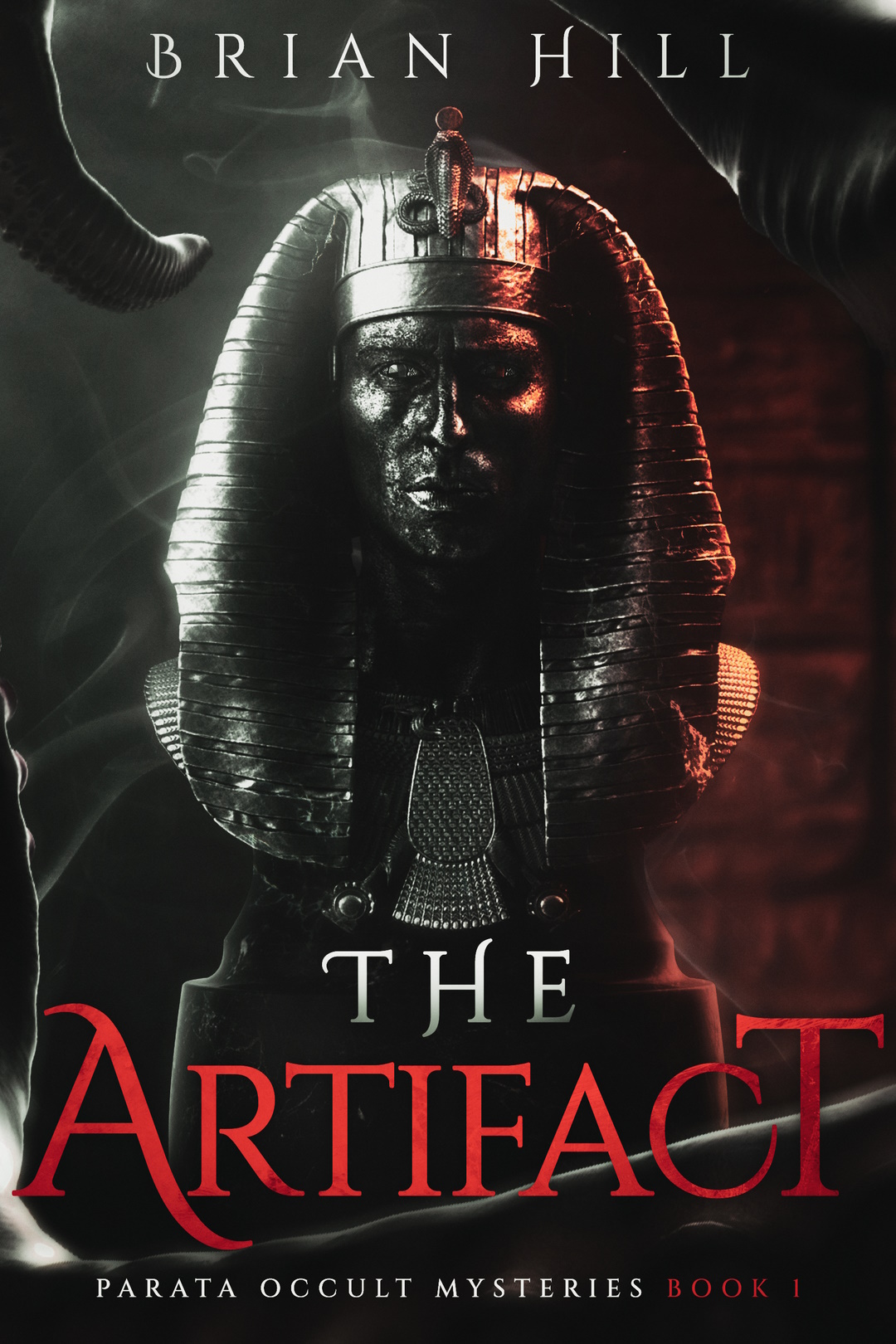
The Artifact drops a 6’7”, 325-pound half-Apache, half-Maori, ex-NOPD homicide cop turned Pensacola PI named Revel “Rev” Parata into a missing-persons case that turns out to be a Mythos snare. Rev thinks he’s chasing a stolen Egyptian Canopic jar from a non-profit antiquities outfit; what he’s actually doing is walking up the chain from a cult dupe, to a cult recruiter, to a cult sorcerer, to a cult financier — each of whom is pursuing the same artifact for incompatible reasons. The Jar of Nephren-Ka is exactly what one party claims (a sealed funerary vessel from the Egyptian Old Kingdom) and exactly what another party fears (a literal egg case for an avatar of Nyarlathotep). The book commits to both readings simultaneously and never blinks.
The novel fuses two American genres that don’t usually share a barstool. The first is hardboiled noir of the Chandler / Macdonald / Ellroy lineage: a wounded loner PI, a city as character, an unreliable client, an investigation that keeps escalating past the protagonist’s pay grade. The second is the cosmic-horror Mythos that traces back to H.P. Lovecraft and his circle — specifically the Nyarlathotep / Nephren-Ka / Book of Eibon corner of the Mythos developed by Lovecraft and elaborated by Robert Bloch and Clark Ashton Smith. Rev is a Chandler PI who walks into a Bloch story.
The 1984 setting is load-bearing. No cell phones, no internet, no DNA testing, no security-camera ubiquity. Rev’s tradecraft (pay phones, microfiche at the public library, reverse-lookup operators, fax machines, the answering service, bump keys, Polaroid evidence shots, mail-in expense reports) reads as period detail, but it’s also what lets the Mythos elements stay buried — modern forensics would have ended the Coventry case in twenty minutes. In a later decade the cover-up would not stay plausible.
What follows is a fan companion: a tour of who’s who, what’s what, what’s borrowed from real esoteric tradition, and what’s invented. Cite-and-go: every claim is anchored to a chapter. For craft critique, see /critique.
Inventory
- Entities and cosmology — Nyarlathotep (“the Crawling Chaos”); the centipede-avatar that gestates inside hosts; the implied Nephren-Ka mythos; “the Father” invoked in the Vacherie ritual; the coyote-spirit that intervenes at the Vacherie square.
- Rituals, sigils, and magical operations — the chalk-and-candle pentagram-in-circle (Kayrevla, Lafon, Vacherie); the asymmetric, distorted five-pointed star; the blood-painted variant; the Zisurrû fog-circle Calhoun describes; the Vacherie marble-square ritual with obelisks; the body-vessel rite that births the avatar from a host.
- Forbidden tomes, grimoires, and texts — The Book of Eibon (English/“ye olde English” copy with iron clasp, water-stained, found at Besonwa); a small French-language occult book on the same workbench; Calhoun’s personal occult journal; the chant-language fragments throughout.
- Artifacts, relics, and power objects — the Jar of Nephren-Ka itself (onyx, black-pearl-eyed pharaoh-head lid, “Canopic” in form); the bronze-scabbarded Kris dagger at the Society for Esoteric Knowledge office; the inverted black Ankh and golden crook Randolph wields; the Beatnik forgery-Jar (with red-gem eyes and a hidden insectoid second face); the marble obelisks and white-marble ritual square at Coventry’s plantation; the Barnes pendant (silver, glyph-inscribed) that ties Barnes’s existence to a sand-pile.
- Factions, cults, and secret societies — the Cultural Preservation Society (front for Coventry’s faction); the Society for Esoteric Knowledge (Randolph’s Atlanta-based cult); Searchlight Staffing (penetrated by Randolph’s daughter Isabelle as a hiring conduit); the Lafon ritual circle (five hooded celebrants — including Barnes, who attacks Rev on the landing); the Vacherie rite (Coventry alone, with Barnes attending until Barnes vanishes).
- The investigator’s craft — Rev’s hybrid noir tradecraft (surveillance, tails, document work, leg work, informant interviews, bribery, evidence sterilization) layered with skills that become quasi-occult only in retrospect (the Sunrise Ceremony invocation, the unconscious chant from grandfather, the dream of Calhoun’s death).
- Cover-up infrastructure — Coventry’s stated reason for refusing police involvement (provenance preservation) which is partly true and partly cover; Rev’s deliberate decision not to file with police because of his race (“place me, a Native American, breaking into a scene with no other footprints”); Freddy Guidry as the inside-the-force ally who lets the Calhoun missing-persons report eventually surface as an “anonymous tip”; arson-as-evidence-management twice (Besonwa, Vacherie).
- Locations and hidden geography — Pensacola Palafox Street office; the Cultural Preservation Society intake center on Julia Street, NOLA; Washington Manor apartments and the cemetery across the street; King Cab and the Westwego cabbie’s apartment; Kayrevla (Lacombe, the Randolph family Victorian); Besonwa (Quitman, GA, the Randolph estate); the Society for Esoteric Knowledge house in South Atlanta; Faucheux Monuments in Belle Chasse (Beatnik’s forgery shop); the Lafon Home for Boys ruin on Chef Menteur Highway (the auditorium ritual); Coventry’s plantation in Vacherie.
- Psychological and sanity costs — Rev’s prophetic dream of Calhoun’s dissolution; the “spiritual fear” beyond existential fear; the involuntary muscle compulsion under Randolph’s gaze; the three-lobed red eye that imprints during the Lafon ritual and again at Vacherie; the post-event hysterical laughter at the Barnes sand-pile; the persistent doubt afterward (“What if I had lost my fucking mind”).
- Mythos vocabulary — Nephren-Ka, “the Black Pharaoh”; Nyarlathotep; Zisurrû; The Book of Eibon; the Aklo-style chant-language with words like fhtagn, mglw’nafh, r’luh, kadishtu, ng, ahor, gnaiih, gof’nn; Kayrevla, Besonwa (the place-names that read like they belong to that same vocabulary).
- Case history — Rev’s NOPD homicide work (twelve years); his service in Vietnam as a recon specialist (the bad knee, the Buddhism kick, witnessing the Thích Quảng Đức photograph); the four-year-old “accident” — drunk-driving wreck while picking up Janet and Fred Guidry, which he survived as the rescuer but blames himself for — the wound that defines his sobriety; the Turbo Franklin bail-skip that opens the book and establishes Rev’s normal caseload.
- Period and setting texture — June 1984; Reagan-era Gulf Coast and Deep South; Police’s “Every Breath You Take” on the clock radio; Master and Commander in paperback; The Old Man and the Sea on stakeout; Mr. T on the convenience-store TV; Van Halen’s “Jump”; Caprice cruiser, Rolls or Bentley, AMC Gremlin, Pinto wagon; pay phones, Yellow Pages, microfiche, fax machines, Fuzzbusters; pre-CT-scan Egyptology pioneered at Tulane.
Cosmology
The book takes a hard position on whether the supernatural is real, and then refuses to let Rev rest in that position. Magic works. Rituals do something. The Jar of Nephren-Ka is, at minimum, a sealed vessel containing a living gestating avatar of Nyarlathotep — when Coventry completes the Vacherie rite, the Jar’s lid loosens (the “grout” residue is what kept the seal closed for four millennia), and a centipede-shaped being roughly three feet long with mandibles “sufficient to sever a hand” and a single triple-lobed red eye crawls out of Coventry’s mouth, having gestated inside him during the chant. This is not metaphor. Rev sees it, fears it, and watches it leave with a coyote spirit at its heels.
But the book also gives Rev — and the reader — every possible rationalist out, and lets him take them. The compulsion to put the gun under his chin at Besonwa? Hypnotic suggestion, like the dancing plague of 1518. The Calhoun dissolution dream? His mind running free. The Vacherie creature? A face he’d never quite admit to the Guidrys. Rev keeps the rationalist door open even after the door has been kicked off the hinges. This is a cosmological choice as much as a narrative one — the world contains the uncanny, and the world also contains people who refuse to let the uncanny disorganize their daily life. Rev is the second kind of person.
The hierarchy that gets named is small but pointed. Nyarlathotep sits at the top of what the cultists invoke — “the Crawling Chaos” of Lovecraft, who in this book is “the crawling one” and “the Father” of the larval avatar. Nephren-Ka is named as the Black Pharaoh, “the last pharaoh of Egypt’s Third Dynasty, reigning until his death around 2600 BC” (per the New York Times article on microfiche, which dates the Jar’s discovery to 1912; Sani separately tells Rev the tomb was found in 1913, when the Egyptian Antiquities release consigned the Jar to a Frenchman). He is a sorcerer-king whose Canopic jar contains not viscera but a piece of the god he served. The book implies, without spelling out, that the Jar is a birthing vessel — that “Nephren-Ka” the historical pharaoh was either the first host or the engineer of a recurring rite, and that what’s “sealed” inside is a generative form of the avatar itself.
Below the gods sit smaller spirits the book treats with equal weight. The coyote at the Vacherie ritual is plainly Rev’s tsúyé — his maternal grandfather, Chiricahua Apache medicine man — answering across the line between living and dead. Rev’s unconscious chant in the Lafon side room (syllables he doesn’t remember being taught but that flow “as if I were scatting in a jazz club”) is his grandfather’s protective rite, surfacing under occult pressure. The book is careful: Apache spirit-traditions and Cthulhu Mythos are presented as different vocabularies for the same kind of real, not as exotic decoration to dress up the Lovecraftian core.
Practical rules of the world: blood is currency (Calhoun’s death, the slab-victim at Besonwa, Rev’s own bleeding from a beating at Vacherie). Circles and pentagrams confine and protect — Randolph’s smudged circle at Besonwa is what almost certainly keeps Randolph from bringing the bullet’s force back at Rev (Rev’s gun fires under his own chin, ricochets off the stone walls, and finds Randolph through the foot-smudge in his own circle). The Vacherie ritual is more ambiguous: Coventry collapses mid-rite for reasons the book does not explain, the centipede emerges from his throat anyway, and the avatar declines to take Rev as a second host even though Rev is bound and gagged at the foot of an obelisk — what saves him is the coyote-grandfather drawing the creature into the woods. Words in the chant-language do work whether or not the speaker knows what they mean — Calhoun’s journal flags this directly: “I don’t even know what the words mean. They are so weird to say… But I feel the power when we say them.”
The investigator
Revel “Rev” Parata. Forty-something. Six-foot-seven, 325 pounds. Half Chiricahua Apache (mother’s side, raised on the reservation), half Maori (Maori father whose name he carries). Born in the U.S., raised partly on the rez, formed by his grandfather’s medicine-lodge tradition. Vietnam recon specialist; the bad left knee and the Buddhism are both legacies of that tour. Bachelor’s in Criminal Justice from Southern University at New Orleans. Twelve years New Orleans PD homicide, working under Captain Freddy Guidry. Four years a Pensacola PI, operating Parata & Associates out of a converted Creole townhouse on Palafox Street where he also lives — single cot in a converted storage room, single suit on a rolling rack, the YMCA shower he walks to on weekday mornings.
The damage that defines him isn’t the war. It’s a drunk-driving wreck four years before the book opens. His wife Rebecca had left him without warning; the department was grinding him; he was drinking. He picked up Janet and Fred Guidry (Freddy’s wife and son) drunk after pulling them out of “those men” (the book leaves this oblique — a violent threat Janet narrowly escaped) and crashed the car. He then dragged both of them out of the burning vehicle. They survived. He carries the shame as if they hadn’t. Janet’s confrontation at the dinner table — “you saved us… don’t torture yourself for it” — is the book’s emotional climax, and it carries more weight than the cosmic horror.
He doesn’t drink to drunkenness anymore. One scotch at Lili Marlene’s in Seville Quarter, then water, every time. He smokes a single Arturo Fuente cigar with it, which he caps and saves. He reads paperbacks on stakeout (Master and Commander, The Old Man and the Sea, both well-thumbed). He cooks badly and eats enormously — six eggs and half a pack of bacon, three plates of red beans and rice, forty McDonald’s nuggets at a sitting. He quotes Epictetus to himself when he gets aggravated about clients who won’t hire a Native PI (“There is only one way to happiness, and that is to cease worrying about things which are beyond the power of our will”). He wears the suit he hates because white clients trust the suit; he wears the slick-back hair for the same reason; he is fully aware these are tactical concessions and is not bitter about them, just clear.
His method is conventional PI legwork, layered with three things most PIs don’t carry. First, a recon specialist’s eye for terrain, surveillance counter-surveillance, and breaching (Besonwa, the Society for Esoteric Knowledge, Faucheux Monuments, Lafon, Vacherie are all entered without alarms or lasting traces). Second, a deep capacity to read people fast and accurately — he clocks Coventry’s display of wealth-as-intimidation in the first meeting, clocks Randolph’s voice as a grifter’s voice on the answering machine, clocks the apartment B&E as professional rather than panicked. Third, a Buddhist’s discipline around pain and a stoic’s around outcomes, both of which let him keep functioning in scenes that would lock up most people.
His tools are mundane and consistent: a Smith & Wesson Model 60 .38/.357 snub-nosed revolver (replaced after Quitman with an identical one whose serial he later files off); an old dark-green Caprice ex-cop cruiser with a chain-link cage divider; a leather pouch of bump keys; bolt cutters; a Polaroid camera; binos and a Fuzzbuster. His occult tools, such as they are, are inherited rather than chosen: the unconscious chant from his grandfather, the recognition of the coyote-grandfather at Vacherie, the dream-receptivity that shows him Calhoun’s death.
The accumulated damage by the end of the book: cracked ribs (twice), a broken nose (badly), a mild concussion, two killings (Randolph by ricochet, Lurch by gunshot), one corpse he doesn’t claim (Coventry, who killed himself by completing his own rite), one disposed murder weapon (the original Model 60 in Lake Pontchartrain), two arsons (Besonwa, plausibly Vacherie though he can’t remember setting that one), the Jar of Nephren-Ka itself in his possession (which he leaves the book holding, with no plan stated). Plus the part Rev would call psychological and his grandfather would call spiritual: confirmed contact with something genuinely other.
Case mechanics
The Parata case template, as established by this opener:
The hook is a wealthy, secretive client offering disproportionate money for what’s pitched as a routine job. Coventry pays Rev five thousand dollars (a month of full-time billable, when Rev is starving for fifteen-hundred-dollar bail-skip work) for a missing-persons-and-property job that any of three larger firms could do. Rev’s first instinct is to refuse — and he does — and is then forced back to the case by sheer financial desperation. The lesson the series will rely on: when the money is wrong for the job, the job is wrong for the money.
The first interview is the interrogation underneath the interrogation. Rev’s questions to Coventry on day one are nominally about the Jar, but Rev is reading the man — the timing of the call (already in town when he called), the chauffeur-as-power-display, the British aristocrat manner, the religious tenor when Coventry says “the Jar.” Half of what Rev decides about a case is decided in the client interview by watching the client lie.
The investigation follows visible breadcrumbs (apartment, credit card, cab fare) one step at a time, with each step generating one new lead. Cab → Lacombe → Kayrevla → diary → Randolph → Searchlight → Isabelle → Atlanta → Society for Esoteric Knowledge → Quitman / Besonwa. Rev never skips a step. The book takes its time on this; the pleasure is procedural. Rev is what he says he is — an errand boy, like a dog — and the dog finds the bone by sniffing.
The escalation is when the visible case turns out to be hiding a second case. Once Rev finds the bloody bed at Kayrevla and the centipede-eye starts surfacing in his peripheral vision, the missing-property job turns into a missing-person job turns into a homicide turns into a cult investigation. Each escalation pulls Rev further from anything he can take to the police and deeper into territory where his Apache and Buddhist resources have to do work his Smith & Wesson can’t.
The confrontation is on the cult’s ground, in the cult’s ritual, at the moment of the cult’s working. Rev twice arrives at the climactic ritual already in motion (Besonwa at the basement Nyarlathotep summoning, Vacherie at the avatar-birth) and twice survives it by a hair: at Besonwa, when his own gun-to-chin discharge under Randolph’s compulsion ricochets through the stone room and finds Randolph through the foot-smudged break in Randolph’s own circle; at Vacherie, by being knocked unconscious early in the rite (his head struck against the marble pillar after Coventry threw a fistful of sand in his face) and waking only after Coventry has collapsed and the centipede is already crawling out of Coventry’s mouth — the coyote-grandfather then arrives and draws the avatar away into the woods.
The price is paid by Rev in body (broken nose, cracked ribs, concussion, the killings), by the dupes in death (Calhoun, the slab-victim at Besonwa), and by the cultists themselves (Randolph, Lurch, Coventry, Barnes — Barnes most spectacularly, reduced to a hundred-pound pile of pink-and-brown sand inside his own clothes and shoes). What Rev does not get is closure on the metaphysics. The book ends with the Jar in Rev’s chest at the Pensacola office, the avatar loose somewhere in the Vacherie woods, Isabelle Randolph still unaccounted for, and Rev unsure whether he believes what he saw.
The reporting is asymmetric. To paying clients, Rev gives a tidy report and an itemized bill. To the police (via Freddy Guidry), he gives selective truth laundered as anonymous tips. To friends (Freddy at the porch, Janet at the table), he gives pieces that fit a noir story but not the cosmic-horror story. To himself, he gives a journal-equivalent of constant internal argument. The series will live or die on how it manages this asymmetry over four books.
Deep dives
Entities and cosmology
Nyarlathotep, “the Crawling Chaos”
In the story, the cultists invoke Nyarlathotep by name — both circles use the name in chant (“uh’eog nyarlathotep l’ ahuh’eog” at Besonwa, “nyarlathotep ahthrodog ng gokln’gha” at Lafon). The Vacherie chant translates explicitly: “For the crawling one we bring, / A vessel for your need, / His skin is no barrier, / His mind is no impediment, / He will be a servant of the Father, / Your larval children born of his body.” The thing that crawls out of Coventry is “the Father’s” larva — a child of Nyarlathotep gestated in the host. The triple-lobed red eye is the avatar’s signature; Rev sees it three times (in vision at Lafon, on the Faucheux bust hidden behind the false Pharaoh-head, and on the centipede at Vacherie).
This is straight Lovecraft. Nyarlathotep first appears in Lovecraft’s 1920 prose poem of the same name, then recurs throughout his work — most relevantly here in “The Haunter of the Dark” (1936), where Nyarlathotep is identified with the Egyptian avatar and where Robert Bloch’s Nephren-Ka first enters the Mythos. Lovecraft often wrote Nyarlathotep as taking many forms (“a thousand other forms”), and the Crawling Chaos epithet is his. The “crawling” gets literalized here as a centipede shape, which is the book’s contribution but consistent with the Lovecraftian convention that the avatar takes whatever form humiliates and disorients the host culture most.
What’s invented: the specific reproductive mechanism. Lovecraft’s Nyarlathotep manifests; he doesn’t typically gestate larvally inside human hosts in the canonical stories. The body-horror of a centipede emerging from Coventry’s mouth, splitting his jaw, is closer to Ridley Scott’s Alien (1979) than to Lovecraft’s typical mode — 1984 audiences had had five years to absorb the chestburster as horror grammar.
Why it matters in-universe: the cultists are not lying when they call this a “rebirth.” Coventry sincerely believes he is being honored by becoming the host. He is. He also dies for it, and the thing that wears him does not stay. The book hints that the avatar requires the Jar’s seal to incubate — that the Jar is part container, part egg-case, part incubator — and that the rite at Vacherie was the first time it had been allowed to hatch in an unknown number of centuries.
Cross-references: the bust at Faucheux Monuments shows two faces — the spider-/cobra-headed insectoid (with a single large red gem and six smaller red gems in a V) on one side, the regal red-gemmed Pharaoh on the reverse. The book shows the reader what the Black Pharaoh is before the climax confirms it. Beatnik-the-sculptor has been told to make this; Coventry knows the Jar’s true face is not the human one.
The coyote at Vacherie (Rev’s tsúyé / grandfather)
After Coventry has died and the centipede-avatar has been born and is at Rev’s foot, antennae brushing his thigh, a coyote steps out of the woods and locks eyes with Rev. Rev thinks “Grandfather?” and feels a wave of recognition. The avatar bolts after the coyote and disappears into the woods. Rev is spared. He thinks, with tears, “Thank you, Grandfather.”
Real-world antecedents: Apache cosmology recognizes Coyote as a major figure — trickster, transformer, sometimes guide, sometimes warning. Many Apache and broader Southwestern Native traditions hold that medicine people can take animal form, and that the dead may return as animals to deliver protection or messages to descendants. Rev’s grandfather, whom Rev calls tsúyé (his maternal grandfather; the Western Apache term -tsóyé / tsúyé indicates a maternal grandparent relationship), was a diyín — a healer, what whites call a medicine man. The word diyí’ that Rev uses for “magic” / spiritual power is the Apache term for the sacred power held by such practitioners. (The casefile is not confident in the precise spelling conventions across Apache dialects, and the book does not specify whether it draws on a particular community’s tradition or a more general Southwestern composite — readers wanting depth here should consult Apache-authored sources.)
What’s invented: the specific causal claim that the coyote-grandfather can attract and lead away a Mythos avatar of Nyarlathotep. But the structure — ancestor returning as animal at a moment of mortal crisis to protect a descendant — is in the tradition.
Why it matters in-universe: this is the book’s clearest statement that there is more than one occult system in operation, and that they are not equally hostile. The Mythos cults call down crawling things that hollow out their hosts. The Apache tradition Rev grew up dismissing returns him a grandfather who saves his life. The book does not editorialize, but the outcomes diverge: the inherited tradition Rev was embarrassed about helps him; the imported Mythos tradition Coventry mastered kills him.
Cross-references: Rev’s unconscious chant in the Lafon side room is the same tradition surfacing earlier, less dramatically. His fasting-vision dream as a child (the only previous time he’d had a dream as vivid as the Calhoun death-dream) is the same channel opening. The series can use any of these as a recurring motif if it wants to.
The centipede-avatar’s triple-lobed red eye
The avatar’s defining feature is “a single, burning, three-lobed red eye” with six smaller red lights below it in a V. Rev sees this composite shape three separate times: as an afterimage during the Lafon chant, carved on the cobra-headdress / spider-fanged bust at Faucheux Monuments, and on the centipede emerging from Coventry. The repetition is structural — the eye is the signal that the same thing is being approached from different angles. Lovecraft’s Nyarlathotep is rarely visually fixed (he changes form), but the idea of the singular eye that sees you from inside your own head before you ever see it goes back to Robert W. Chambers’s The King in Yellow and forward through Bloch’s Nephren-Ka stories. The three-lobed shape is original to this book; it reads as both botanical and arthropodal, neither stable.
Rituals, sigils, and magical operations
The asymmetric pentagram
The rituals at Besonwa, Lafon, and Vacherie all use a five-pointed star inside a circle, but Rev specifically notes the star is not a regular pentagram — “it was asymmetrical, warped looking, with some points being wider or longer than others.” A regular pentagram is a near-universal symbol with overlapping meanings across Pythagorean, ceremonial-magical, neopagan, and Christian traditions. The distorted variant marks the ritual as not in the standard ceremonial-magic line — something older and more specific.
Real-world antecedents: ceremonial magic in the Solomonic / Lemegeton / Key of Solomon tradition uses circles of protection inscribed with divine names to confine summoned beings. Rev’s reading of Randolph’s circle — that breaking it was what let the ricochet kill Randolph — would be perfectly intelligible to a sixteenth-century Solomonic practitioner: the circle’s integrity is what protects the magician from the entity being summoned, and a break in the circle means the entity has access. The book is using a real grammar from grimoire tradition.
What’s invented: the specific glyphs around the circle and the specific star-distortion. The chant-language is original to the book (see below).
Why it matters: each ritual scene is functionally the same scene — circle, candles, jar, chant — and the variations are diagnostic. At Besonwa, Randolph is alone with one human sacrifice and is trying to call something into the world. At Lafon, five robed celebrants chant in unison around a hand-linked circle and something is visibly forming in the candlelight (a shape Rev half-sees in the brief moments when the candles gutter, then vanishes when they re-catch). At Vacherie, Coventry is the only ritualist and is using his own body as the vessel — the rite has progressed from summoning to incubation to birthing across three scenes.
The chant-language (Aklo-style)
The cultists chant in a constructed language with words like fhtagn, mglw’nafh, r’luh, kadishtu, gof’nn, ng, ahor, gnaiih, ahthrodog, ehyeog, ymg’, llll. Some examples from the text: “C’ c’ uln n’ghft uh’eog nyarlathotep l’ ahuh’eog” (Randolph at Besonwa); “Ep gn’thorr mgepog, ah’legeth agl ahagl n’gha ahornah fhtagn, mgng Iiahe r’luhhor fhtagn, nyarlathotep ahthrodog ng gokln’gha” (Lafon); “Llll ahfhtagnor ehye c’ tharanak, ebumna llll ymg’ kadishtu” (Vacherie).
Real-world antecedents: this is in the Aklo tradition. Aklo is a fictional ritual language first named by Arthur Machen in “The White People” (1904) and absorbed into the Cthulhu Mythos by Lovecraft (in “The Dunwich Horror,” 1928, where Wilbur Whateley’s diary uses “Aklo”). The phrasebook draws on the modern community-built Aklo / “R’lyehian” lexicon that has accumulated across pastiche and gaming — words like fhtagn (“waits / sleeps”) and mglw’nafh (“dream”) come straight from Lovecraft’s “The Call of Cthulhu” (the famous “Ph’nglui mglw’nafh Cthulhu R’lyeh wgah’nagl fhtagn”). Kadishtu, gof’nn, gnaiih are from later contributors — Lin Carter, August Derleth, gaming sourcebooks — and the diction and consonant clusters track the Lovecraftian original. A reader recognizing fhtagn will recognize the whole.
What’s invented: the specific phrases are constructed for the book; the translated couplet (“For the crawling one we bring…”) is original verse in the constructed tongue, not a borrowed text. The Vacherie translation is the only one rendered into English in the novel — Rev “somehow understood” the chant at the moment of greatest peril, and the meaning arrives the way it would in a vision.
Why it matters: the chant-language gives the book its Mythos credentials in two words. Anyone who knows Lovecraft will recognize what they’re hearing; anyone who doesn’t will hear it as authentically alien rather than merely invented.
The Zisurrû
In Calhoun’s journal entry of 4/7/83: “there was a fog that formed, kind of floating over the circle that Mr. Randolph calls a Zisurrû.” Zisurrû (sometimes zisurrâ) is an actual Akkadian / Sumerian term for a magical flour-circle drawn around a person, bed, or object as a protective barrier in Mesopotamian apotropaic rituals — attested in cuneiform texts and discussed in modern Assyriological literature on Mesopotamian magic (e.g., Erica Reiner’s and others’ work on Akkadian incantations). For Randolph to use the word for a fog-emitting summoning circle is a Mythos-style appropriation: the historical Mesopotamian zisurrû is defensive (keeping bad spirits out); the cult’s use is invocational (drawing a being in). This is the kind of slightly-off use of real Near Eastern magic vocabulary that Lovecraft, Bloch, and Smith all favored — borrow the word, twist the function.
What’s invented: the fog-and-joy phenomenology of Randolph’s circle. The defensive Mesopotamian original doesn’t summon anything.
Why it matters: it signals that Randolph is not a generic cultist but a real reader — he knows historical magical vocabularies and rebrands them for his own use. His patter has the texture of someone who has actually read. Calhoun, who can’t tell the difference, gets caught.
Forbidden tomes, grimoires, and texts
The Book of Eibon
Rev finds The Book of Eibon on Randolph’s workbench at Besonwa, “bound in ancient leather, edges cracked and crumbling… closed with an iron clasp.” The pages are in “ye olde English,” water-stained, with diagrams whose meanings are lost on Rev.
Real-world antecedent: this is a real Mythos book — real in the sense that it has a real, documentable literary history, not in the sense that it physically exists. The Book of Eibon (Latin Liber Ivonis) was created by Clark Ashton Smith in his Hyperborean cycle of stories (“The Door to Saturn,” 1932; “Ubbo-Sathla,” 1933, etc.) and absorbed into Lovecraft’s Mythos. Lovecraft cites it explicitly in “The Dreams in the Witch House” (1933) and “The Haunter of the Dark” (1936) — where Robert Blake’s bookshelf in Providence holds, alongside the Necronomicon and the Cultes des Goules, the Liber Ivonis. So the book’s presence in Randolph’s library does two jobs: it’s a Mythos reference for readers, and it places Randolph in the Smith / Bloch / Lovecraft Haunter of the Dark lineage specifically, not the more generic Cthulhu corner.
What’s invented: any specific ritual the book contains. Smith never wrote a complete Book of Eibon — only excerpts and references. The “ye olde English” detail is original to this book; the Smith-canonical version was Hyperborean, then Latin, then variously translated.
Why it matters: it places Randolph (and through him, Coventry’s faction) in a Mythos lineage where rituals aimed at Nyarlathotep, the Black Pharaoh, and similar Eibon-adjacent figures are the genre. A reader who knows what The Book of Eibon is now knows what Randolph thought he was doing.
Calhoun / “Kinsey“‘s journal
Calhoun’s leather-bound journal — the central document of Act II — is the cult’s recruitment process documented in the convert’s own words. The 3/14/83 entry (meeting Randolph at the “Beyond the Veil conference”); the 3/19/83 entry (Randolph somehow knew his dreams, his beliefs); the 4/7/83 entry (the Zisurrû fog-circle); the 9/17/83 entry (the plan to steal the Jar revealed); the 5/23/84 entry (the heist accomplished, the bed at Kayrevla, the moment before death). It is the book’s compressed account of cult recruitment from the inside.
Real-world antecedents: the recruitment pattern Calhoun describes is documented in the academic and popular literature on cults — Steven Hassan’s Combatting Cult Mind Control, Margaret Singer’s Cults in Our Midst, Eileen Barker’s The Making of a Moonie. The “love-bombing → cosmic mission → us-vs.-them secrecy → escalating commitments” pattern fits classic high-control-group recruitment templates. The “cold reading” Rev attributes to Randolph (knowing what Calhoun dreamed) is real — practiced by stage psychics, faith healers, and cult recruiters alike, and documented at length in Ray Hyman’s and James Randi’s writing on the topic. The detail about Calhoun feeling power in the chant despite not knowing the words is the kind of phenomenology participants in trance-inducing group rituals genuinely report.
What’s invented: the specific Mythos content. Real cults rarely come dressed in Book of Eibon and Nephren-Ka iconography (though see, for the curious, the actual existence of the Temple of Set, the Order of Nine Angles, and the broader “Left-Hand Path” milieu of the late twentieth century — Mythos themes do leak into real esoteric subcultures, especially after Anton LaVey).
Why it matters: the journal is Rev’s only window into Calhoun as a person rather than a victim, and it’s the document that ultimately closes the question of what happened at Kayrevla. It also names Randolph, Searchlight, and the Atlanta Society for Esoteric Knowledge — the entire next half of the book is launched from these pages.
Artifacts, relics, and power objects
The Jar of Nephren-Ka
The eponymous artifact. Black stone — Rev’s first impression from a photograph is “onyx or basalt”; close-up at Besonwa he sees the lid is onyx, with individual black pearls set as the pharaoh’s eyes. Roughly the size of a small flower vase, ten pounds. Provenance traced from a 1913 Egyptian Department of Antiquities release to a Frenchman, to a 1918 Sotheby’s sale to John Birch for £1.24 million (~$10 million in 1984 dollars), to a 1984 gift from the Birch Collection to the Cultural Preservation Society. Sealed; presumed Canopic; the new CT-scan technique pioneered by Dr. Ibrahim Aziz at Tulane was supposed to image the contents non-destructively. It does not contain organs. It contains, per the climax, a gestating avatar of Nyarlathotep, sealed in by a grout-like material that has held since the Old Kingdom and that loosens during Coventry’s rite.
Real-world antecedents: the Black Pharaoh and Nephren-Ka are Robert Bloch’s contribution to the Mythos, introduced in “The Fane of the Black Pharaoh” (1937) and elaborated in stories where Nephren-Ka is the last priest-king of a forgotten dynasty who served Nyarlathotep and was buried with prophetic murals showing the future of mankind. Bloch’s Nephren-Ka is the direct ancestor of this book’s. Lovecraft picked up the figure in “The Haunter of the Dark,” explicitly identifying Nyarlathotep in his Black Pharaoh aspect. The 1913 discovery date the book cites for “Nephren-Ka’s tomb” is original to this book, but the broader claim — a Mythos pharaoh whose tomb contained sealed vessels that should not be opened — is straight Bloch.
The Canopic jar itself is real Egyptian funerary archaeology. Real Canopic jars contain the lungs, liver, intestines, and stomach of the embalmed; the heart was left in the body; the brain was discarded. Sani’s brief lecture to Rev on this is accurate Egyptology. The four canonical Canopic jars are associated with the Four Sons of Horus (Hapy, Imsety, Duamutef, Qebehsenuef), each with a distinctive lid (baboon, human, jackal, falcon respectively) — which is why a single jar with a pharaoh’s head is already an anomaly in real Egyptology, and why the book frames it as exceptional. The CT-scan imaging of unopened Canopic jars is a real technique, pioneered in the 1970s and widely used by the 1980s; the specific Tulane / Aziz attribution is invented.
What’s invented: Nephren-Ka as a Third Dynasty pharaoh (the historical Third Dynasty is Djoser, Sekhemkhet, Khaba, Huni — no Nephren-Ka); the Manetho tablet mention follows the Bloch-Lovecraftian convention (Manetho is real, his fragments are real, but the Nephren-Ka entry is fictional); the 1912 NYT-cited “discovery” date and the 1913 Antiquities-release date Coventry shows Rev are author specifics; the Jar’s specific provenance documents are fiction overlaid on the real Sotheby’s-and-Egyptian-Antiquities-Service apparatus that genuinely existed and processed Egyptian artifacts in the early twentieth century.
Why it matters in-universe: it’s the prize, the bait, the egg, and (probably) the recurring object the rest of the series will have to deal with. By book’s end Rev has it locked in his chest in Pensacola. The avatar that hatched from it is loose. What that means going forward is the series’ problem.
The Kris dagger at the Society for Esoteric Knowledge
Rev finds a sheathed dagger on display in Randolph’s Atlanta office: hardwood handle, bronze scabbard, “double-edged and wavy, like the stylized surface of a pond. A Kris knife, then.” Two scenes later, the same dagger turns up at Besonwa, bloody on the slab beside the human-heart sacrifice — Rev recognizes it instantly.
Real-world antecedents: the Kris (or keris) is a real and culturally important asymmetrical dagger from Indonesia, Malaysia, and the broader Maritime Southeast Asian world. It has UNESCO Intangible Cultural Heritage status (since 2008). The wavy blade (luk) is iconic; not all kris are wavy, but the wavy ones are the popular image. In traditional Javanese and Balinese contexts, the kris is considered to have isi — a spiritual power — and is associated with the empu (master smith) tradition. Some kris are believed to be enchanted and to require ritual care. The book is entirely correct in treating this as an object with deep cultural-magical resonance, though it doesn’t draw on Indonesian tradition specifically — it just borrows the kind of knife.
What’s invented: the dagger’s specific use as a Nyarlathotep-rite sacrificial blade. In Indonesian tradition the kris is a personal weapon and heirloom, not a temple-sacrifice implement.
Why it matters: it’s the first concrete bridge between Randolph’s Atlanta Society and the Besonwa basement — the same object travels between locations, confirming for Rev that the Atlanta operation and the Quitman operation are the same operation. The dagger is planted in Atlanta and recognized in Quitman, an object-level continuity in a book that is otherwise mostly procedural.
The Beatnik forgery and the Pharaoh-bust with the second face
The forgery that Coventry has commissioned from “Beatnik” at Faucheux Monuments to substitute for the real Jar at the Manhattan exhibition. Rev watches the substitution happen, marks one of the two crates with mud to keep them straight, follows Coventry to the Lafon ritual where Coventry uses the real Jar.
The hidden detail is the cobra/spider-headed bust on Beatnik’s shelf — what looks at flashlight-glance like a chitinous nightmare resolves on the other side into the regal Pharaoh head with red gems for eyes. The bust shows the Pharaoh and the avatar as two faces of one head. Beatnik has been carving this iconography for Coventry. He is not a confused artist; he knows what he is making. (Whether he knows what for is left ambiguous.)
What’s invented: the specific iconography of the Pharaoh with red-gemmed eyes as a coded second face. It sits in a Mythos tradition of double-aspect deities — the Black Pharaoh / Nyarlathotep is such a figure in Bloch.
The Barnes pendant
The strangest object in the book and the one with the least Mythos-canon backing. After the Vacherie ritual, Rev finds Barnes’s clothes in a heap with about a hundred pounds of pink-and-brown sand inside them, and underneath the sand a silver pendant inscribed BARNES on one side and “strange glyphs” on the reverse. The inference Rev cannot make himself articulate: Barnes was a constructed servitor, animated by the pendant, returned to sand when the binding was broken (presumably when Coventry died).
Real-world antecedents: the closest analogue is the golem of Jewish mystical tradition — particularly the Kabbalistic golem stories associated with Rabbi Loew of Prague (sixteenth century, popularized in Gustav Meyrink’s Der Golem, 1915, and many later works), where a clay or earth figure is animated by the inscription of a divine name (often EMET, “truth”) and de-animated by erasing the first letter to leave MET, “death.” A pendant inscribed with name-on-one-side and binding-glyphs-on-the-other is a Kabbalistic / Solomonic structure. There are also Egyptian shabti / ushabti figures — the small mummy-form servant statues placed in tombs to serve the deceased in the afterlife — which are not animated automata but which sit in the same conceptual space (named, inscribed, expected to serve).
What’s invented: the sand-rather-than-clay material; the specific contemporary servitor function; the un-naming via principal’s death rather than via inscription erasure.
Why it matters: Barnes-as-construct is shown rather than stated, and it retroactively recolors every prior Barnes scene. The “very image of discretion,” the chauffeur who never speaks, the unnervingly precise door-opening, the parade-rest stillness, the willingness to go hand-to-hand with a man Rev’s size: not a person being weird, a thing being well-made.
Factions, cults, and secret societies
The Cultural Preservation Society (Coventry’s faction)
Front for whatever Coventry actually is. Manhattan headquarters, New Orleans intake center, Lord Donald Coventry III as Director. Operates as a legitimate antiquities non-profit, processes real artifacts at the Julia Street facility (Sani and her team are not in on the cult; their work is real archaeology), insures heavily (per Sani, mandatory full intake-floor surveillance is an insurance requirement), and was specifically designed to acquire and “research” the Jar of Nephren-Ka under the cover of CT-scan imaging research with Tulane. After the climax, the organization’s status is unclear — Coventry was the head, the New Orleans facility may continue as a normal antiquities operation under Sani, or may unravel.
Real-world antecedents: the model is the small, privately funded non-profit antiquities society that exists to acquire objects for which institutional museums have provenance hesitations. These exist in the real antiquities world (the trade in dubiously-provenanced antiquities is the subject of Roger Atwood’s Stealing History and Peter Watson’s The Medici Conspiracy). The “Cultural Preservation Society” name and structure are invented, but the functional niche — gentleman-scholar with money, hires staff to do legitimate-looking work, also has private agenda — is real.
What’s invented: the cult layer underneath. Most real-world dubiously-provenanced-antiquities outfits are about money or ego, not Nyarlathotep.
The Society for Esoteric Knowledge (Randolph’s cult)
Atlanta-based occult organization fronting as a research society. Recruits via “Beyond the Veil” conferences. Cornelius Randolph as charismatic leader; daughter Isabelle Randolph as operations-and-logistics; Calhoun as one of presumably several recruits used for tasks the society can’t be seen doing directly. Funded enough to make a $300,000 “investment” in Searchlight Staffing in order to plant Isabelle there as a recruiter — a long-game infiltration. The donations Calhoun makes (over $3,000 across ten gifts in roughly a year) suggest a typical high-control-group financial-extraction pattern.
The relationship between the Society for Esoteric Knowledge and the Cultural Preservation Society is the book’s most important unresolved question. Both are after the Jar. Coventry feigns not knowing Randolph’s name in their conversation (Rev catches the flicker of recognition). The simplest reading: rival cults inside the same Nyarlathotep cult-tradition, who know each other and are in mortal competition. The Society wants to destroy the Jar (per Randolph’s pitch to Calhoun and Calhoun’s belief). The Cultural Preservation Society wants to use it (per Coventry’s actual rite). Calhoun was being used to steal the Jar from Coventry’s people on the assumption it would be destroyed; in reality, he was being used to deliver it to Randolph’s people for the same rite Coventry eventually performs at Vacherie. The two cults are doctrinally split on how to handle the artifact, not on what the artifact is.
What’s invented: the specific Society. The pattern — a cult founded by a charismatic with esoteric reading, operating out of a residential property in a city, funding itself through dues and “investments,” producing convinced recruits — fits the late-twentieth-century North American cult landscape (compare Bhagwan Shree Rajneesh’s organization, the Lyndon LaRouche organization, Heaven’s Gate, the Branch Davidians in their pre-Koresh phase, etc.).
The Lafon and Vacherie ritual circles
At the Lafon Boys Home auditorium ritual, five hooded celebrants stand around the chalk circle holding hands; their faces are concealed throughout the chant. Rev sees four arrivals (one luxury sedan, an unspecified second car, Beatnik’s Gremlin) plus Coventry’s Rolls (driven by Barnes), so Coventry and Beatnik are present in the building, and Barnes is too — but Rev never confirms which of these men is or isn’t one of the five robed figures. He does identify Barnes positively, when Barnes ambushes him on the landing afterwards and the hood falls free. The Vacherie rite, by contrast, has only Coventry as ritualist, with Barnes attending until Barnes himself vanishes (his clothes left in a heap with a hundred-pound mound of pink-and-brown sand inside them and a silver BARNES pendant beneath). The “BMW or Mercedes” arrival at Lafon suggests at least some celebrants are wealthy professionals — the demographic real-world esoteric orders historically draw from (compare the membership of late-Victorian and Edwardian magical orders like the Hermetic Order of the Golden Dawn, which counted W.B. Yeats and Aleister Crowley among its members).
What’s invented: the specific composition. We never learn names for four of the five.
The investigator’s craft
Tradecraft: the noir half
Rev’s investigative method is recognizably Chandlerian. He interviews the client and reads them as much as their words. He runs down breadcrumbs (apartment, credit card, cab fare) one at a time. He bribes informants in small denominations (five for the Washington Manor neighbor, ten then twenty for Oleg, twenty for Hubert at King Cab — increased to forty when needed, exactly the way Marlowe handled it). He cultivates a contact inside the police (Freddy Guidry, captain at the Fourth District) and trades on the friendship sparingly. He uses the Yellow Pages and reverse-lookup operators the way a modern PI uses Google. He sits stakeouts for hours with a paperback.
The noir touches that mark him as a particular flavor of PI: the bad knee from the war, the size that does half his work for him, the suit he wears as costume rather than identity, the office that doubles as his bedroom, the loose-tied financial precarity that forces him to take cases he’d rather refuse. The drinking-and-stoicism mix (Epictetus, Buddhism, Apache reserve) is a more interesting personality stack than the standard Marlowe model, but the silhouette is the same.
Tradecraft: the breaching half
Rev breaks into five locations across the book: Calhoun’s apartment, the Society for Esoteric Knowledge house in Atlanta, Besonwa, Faucheux Monuments, the Lafon Boys Home. In each case he uses a small leather pouch of bump keys, a flashlight, gloves, and a Polaroid. The bump-key technique is real — bump keys are specially cut keys that exploit the pin-tumbler mechanism, and they were a known hobbyist / criminal technique well before the broader public learned about them in the 2000s. Rev’s confession that he is bad at picking locks but good with bump keys is a realistic admission; many real second-story workers specialize in one or the other.
The breaching is married to a recon-specialist’s spatial discipline: clear each room before exploring; close doors behind you; mark evidence (the scotch tape on the Faucheux safe, the mud-streak on the Jar’s transport crate); sterilize the scene (the Besonwa arson, the new Smith & Wesson with the filed serial after dropping the original off the Twin-Span bridge into Lake Pontchartrain). Rev’s understanding that hairs, fibers, blood, and skin will be at any scene where he was present is a 1984 understanding of forensics — pre-DNA but post-fingerprint, post-fiber-analysis. By the standards of the era, his sterilization is competent. By modern forensic standards he’d be in prison by Tuesday.
Tradecraft: the inherited half
The third layer is the one Rev half-believes and half-rejects: the Apache spiritual inheritance from his grandfather. The Calhoun-dissolution dream that wakes him screaming the morning after Kayrevla. The unconscious chant in the Lafon side room that flows out of him “as if I were scatting in a jazz club” and that drives back the three-lobed eye. The Sunrise Ceremony memory that surfaces at Besonwa just before the bullet finds Randolph. The coyote-grandfather at Vacherie. The text treats each as the same channel — diyí’ — opening at moments of mortal occult pressure. Rev consistently rationalizes them after the fact (hypnotic suggestion, mind running free, hallucination) but the book’s framing does not — the events occur as described, and Rev’s rationalizations are presented as Rev’s, not the narrator’s.
Cover-up infrastructure
Who knows the occult is real (in this book)
Randolph (who summoned and was killed by his own ricochet); Coventry (who hosted the avatar and was killed by it); Calhoun (briefly, and was killed by the bed at Kayrevla); Isabelle Randolph (presumed; whereabouts unknown by book’s end); the four robed celebrants at Lafon (three of whom we never identify); Beatnik the sculptor (lives to sculpt another day); Sani (does not — she is a working Egyptologist and as far as we can tell never crosses into the cult layer); Rufus Freeman the trucker at the loading dock (does not). And Rev. Rev is now the only person on Rev’s side of the case who knows.
Suppression mechanisms
- The cult itself prefers private rituals, isolated locations (Lacombe swamp, Quitman countryside, abandoned Lafon Boys Home, rural Vacherie plantation), and no police involvement at any cost. Coventry’s stated reason for not calling police about the theft — provenance preservation — is half a real concern of the antiquities world and half a cover. Both sides of the cult would lose everything if the rituals became public knowledge.
- The legitimate antiquities world provides cover by accepting “discreet, donor-funded research society” as a normal organizational form. Sotheby’s, the Met, the British Museum all genuinely have items of dubious provenance; the Cultural Preservation Society fits in.
- Race, class, and rural geography do most of the actual suppression work. Rev explicitly cannot call the police about Kayrevla — “What, and place me, a Native American, breaking into a scene with no other footprints besides the victim’s?” Vacherie is too remote for anyone to investigate quickly. Quitman has a single Parish courthouse and no curious press. The cult chooses these places because they will hold a secret.
- Friendship-based selective disclosure, via Freddy Guidry, lets Rev launder partial truths into police channels as anonymous tips. Calhoun’s body almost certainly gets recovered from one of the Besonwa cemetery plots through this channel, and his parents in Tucker eventually learn what happened to him — but the cosmic-horror frame around his death stays buried.
- Fire does the rest. Besonwa and the Vacherie plantation both burn. Whether Rev set Vacherie or whether the candles did is unclear (Rev himself can’t remember). The result is the same: physical evidence of the rituals reduces to ash.
Locations and hidden geography
Pensacola — Palafox Street and Seville Quarter
Rev’s office and home, in a former bar-and-grill storage space inside a turn-of-the-century Creole townhouse on Palafox, is a working portrait of Pensacola’s actual historic district — the old downtown where Spanish Colonial wrought-iron facades, twelve-foot ceilings, and reclaimed-from-elsewhere bar wood (Lili Marlene’s bar is genuinely supposed to be from Chicago’s Blackstone Hotel) coexist with serious building decay. Lili Marlene’s, Rosie O’Grady’s, the Seville Quarter complex — these are real Pensacola institutions. The book’s affection for this neighborhood is the affection of someone who knows it.
New Orleans — the working geography
The Cultural Preservation Society at 920 Julia Street puts the cult right at the edge of the Warehouse District, plausible for a 1984 antiquities operation. Washington Manor on Washington Avenue puts Calhoun in a part of the city with the cemetery-across-the-street motif that’s distinctively New Orleans (above-ground vault tombs because of the water table — “stone vaults reaching like dead trees toward the dingy gray sky”). The Twin-Span bridge across Lake Pontchartrain to the North Shore is the route the book takes seriously: every drive across it is a small set-piece. King Cab on Howard Avenue, the West Bank trip to Buck Forty-Nine, the East New Orleans Lafon ruin on Chef Menteur — these are real places (or carefully invented to feel real).
Kayrevla, Lacombe
The abandoned Victorian on a dirt drive off LA-434 north of I-12, with the gate, the cypress canopy, the marble fountain with the avenging-angel centerpiece, the wraparound-porch and turret. The name KAYREVLA carved on a sign over the entrance is Rev’s name, with an unidentified “Kay” and “La” framing it — the book never explains this, leaving it as a hook for later books. The simplest reading is that Kayrevla is the family seat of the Apache + Maori + Louisiana tradition Rev’s people came from — a name in a tradition that includes Rev. The book does not confirm. (On this casefile’s reading, this is the series’ largest dangling thread and a likely candidate to pay off in a later volume.)
The bedroom with the bay window over the swamp, the bed soaked through with blood, the sprouting mushrooms in the wet center, the comforter folded back over to hide the mess: the book’s first horror tableau. The dream of Calhoun being absorbed into the bed — flesh, then fat, then muscle, then bone — is the second.
Besonwa, Quitman
Cornelius Randolph’s restored estate on Old Jones Place (formerly Worn Lane) in Quitman, GA, an hour and change northeast of Tallahassee. White-stone, Greek-revival in feel with European pretensions; six columns, double doors under a pointed Italianate-cathedral arch with the word BESONWA carved at the apex. The barbed-wire perimeter, the recon-style infiltration, the priest hole in the parlor fireplace, the basement cellar with the sacrificial slab — the book’s most cinematic location.
The name pattern (Kay-Rev-La / Be-Son-Wa) is structurally identical: three syllables, asterisked. They read as belonging to the same constructed proper-noun system. Whether this is the language of the Mythos chant, an unrelated personal-cipher Randolph and Rev’s family share, or something else, the book doesn’t say.
The Society for Esoteric Knowledge house, South Atlanta
White siding, burgundy trim, paved-over backyard for parking, no signage. Recently gentrified neighborhood. Inside: a downstairs office for accountant-grade paperwork on donations and an investment in Searchlight; upstairs an “office” that is really a small ritual chamber, with the painting of the radiating-arrows glyph above the small altar with marble bowl and twin candlesticks. The location — residential-converted-to-quiet-professional-space in a gentrifying neighborhood — is unremarkable.
Faucheux Monuments, Belle Chasse
A failing monument shop run by Beatnik, used as a forgery workshop. The Cobra/Pharaoh dual-faced bust, the centipede sculpture that gives Rev a flash of recognition before he can name it, the unworked block of onyx that becomes the forgery Jar. Functions as the book’s “what is this man making and for whom” middle act. The man-sized safe in the back office contains, presumably, the real Jar between rituals — Rev tapes it, confirms it’s been opened in the relevant interval, and that’s how he knows the substitution is happening.
Lafon Home for Boys, Chef Menteur Highway
Real or near-real: the Lafon Asylum / Lafon Old Folks Home is a real New Orleans institution founded by Thomy Lafon in the nineteenth century, though the boys’-home version and its specific Chef Menteur location may be relocated for fiction. The building Rev infiltrates is a ruin: brick colonial, two-story, with the auditorium where the five-celebrant ritual takes place. The decapitated-Jesus statue with the spray-painted blood around its neck reads as Mythos overwriting Christian iconography — the older symbol literally beheaded and dripping into the new one.
The Vacherie plantation
Greek-revival plantation house on Oak Alley Lane in Vacherie, ~800 yards from the Mississippi (Rev triangulates from the smell of factory runoff). The white-marble ten-foot ritual square in the back garden, surrounded by four ten-foot marble obelisks at the corners with Egyptian hieroglyphs. The book’s only purpose-built ritual space — Coventry has constructed it to specification. Oak Alley Lane echoes the real Oak Alley Plantation in Vacherie (a well-known antebellum plantation on River Road, with its quarter-mile alley of live oaks); the book is using the geography, not the actual site.
Psychological and sanity costs
The doubt
The most consistent psychological weight in the book is not fear but doubt. After Kayrevla, Rev cannot square the dream with his materialism and chooses to “forget the dream.” After Besonwa, he insists the gun-to-chin compulsion was hypnotic suggestion (the dancing plague of 1518). After Lafon, in the side-room aftermath: “Was I going crazy? What in the fuck was happening to me?” After Vacherie and the Barnes sand-pile, he laughs hysterically and afterwards recounts the night while half-arguing with himself: “What if there were no rituals, no cult? What if I had lost my fucking mind…” The doubt does not resolve. The book ends with Rev unsure what to believe and unwilling to talk to anyone who could help him triangulate.
This is a real psychological response to extreme experience and is documented in the trauma literature — the impulse to dismiss what happened to maintain coherence with the worldview one had before. Rev’s particular flavor of it (Buddhist + Stoic + materialist + ex-cop) is unusual but coherent.
The compulsion
The most physically frightening thing in the book is not the centipede. It’s Randolph, in the basement at Besonwa, taking direct control of Rev’s right arm and walking the gun up Rev’s chest to his chin while Rev mewls in resistance. The horror is not death but the loss of agency over one’s own body — being made to be one’s own murderer. The anxiety goes back through Lovecraft (the loss of self in “The Shadow Out of Time,” “The Thing on the Doorstep”) to Edgar Allan Poe (“The Imp of the Perverse,” “William Wilson”). The scene carries as much weight as any of the book’s visual horrors.
Mythos vocabulary (quick reference for the curious)
- Nephren-Ka — The Black Pharaoh. Robert Bloch coinage, 1937.
- Nyarlathotep — The Crawling Chaos. H.P. Lovecraft, 1920.
- The Black Pharaoh — Mythos epithet identifying Nephren-Ka with Nyarlathotep. Bloch / Lovecraft, c. 1936.
- Zisurrû — Real Mesopotamian magical-circle term, repurposed.
- The Book of Eibon — Clark Ashton Smith, 1932 onward. Real Mythos book in Lovecraft’s bibliography of fictional grimoires.
- Aklo — Arthur Machen, 1904. Ritual language. Adopted into the Mythos by Lovecraft in “The Dunwich Horror.”
- fhtagn / mglw’nafh / r’luh — From Lovecraft’s “Call of Cthulhu” R’lyehian fragment.
- diyí’ — Apache term for spiritual/sacred power. Real.
- tsúyé — Apache kinship term for maternal grandfather. Real.
Wait, that’s real?
- Nephren-Ka and the Black Pharaoh — A reader might assume this is invented for the book; it’s Robert Bloch’s contribution to the Mythos from 1937, refined by Lovecraft.
- The Book of Eibon — A real fictional book with a real literary history. Created by Clark Ashton Smith, cited by Lovecraft, beloved by Mythos readers since the 1930s.
- Aklo / R’lyehian chant-language — The chant fragments are in a constructed language with deep Mythos pedigree. fhtagn is Lovecraft’s, and recognizable to anyone who’s read “The Call of Cthulhu.”
- The Zisurrû — A genuine term from Akkadian / Mesopotamian magical practice for a protective flour-circle.
- Canopic jars and CT-scan imaging — The Egyptology Sani teaches Rev is accurate. CT-scan imaging of unopened Canopic jars was a real and reasonably new technique by 1984.
- Cold reading / cult recruitment patterns — Randolph’s apparent psychic knowledge of Calhoun’s beliefs and dreams is a documented real-world technique used by stage psychics, faith healers, and cult recruiters. The recruitment pattern Calhoun’s journal traces (love-bomb, grand mission, isolation, escalating commitments) is documented in the academic cult literature.
- Bump keys — Real lockpicking technique exploiting pin-tumbler mechanism; well-known to security professionals and second-story workers in the era.
- The Kris dagger — Real Indonesian / Malaysian cultural-magical artifact with genuine spiritual associations.
- Lili Marlene’s, Seville Quarter, Pensacola Palafox Street — Real places. The Blackstone Hotel bar story is real local lore.
- The Lafon institutional history (in part) — Thomy Lafon was a real nineteenth-century New Orleans philanthropist whose name attached to several institutions. The boys’-home location may be displaced for fiction.
- Oak Alley Plantation, Vacherie — Real plantation. The book uses the geography.
- Thích Quảng Đức’s self-immolation — Real (Saigon, June 11, 1963). Rev’s mention is historically accurate.
- Police, “Every Breath You Take”; Van Halen, “Jump” — Real songs on the radio in summer 1984.
Wait, that’s not?
- Nephren-Ka as a Third Dynasty pharaoh — The historical Third Dynasty has no Nephren-Ka. The figure is purely Mythos. The “Manetho tablet mention” follows the Bloch-Lovecraft convention of plausibly placing a fictional pharaoh in real Egyptological apparatus.
- The 1912 NYT-cited tomb discovery and the 1913 Antiquities-release — Author’s specific dates, not a real archaeological event. (The book gives both dates, in different sources Rev reads.)
- Dr. Ibrahim Aziz at Tulane and his CT-scan technique — Specific attribution invented; the underlying technique (CT imaging of Canopic jars) is real but originates with other researchers.
- Cornelius Randolph as a real occult figure — Wholly invented. Not to be confused with the historical Randolph family of Virginia or with Paschal Beverly Randolph, the nineteenth-century African American occultist (different person, despite the surname overlap).
- The Society for Esoteric Knowledge / Cultural Preservation Society — Both fictional organizations.
- The Jar of Nephren-Ka itself — Author’s specific object. The Bloch / Lovecraft Mythos has Nephren-Ka’s tomb and prophetic murals; it does not, to my recollection, have this specific jar.
- The Kayrevla / Besonwa names — The author’s constructed proper nouns, not anything from existing tradition.
- The triple-lobed red eye — The author’s visual signature for the avatar; not a Lovecraft canonical detail.
- The centipede form of the avatar — The author’s choice. Lovecraft’s Nyarlathotep is famously protean; this specific form is original to this book and probably borrows visual grammar from late-twentieth-century body horror (chestbursters, the parasitoid wasp, the centipede as universal arthropod-horror form).
- The Barnes-as-sand-construct mechanism — The author’s variation on golem / shabti traditions, not a direct tradition.
- “Beyond the Veil conference” — Invented, though it gestures at the real subculture of esoteric conferences (compare the Theosophical Society’s annual conventions, Spiritualist gatherings, modern occult conferences like Esoteric Book Conference, Ancient Mysteries Conference).
- Searchlight Staffing — Invented agency.
- Faucheux Monuments — Invented business.
- The chant-language phrases — Specific lines composed for the book. The vocabulary draws on Mythos community usage but the sentences are original.
- The Vacherie ritual square’s specific design — Author’s invention, though the obelisks-at-cardinal-points layout is consistent with Solomonic / Egyptian-revival ceremonial-magical practice as it filtered through nineteenth-century occult orders.
Easter eggs and callouts
- “You can call me Rev” in the opening liquor-store scene — first name introduction is also a noir-genre genuflection: every PI of Chandler’s school gets nicknamed by someone who underestimates him in the first chapter.
- The Caprice ex-cop cruiser with chain-link cage — period-correct PI cliché played straight; Rev names the cage as the reason he bought it.
- Police’s “Every Breath You Take” on the clock radio the morning of the Coventry first call — a sly noir wink (“Sounded like someone needed a restraining order”) at a song about surveillance, opening the surveillance-heavy book.
- Mr. T on the Quitman convenience-store TV — Period anchor. The A-Team premiered January 1983; “I pity tha’ fool” was at peak cultural saturation in summer 1984.
- Van Halen’s “Jump” as the wake-up song before the Lacombe break-in — Van Halen’s 1984 released January 1984, “Jump” was the first single and a #1 hit. Period anchor and a sly title (“Just go ahead and jump”) for a scene where Rev is about to leap a fence.
- “Geronimo” the slur from Turbo in the Caprice — and Rev later, with Janet, recalling how the police treated him as a “secondary citizen.” The book uses period-realistic racism without comment, which is itself a noir convention (Walter Mosley’s Easy Rawlins novels do this most famously, set in roughly the same era).
- Rev quoting Epictetus and citing “the dancing plague of 1518” — both real (Epictetus, the Stoic; the 1518 dancing plague of Strasbourg, real and well-documented). The latter is also Rev’s preferred rationalization for the gun-to-chin compulsion at Besonwa.
- Beatnik’s “anthropomorphic insectoid” sculpture and the Vacherie centipede — the avatar (or something close to it) is shown to Rev as art before it’s shown to him as itself. The Faucheux carving isn’t literally a centipede — it’s a curled, spindly-armed insectoid form on black marble — but it gives Rev a “flash of something from a dream” he can’t place, which the climax retroactively explains. A reader paying attention to the Faucheux scene gets the surprise of recognition at Vacherie.
- The decapitated Jesus statue at Lafon — visual statement that the Mythos has overwritten the previous tradition in this space; the religious imagery isn’t being repurposed, it’s being desecrated.
- The Webley automatic Coventry pulls on Rev — period-correct British officer’s sidearm choice for an English aristocrat character. The Webley revolver is more famous, but Webley made automatics too in the early twentieth century. Coventry’s choice of an old British service pistol is in character.
- Oleg eating the fare ticket in front of Rev to dispose of the evidence — small comic noir set piece; Rev’s reaction (“Fucking Russians, crazy as shit-house rats”) is the book’s funniest line.
- The “Black Pharaoh” called out by name in the New York Times article — Mythos readers will recognize the Bloch reference the moment they read the article on microfiche; for casual readers, it’s just background.
- Coventry’s “Cultural Preservation Society” — the name reads as ironic in retrospect. The society does not preserve the culture it’s storing; it’s preparing one of its objects to hatch.
- Calhoun’s “Beyond the Veil conference” — title that any reader of nineteenth-century Spiritualist literature will recognize as a Spiritualist trope. The veil between this world and the next is the central Spiritualist metaphor.
For further reading
- The Robert Bloch Mythos stories — especially “The Fane of the Black Pharaoh” (1937), “The Faceless God” (1936), and “The Shambler from the Stars” (1935). This is where Nephren-Ka lives. Available in the Mysteries of the Worm collection (Chaosium / Hippocampus Press).
- H.P. Lovecraft, “The Haunter of the Dark” (1936) — The Lovecraft story that consolidates Nyarlathotep / Black Pharaoh / Liber Ivonis into one frame; explicit dialogue with Bloch (Lovecraft kills off a character based on Bloch in the story; Bloch had killed off a character based on Lovecraft in his earlier “The Shambler from the Stars”).
- H.P. Lovecraft, “Nyarlathotep” (1920) and “The Dream-Quest of Unknown Kadath” (1927) — for the original and the longest Nyarlathotep portraits.
- Clark Ashton Smith’s Hyperborean cycle — for the original Book of Eibon fragments. The Book of Hyperborea (Necronomicon Press) collects them; many are also in Penguin’s The Dark Eidolon and Other Fantasies.
- Raymond Chandler, The Big Sleep (1939) and The Long Goodbye (1953) — for the noir PI lineage Rev is in.
- Walter Mosley, Devil in a Blue Dress (1990) — for the closest direct comparand: a non-white PI in a period setting (1948 LA) navigating both criminal underworld and racial hostility, a clear cousin to Rev’s situation in 1984 Pensacola / NOLA. The Mosley novels are essential reading for anyone interested in how this book fits in the broader American hardboiled tradition.
- For the Egyptology — Salima Ikram, Death and Burial in Ancient Egypt (AUC Press) is a clean general introduction. For Canopic jars specifically and the Sons of Horus iconography, John H. Taylor, Death and the Afterlife in Ancient Egypt (British Museum Press) is the standard.
- For the cult-recruitment realism in Calhoun’s journal — Steven Hassan, Combatting Cult Mind Control (Park Street Press), and Margaret Singer, Cults in Our Midst (Jossey-Bass). These will let you map Calhoun’s progression entry by entry against documented patterns.
- For grimoire tradition and the protective circle — Owen Davies, Grimoires: A History of Magic Books (Oxford), is the readable scholarly survey. For an actual Solomonic primary, The Lesser Key of Solomon (Joseph H. Peterson’s edition is the standard) shows what a real circle-and-spirits ceremonial system looks like.
- For the Mesopotamian zisurrû and ancient Near Eastern apotropaic magic — Erica Reiner, Astral Magic in Babylonia (American Philosophical Society) or, more accessibly, Daniel Schwemer’s chapters on Mesopotamian magic in the Cambridge Companion to Ancient Mediterranean Religions. (Honest disclaimer: the Assyriological literature on zisurrû specifically is technical; a curious general reader is better off with Schwemer’s overview chapters.)
- For the Apache tradition Rev draws on — Keith Basso, Wisdom Sits in Places (University of New Mexico Press) is the obvious starting place for Western Apache thought. For Apache-specific medicine traditions, the literature is uneven and frequently extractive; Apache-authored sources should be preferred where available. (I’m not confident in current best-of-list recommendations here — the field has shifted significantly toward Indigenous-authored scholarship in the last twenty years and a curious reader should look for current Apache-authored work rather than older anthropological accounts.)
- For the noir-Mythos crossover as a sub-genre — Tim Powers, Declare (2001), and Charles Stross’s Laundry Files novels (starting with The Atrocity Archives, 2004) are the obvious modern landmarks. T.E.D. Klein’s The Ceremonies (1984, exact contemporary of The Artifact) is a folk-horror cousin. Caitlín R. Kiernan’s Agents of Dreamland (2017) and Premee Mohamed’s Beneath the Rising sequence are recent entries. None of these is doing exactly what The Artifact does, but each is in conversation with the same tradition.