Incursion
The deepest D&D roguelike ever written. Now it runs on more than Windows.
Release 4
Julian Mensch wrote Incursion over the better part of a decade and then very nearly finished it. It is not a game with a few D&D words borrowed for flavour — it is a real, implemented 3.5 ruleset, with feats that combine, classes that branch into prestige paths, and a tactical combat model that pays you back for every rule you actually know. The magic is not even straight 3.5: Mensch threw out the SRD's eight schools and wrote his own eleven, Arcana and Thaumaturgy and Weavecraft among them.
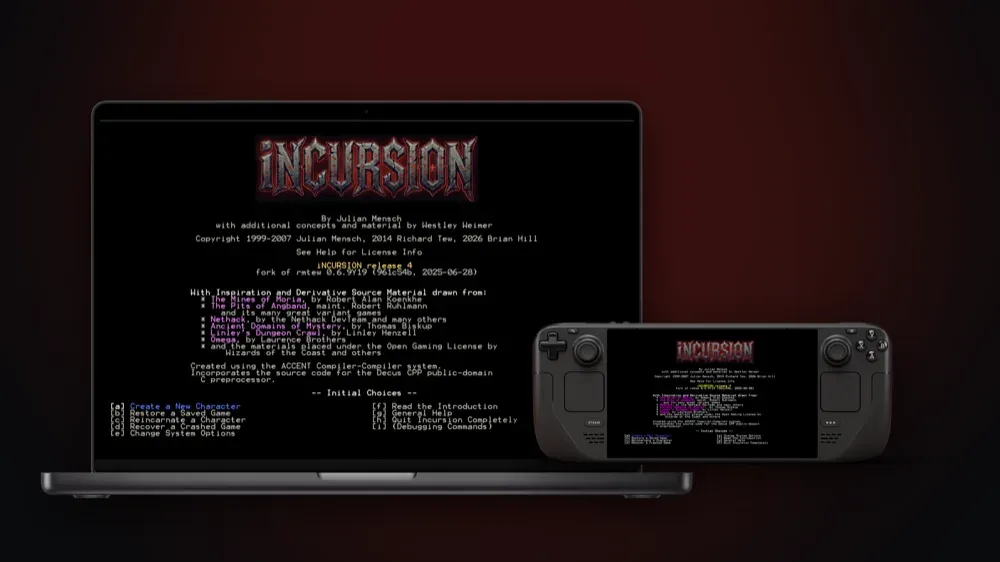
And for its entire life it ran on Windows and nowhere else. This fork is the port. Release 4 is macOS, Windows, Linux and the Steam Deck, all four downloads built from one commit, signed and notarised on the Mac. No installer, no dependency to fetch, no compiler. It is meant to be played, not built.
What Playing It Is Like
You roll a character through a long, gloriously opinionated creation flow — race, subrace, class, attributes, alignment, feats, skills, a god — and then you go down into the Halls of the Goblin King. Combat is turn-based and genuinely tactical. Positioning matters. Attacks of opportunity matter. Two-weapon fighting, spell components and saving throws all matter, and the game will happily kill you for ignoring any of them. Play it like a hack-and-slash and it will teach you otherwise in about ten minutes.
The writing is the other half of it. Every monster, item, spell and class carries its own description inside the game — not a stat line, a paragraph with a voice. You can read the entire ruleset from inside the game, and it is worth reading.
What Release 4 Added
The map is lit in colour. Incursion draws its map in the sixteen colours the character set gives it, and a lit square used to be no more than a brighter version of its own colour. There is now a light map under the display. Every torch, lantern, magma pool, glowing creature and light spell casts a coloured footprint that falls away with distance, and each source flickers on noise of its own — a torch gutters, a lantern is nearly steady, magma breathes slowly. Light loses strength and colour crossing ice or fog, and it glints off a shiny wall in the colour that struck it.
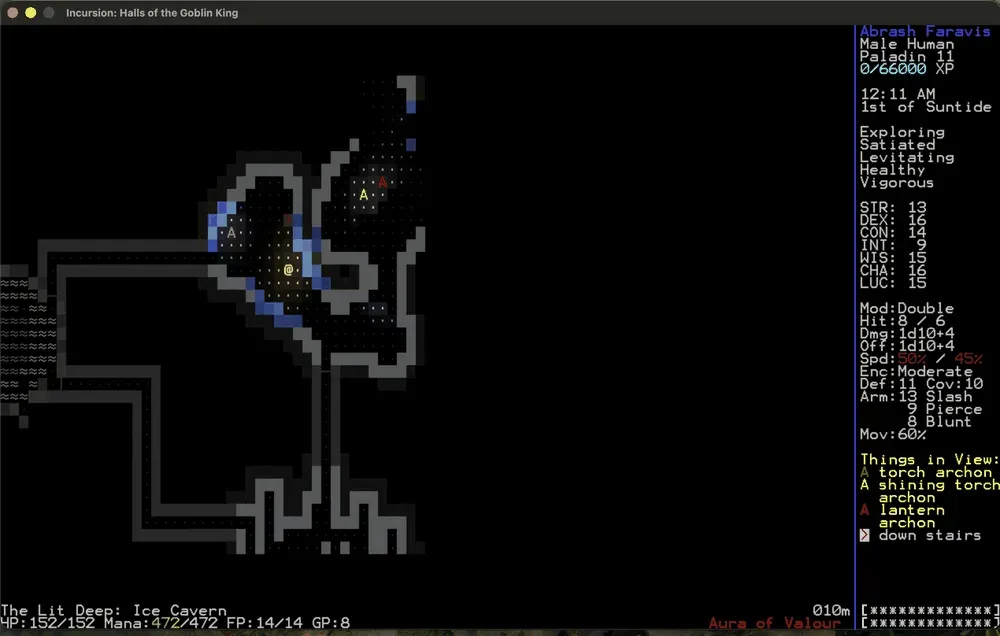
Light now decides what you can see, and what can see you. Twelve creatures and the flame template light their surroundings by their own nature rather than only by carrying a torch. A creature can no longer hide while carrying a lit torch, lantern or glowing weapon. Hiding, light aversion and what the map actually paints all read the same brightness rule now, rather than each answering the question its own way.
The game plays on a gamepad. The SDL build reads a controller itself — eight-direction movement on the left stick, the look cursor on the right, Kick and Pray and Legend and Run on the d-pad. Menus, choice screens, the overview map, the inventory and the Options screen all take the pad. That is what makes the Steam Deck bundle playable with no keyboard attached.
Credit
Incursion is Julian Mensch's game. Richard Tew released the source and kept it alive for years afterwards. This fork stands on both of them; it makes the game run on hardware Mensch never targeted, and fixes what that exposed. It is open source under the original Incursion, MIT and OGL terms.